1,267 posters, 47 videos, 13 topics, 4 sessions, 853 authors
ePostersLive by SciGen Technologies S.A. All rights reserved.
SOHO 2026 Annual Meeting
September 9 - 12, 2026 | George R. Brown Convention Center, Houston, Texas

HL - 1598
Real-World Uptake of Frontline Brentuximab Vedotin in Classical Hodgkin Lymphoma: A National Cancer Database Analysis
Poster Presenter
Authors
Part of Topic
Hodgkin Lymphoma (HL)
Real-World Uptake of Frontline Brentuximab Vedotin in Classical Hodgkin Lymphoma: A National Cancer Database Analysis
Rita Ahmad, MD1; Shruthi Sridhar, MD2; Sanjal Desai, MD3, Naveen Premnath, MD3
1University of North Dakota, Internal Medicine
2Nassau University Medical Center, Internal Medicine
3University of Minnesota, Division of Hematology, Oncology, and Transplantation
ABSTRACT
Introduction
Access to targeted and immunotherapeutic agents in oncology is insurance dependent. Brentuximab Vedotin (BV) received FDA approval for treatment-naïve advanced classical Hodgkin lymphoma (cHL) in 2018. The Affordable Care Act (ACA) of 2010 and its Medicaid expansion in 2014 aims to improve access to care. We evaluated trends in frontline BV utilization and the impact of Medicaid expansion on overall survival in cHL.
Methods
We used the National Cancer Database (NCDB) to identify individuals aged >18 years with ICD-O-3 codes for cHL between 2018 to 2023. Frontline treatment with BV was assessed over the study period. States were grouped into Medicaid expansion adopted vs not. Baseline demographic, socioeconomic, and clinical characteristics including age, sex, race/ethnicity, insurance status, facility type, income, and comorbidity score were collected. Overall survival (OS) was analyzed using Kaplan-Meier methods and compared using log-rank tests. Analyses evaluating Medicaid expansion status were restricted to patients aged 40 to 65 years to minimize confounding from Medicare eligibility (>65) and suppressed data for younger individuals.
Results
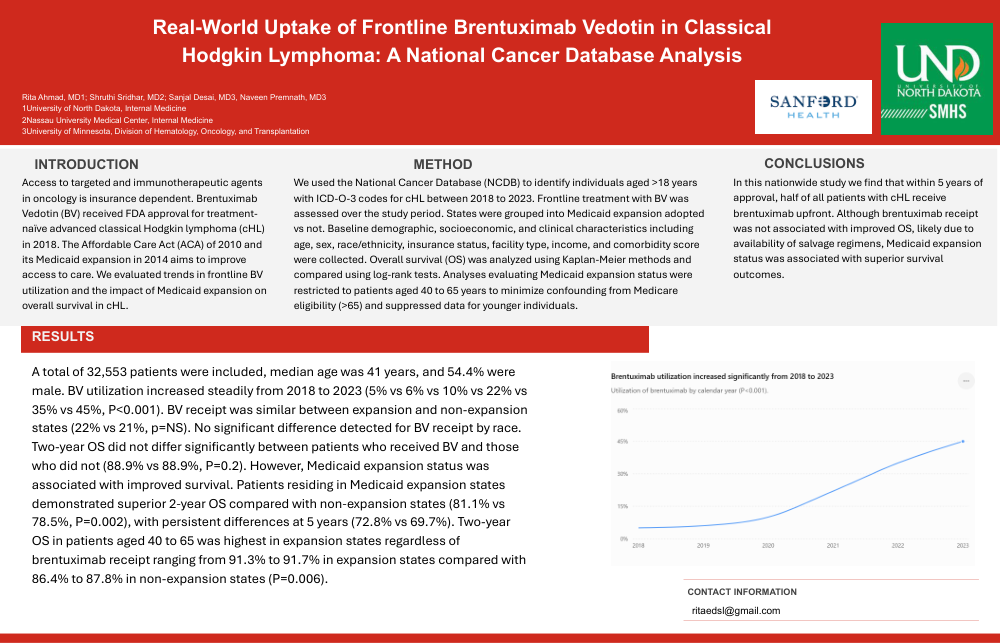
A total of 32,553 patients were included, median age was 41 years, and 54.4% were male. BV utilization increased steadily from 2018 to 2023 (5% vs 6% vs 10% vs 22% vs 35% vs 45%, P<0.001). BV receipt was similar between expansion and non-expansion states (22% vs 21%, p=NS). No significant difference detected for BV receipt by race. Two-year OS did not differ significantly between patients who received BV and those who did not (88.9% vs 88.9%, P=0.2). However, Medicaid expansion status was associated with improved survival. Patients residing in Medicaid expansion states demonstrated superior 2-year OS compared with non-expansion states (81.1% vs 78.5%, P=0.002), with persistent differences at 5 years (72.8% vs 69.7%). Two-year OS in patients aged 40 to 65 was highest in expansion states regardless of brentuximab receipt ranging from 91.3% to 91.7% in expansion states compared with 86.4% to 87.8% in non-expansion states (P=0.006).
Conclusion
In this nationwide study we find that within 5 years of approval, half of all patients with cHL receive brentuximab upfront. Although brentuximab receipt was not associated with improved OS, likely due to availability of salvage regimens, Medicaid expansion status was associated with superior survival outcomes.