1,267 posters, 47 videos, 13 topics, 4 sessions, 853 authors
ePostersLive by SciGen Technologies S.A. All rights reserved.
SOHO 2026 Annual Meeting
September 9 - 12, 2026 | George R. Brown Convention Center, Houston, Texas

HL - 080
Prognostic Value of Soluble CD30 and CD163? Tumor-Associated Macrophages in Relapsed Classical Hodgkin Lymphoma: Could It Guide Treatment Choice?
Poster Presenter
Authors
Part of Topic
Hodgkin Lymphoma (HL)
Introduction
Brentuximab vedotin (BV) is a standard of care in relapsed classical Hodgkin lymphoma (cHL) alone or in combinations however, resistance to BV is common.
Aim:
We hypothesized that circulating soluble CD30 (sCD30) and tumor-associated macrophages (CD163⁺) could detect BV efficacy. Primary endpoint: PET-complete response (CR). Secondary endpoints: eligibility for ASCT, PF and OS.
Methods
120 relapsed cHL patients (BV naïve) treated with ICE + BV salvage (governmental and insurance support) then planned for ASCT and BV maintenance.
Baseline assessments of Serum sCD30 (ELISA) and considered high when ≥75th percentile (>180 U/mL). CD163 macrophage expression in a new tissue biopsy at time of relapse (IHC) and considered high if ≥30% macrophage infiltration.
Results:
120 patients with relapsed classical Hodgkin lymphoma with median age of 36 years. Baseline high sCD30 was detected in 39%, while high CD163⁺ tumor-associated macrophage expression was presented in 44%. Concordance of high both was observed in 21% of studied patients.
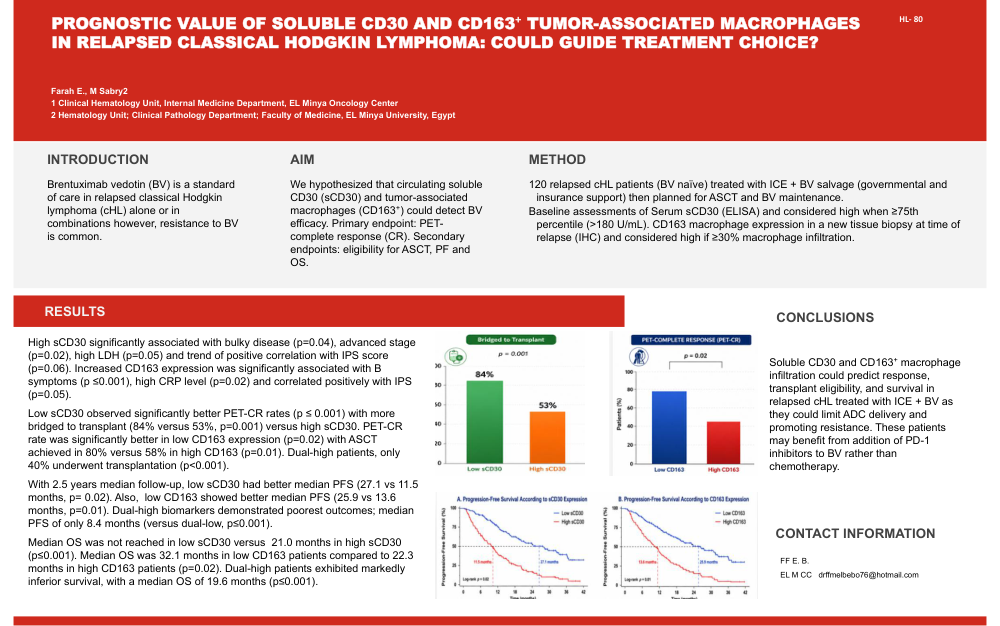
High sCD30 significantly associated with more bulky disease (p=0.04), advanced stage (p=0.02), high LDH level (p=0.05) and trend of positive correlation with IPS score (p=0.06). Increased CD163 expression was significantly associated with B symptoms (p ≤0.001), high CRP level (p=0.02) and correlated positively with IPS (p=0.05). No significant association between age, sex or time to relapse with any of both markers.
Low sCD30 observed significantly better PET-CR rates (75% vs 41%, p ≤ 0.001) with more bridged to transplant (84% versus 53%, p=0.001) compared to high sCD30. Also, PET-CR rate was significantly better in low CD163 expression (75% vs 51%, p=0.02) with ASCT achieved in 80% compared to 58% in high CD163 patients (p=0.01). Among dual-high patients, only 40% successfully underwent transplantation (p<0.001).
With a median follow-up of 2.5 years, low sCD30 had better median PFS (27.1 vs 11.5 months, p= 0.02). Also, patients with low CD163 showed better median PFS (25.9 vs 13.6 months, p=0.01).
The dual-high biomarker group demonstrated the poorest outcomes, with a median PFS of only 8.4 months (HR 3.8 vs dual-low, p≤0.001).
Median OS was not reached in patients with low sCD30, while high sCD30 patients observed a median OS of 21.0 months (p≤0.001). Median OS was 32.1 months in low CD163 patients compared to 22.3 months in high CD163 patients (p=0.02).
Dual-high patients exhibited markedly inferior survival, with a median OS of 19.6 months (p≤0.001).
Conclusion
Soluble CD30 and CD163⁺ macrophage infiltration could predict response, transplant eligibility, and survival in relapsed cHL treated with ICE + BV as they could limit ADC delivery and promoting resistance. These patients may benefit from addition of PD-1 inhibitors to BV rather than chemotherapy.