1,267 posters, 47 videos, 13 topics, 4 sessions, 853 authors
ePostersLive by SciGen Technologies S.A. All rights reserved.
SOHO 2026 Annual Meeting
September 9 - 12, 2026 | George R. Brown Convention Center, Houston, Texas

MM - 1396
Real-World Infection Risk Associated With Teclistamab in Relapsed/Refractory Multiple Myeloma
Poster Presenter
Authors
Part of Topic
Multiple Myeloma (MM)
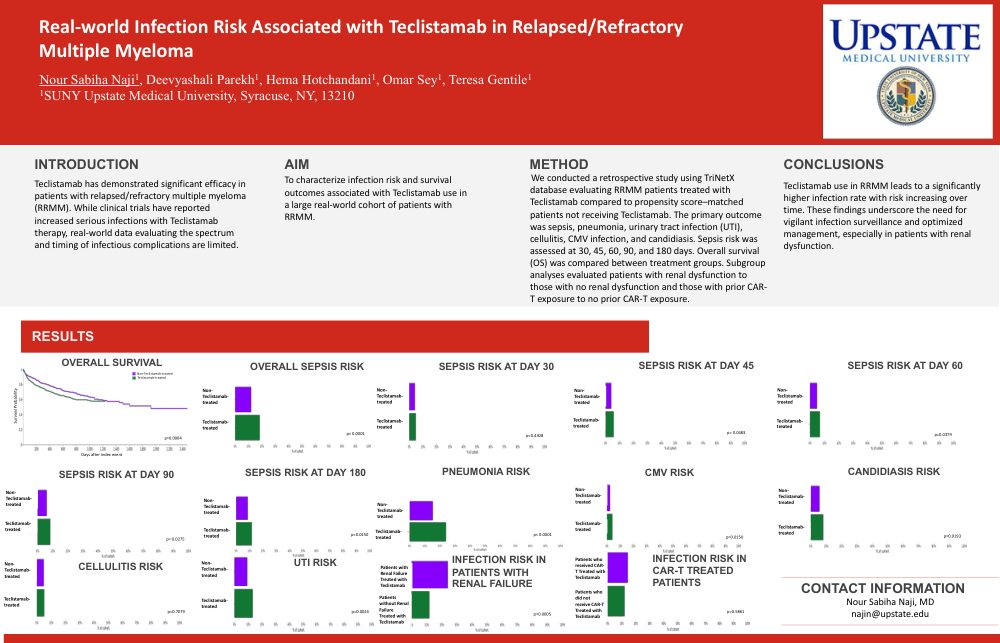
Background: Teclistamab has demonstrated significant efficacy in patients with relapsed/refractory multiple myeloma (RRMM). While clinical trials have reported increased serious infections with Teclistamab therapy, real-world data evaluating the spectrum and timing of infectious complications is limited. We sought to characterize infection risk and survival outcomes associated with Teclistamab use in a large real-world cohort of patients with RRMM.
Methods: We conducted a retrospective study using TriNetX database evaluating RRMM patients treated with Teclistamab compared to those not receiving Teclistamab. Propensity score matching was performed based on demographics, treatment regimen including bone marrow transplant and history of hypogammaglobulinemia. The primary outcome was sepsis, pneumonia, urinary tract infection (UTI), cellulitis, cytomegalovirus (CMV), and candidiasis. Sepsis risk was assessed at 30, 45, 60, 90, and 180 days. Overall survival (OS) was compared between treatment groups. Subgroup analyses evaluated patients with renal dysfunction to those with no renal dysfunction and those with prior CAR-T exposure to no prior CAR-T exposure.
Results: Teclistamab treated patients had better OS (57.8%vs 48.1%, p = 0.0004). However, Teclistamab-treated patients also had a higher overall sepsis risk (18.4% vs 12.0%, p < 0.0001). Although early sepsis risk was not significantly different at 30 days (4.858% vs 4.188%, p = 0.4308), risk became significantly elevated at 45, 60, 90, and 180 days (5.8% vs 4.1%, p = 0.0483; 6.9% vs 4.9%, p = 0.0379;8.4% vs 6.1%, p = 0.0275; 11.725% vs 8.71%, p = 0.0150 respectively). Risks of pneumonia, UTI, CMV infection, and candidiasis were significantly higher in the Teclistamab cohort (24.2% vs 15.4%, p < 0.0001; 13.317% vs 9.38%, p = 0.0024; 4.1% vs 2.3%, p = 0.0150; and 8.124% vs 5.695%, p = 0.0193, respectively), while cellulitis rates were similar between groups (5.2% vs 4.8%, p = 0.7079). Among Teclistamab-treated patients, renal failure was associated with significantly higher infection risk (24.1% vs 11.8%, p = 0.0005). Infection risk was similar between patients receiving Teclistamab alone and those receiving CAR-T therapy and Teclistamab (12.121% vs 14.394%, p = 0.5861).
Conclusion: Teclistamab use in RRMM leads to a significantly higher infection rate with risk increasing over time. These findings underscore the need for vigilant infection surveillance and optimized management, especially in patients with renal dysfunction.