1,267 posters, 47 videos, 13 topics, 4 sessions, 853 authors
ePostersLive by SciGen Technologies S.A. All rights reserved.
SOHO 2026 Annual Meeting
September 9 - 12, 2026 | George R. Brown Convention Center, Houston, Texas

MM - 064
Could Day +30 T-Cell Exhaustion Biomarkers Guide Maintenance Choice Post Autologous Stem Cell Transplantation in Relapsed Multiple Myeloma?
Poster Presenter
Authors
Part of Topic
Multiple Myeloma (MM)
Introduction:
T-cell depletion and immunological dysfunction are key factors in multiple myeloma (MM) relapse. Immune competence is partially restored by autologous stem cell transplantation (ASCT), but the best post-ASCT maintenance in the context of relapse is still unknown.
Aim:
We aimed to assess whether the immune checkpoint receptors PD-1, TIM-3, and LAG-3 expression early after ASCT indicate hallmark in maintenance choice of IMiDs in compare to anti-CD38.
Methods:
PD-1, TIM-3, and LAG-3 expression on CD8+ and CD4+ T cells was measured by flow cytometry in this prospective observational cohort of patients with relapsed MM following salvage therapy with Drara-RD followed by ASCT.
Peripheral blood immune profiling was conducted on Day +30 post-ASCT. Patients were classified as low (no marker elevated), intermediate (one marker elevated), or high (≥2 markers co-expressed). Elevated expression was defined as above predefined thresholds from healthy donor controls. Maintenance therapy (IMiD-based or Dara-based) was adopted. Progress-free survival (PFS) from a Day +100 served as the main endpoint.
Results:
75 relapsed multiple myeloma patients with median age was 62 years (range 42–74), and 60% with high cytogenetic risk. Immune checkpoints were assessed in all patients at Day +30. 51% received maintenance lenalidomide-based and 49% daratumumab-based.
High markers elevated (25 patients) were associated with more plasma cell infiltration (p = 0.03), higher β2-microglobulin (p = 0.04), lower hemoglobin at transplant (p = 0.02) and trend to be high cytogenetics risk (p = 0.06).
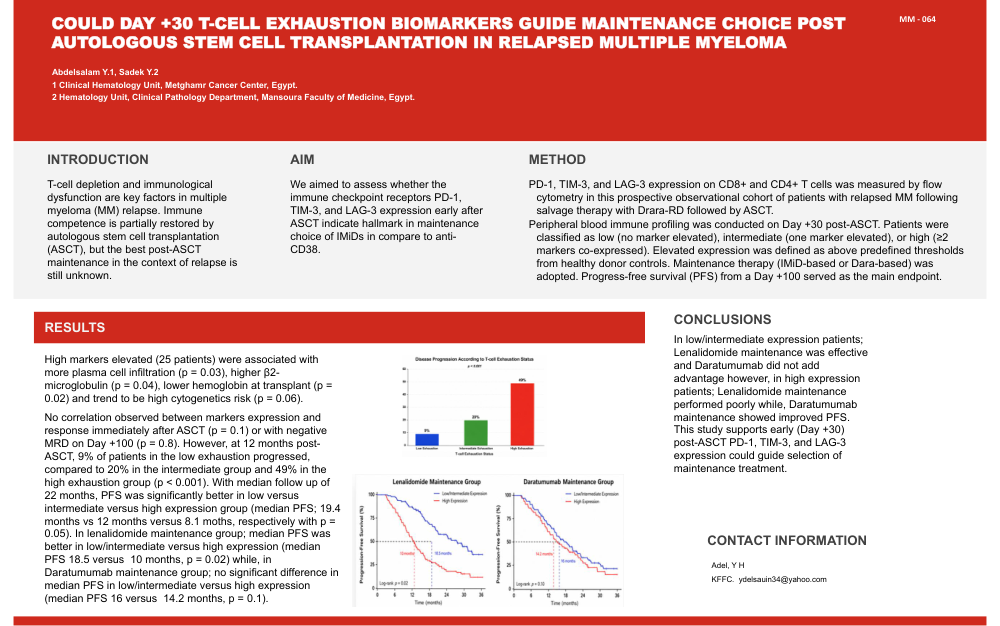
No correlation observed between markers expression and response immediately after ASCT (p = 0.1) or with negative MRD on Day +100 (p = 0.8). However, at 12 months post-ASCT, 9% of patients in the low exhaustion progressed, compared to 20% in the intermediate group and 49% in the high exhaustion group (p < 0.001). With median follow up of 22 months, PFS was significantly better in low versus intermediate versus high expression group (median PFS; 19.4 months vs 12 months versus 8.1 moths, respectively with p = 0.05). In lenalidomide maintenance group; median PFS was better in low/intermediate versus high expression (median PFS 18.5 versus 10 months, p = 0.02) while, in Daratumumab maintenance group; no significant difference in median PFS in low/intermediate versus high expression (median PFS 16 versus 14.2 months, p = 0.1).
Conclusions:
In low/intermediate expression patients; Lenalidomide maintenance was effective and Daratumumab did not add advantage however, in high expression patients; Lenalidomide maintenance performed poorly while, Daratumumab maintenance showed improved PFS. This study supports early (Day +30) post-ASCT PD-1, TIM-3, and LAG-3 expression could guide selection of maintenance treatment.