1,267 posters, 47 videos, 13 topics, 4 sessions, 853 authors
ePostersLive by SciGen Technologies S.A. All rights reserved.
SOHO 2026 Annual Meeting
September 9 - 12, 2026 | George R. Brown Convention Center, Houston, Texas

MM - 1126
Closing the Gap or Widening the Divide? Racial and Sex Disparities in Multiple Myeloma Mortality in the United States, 1999-2020
Poster Presenter
Authors
Part of Topic
Multiple Myeloma (MM)
Background
Proteasome inhibitors, immunomodulatory agents, and anti-CD38 monoclonal antibodies have transformed multiple myeloma (MM) outcomes over two decades, yet therapeutic advances benefit populations unevenly. Whether novel agent introduction narrowed or merely paralleled existing racial and sex-based mortality disparities remains unresolved.
Objective
To characterize MM mortality trends and evaluate whether therapeutic milestones translated into measurable disparity reduction across racial and sex subgroups in the United States from 1999 to 2020.
Methods
Using the CDC WONDER Underlying Cause of Death database, we analyzed 242026 MM deaths (ICD-10 code, C90.0). Age-adjusted mortality rates (AAMRs) per 100000 were standardized to the 2000 US population. Joinpoint regression quantified annual percent change (APC) by era; mortality rate ratios (RRs) assessed racial disparity magnitudes over time.
Results
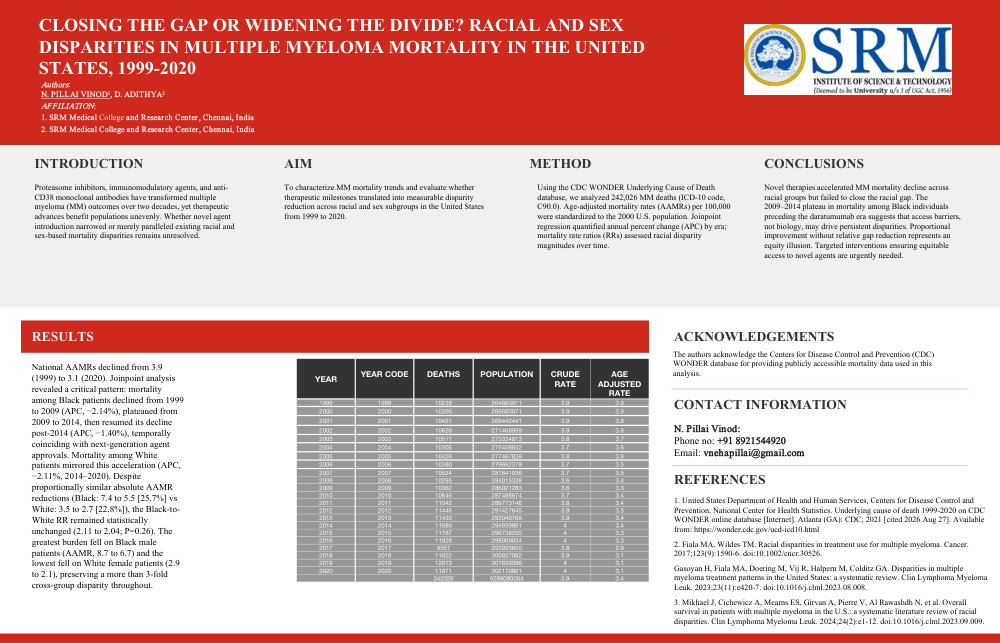
National AAMRs declined from 3.9 (1999) to 3.1 (2020). Joinpoint analysis revealed a critical pattern: mortality among Black patients declined from 1999 to 2009 (APC, −2.14%), plateaued from 2009 to 2014, then resumed its decline post 2014 (APC, −1.40%), temporally coinciding with next-generation agent approvals. Mortality among White patients mirrored this acceleration (2014–2020 APC, −2.11%). Despite proportionally similar absolute AAMR reductions (Black: 7.4 to 5.5 [25.7%] vsWhite: 3.5 to 2.7 [22.8%]), the Black-to-White RR remained statistically unchanged (2.11 to 2.04; P=0.26). The greatest burden fell on Black male patients (AAMR, 8.7 to 6.7) and the lowest fell on White female patients (2.9 to 2.1), preserving a more than 3-fold cross-group disparity throughout.
Conclusions
Novel therapies accelerated MM mortality decline across racial groups but failed to close the racial gap. The 2009–2014 plateau in mortality among Black individuals preceding the daratumumab era suggests that access barriers, not biology, may drive persistent disparities. Proportional improvement without relative gap reduction represents an equity illusion. Targeted interventions ensuring equitable access to novel agents are urgently needed.
CD: cluster of differentiation, CDC WONDER: Centers for Disease Control and Prevention Wide-Ranging Online Data for Epidemiological Research, ICD-10: International Classification of Diseases, 10th Revision
Keywords
MM, multiple myeloma, mortality trends, racial disparities,CDC WONDER, health equity