1,267 posters, 47 videos, 13 topics, 4 sessions, 853 authors
ePostersLive by SciGen Technologies S.A. All rights reserved.
SOHO 2026 Annual Meeting
September 9 - 12, 2026 | George R. Brown Convention Center, Houston, Texas

HL - 962
Clinical Outcomes of Brentuximab Vedotin in Relapsed/Refractory Classical Hodgkin Lymphoma in a Resource-Limited Setting
Poster Presenter
Authors
Part of Topic
Hodgkin Lymphoma (HL)
ABSTRACT
Title:
Clinical Outcomes of Brentuximab Vedotin in Relapsed/Refractory Classical Hodgkin Lymphoma in a Resource-Limited Setting
Authors
Hammad Javed¹, Tariq Ghafoor¹, Nighat Shahbaz¹, Mehreen Ali Khan¹, Raheel Iftikhar¹, Jahanzeb Liaqat¹
¹Armed Forces Bone Marrow Transplant Center, Rawalpindi, Punjab, Pakistan
KEYWORDS: Hodgkin lymphoma, Brentuximab, relapsed/refractory, Resource-limited,
CONTEXT:
Relapsed or refractory classical Hodgkin lymphoma (R/R cHL) remains a therapeutic challenge, particularly in heavily pretreated patients and in low- and middle-income countries where access to novel therapies may be limited. Brentuximab vedotin–based therapy has demonstrated promising activity in this setting; however, real-world outcomes from developing countries remain scarce.
OBJECTIVE:
To evaluate the clinical characteristics, survival outcomes, and toxicity profile of patients with R/R cHL treated with brentuximab-based therapy in a real-world cohort.
DESIGN:
Retrospective observational cohort study.
SETTING:
Single-center tertiary care hematology and transplant center.
PATIENTS:
Eighty-one patients with R/R cHL treated with brentuximab-based immunotherapy were included. The mean age was 29.8 years (range, 12–65 years). Most patients had advanced-stage disease (82.7%), while 51.9% had B symptoms and 43.2% had bone marrow involvement. Brentuximab-based therapy alone was administered in 92.6% of cases, while 7.4% received combined immunotherapy approaches.
INTERVENTIONS:
Patients received brentuximab-based salvage therapy with subsequent supportive management according to institutional protocols.
MAIN OUTCOME MEASURES:
Overall survival (OS), progression-free survival (PFS), treatment response, and treatment-related toxicities.
RESULTS:
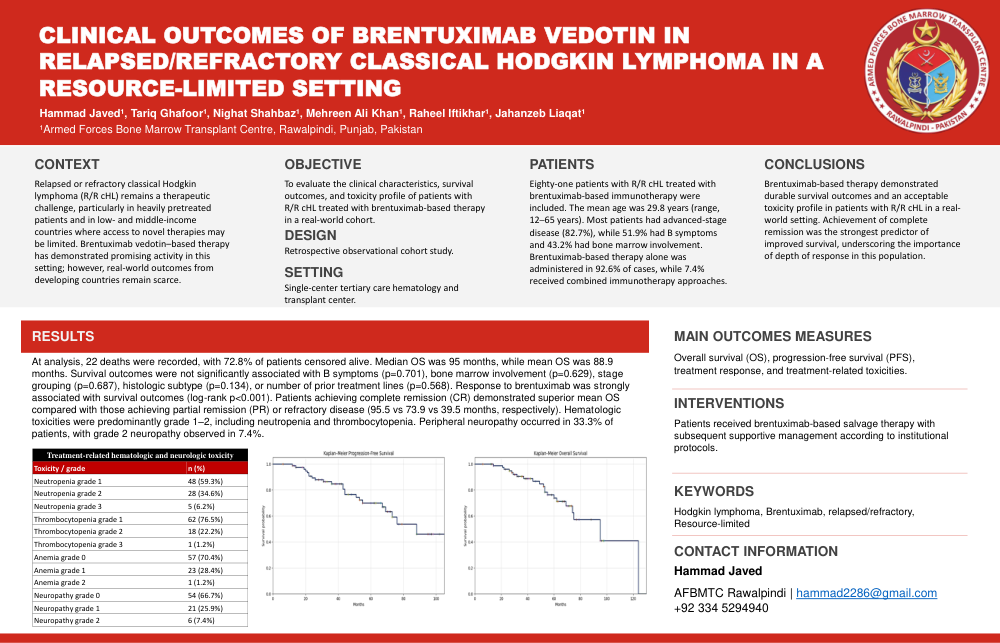
At analysis, 22 deaths were recorded, with 72.8% of patients censored alive. Median OS was 95 months, while mean OS was 88.9 months. Survival outcomes were not significantly associated with B symptoms (p=0.701), bone marrow involvement (p=0.629), stage grouping (p=0.687), histologic subtype (p=0.134), or number of prior treatment lines (p=0.568). Response to brentuximab was strongly associated with survival outcomes (log-rank p<0.001). Patients achieving complete remission (CR) demonstrated superior mean OS compared with those achieving partial remission (PR) or refractory disease (95.5 vs 73.9 vs 39.5 months, respectively). Hematologic toxicities were predominantly grade 1–2, including neutropenia and thrombocytopenia. Peripheral neuropathy occurred in 33.3% of patients, with grade 2 neuropathy observed in 7.4%.
CONCLUSIONS:
Brentuximab-based therapy demonstrated durable survival outcomes and an acceptable toxicity profile in patients with R/R cHL in a real-world setting. Achievement of complete remission was the strongest predictor of improved survival, underscoring the importance of depth of response in this population.