1,267 posters, 47 videos, 13 topics, 4 sessions, 853 authors
ePostersLive by SciGen Technologies S.A. All rights reserved.
SOHO 2026 Annual Meeting
September 9 - 12, 2026 | George R. Brown Convention Center, Houston, Texas

HL - 582
Frontline ABVD Chemotherapy Outcomes in Hodgkin Lymphoma in a Resource-Limited Setting: Real-World Survival and Prognostic Factors
Poster Presenter
Authors
Part of Topic
Hodgkin Lymphoma (HL)
ABSTRACT
Frontline ABVD Chemotherapy Outcomes in Hodgkin Lymphoma in a Resource-Limited Setting: Real-World Survival and Prognostic Factors
Hammad Javed¹, Jahanzeb Rahman¹, Tariq Ghafoor¹, Nighat Shahbaz¹, Mehreen Ali Khan¹, Raheel Iftikhar¹
¹Department of Hematology and Bone Marrow Transplantation, Rawalpindi, Pakistan
KEYWORDS: Hodgkin lymphoma, ABVD, progression-free survival, overall survival, resource-limited setting, interim PET
CONTEXT:
Classical Hodgkin lymphoma (HL) is highly curable with ABVD chemotherapy, yet outcomes from low- and middle-income countries remain underreported. Delayed presentation and limited access to response-adapted interventions adversely affect disease outcomes.
OBJECTIVE:
To evaluate treatment response, survival outcomes, toxicity profile, and prognostic factors in patients with HL treated with frontline ABVD chemotherapy in a resource-limited setting.
DESIGN:
This was a retrospective cohort study of patients treated at our center from 2010 till 2025. The survival analysis was done using Kaplan–Meier estimator, Log-rank test, and Cox proportional hazards model.
SETTING:
This was a single-center study done at a tertiary care hematology and bone marrow transplant center in Pakistan.
PATIENTS:
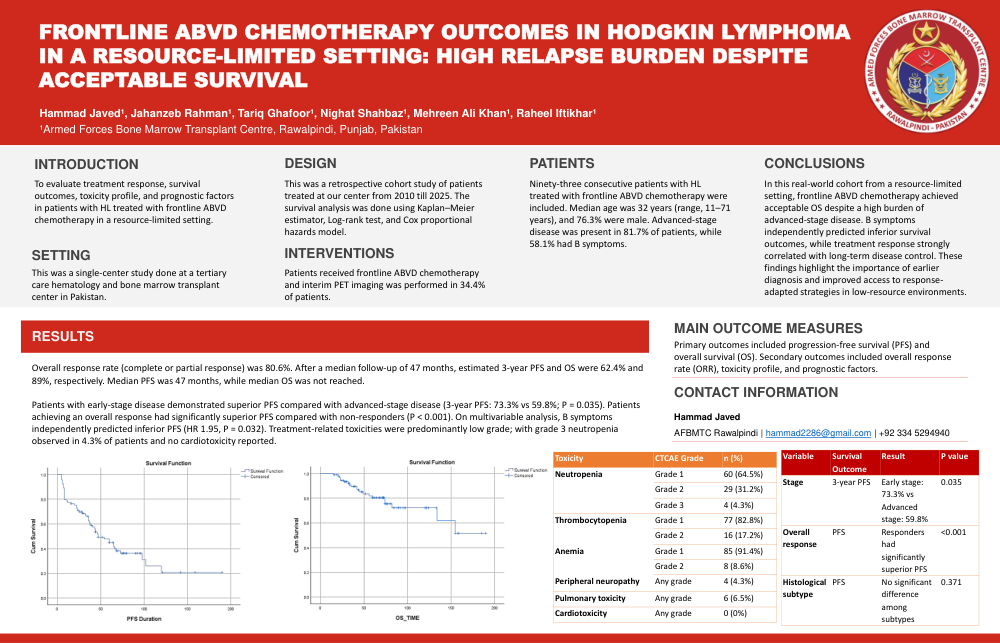
Ninety-three consecutive patients with HL treated with frontline ABVD chemotherapy were included. Median age was 32 years (range, 11–71 years), and 76.3% were male. Advanced-stage disease was present in 81.7% of patients, while 58.1% had B symptoms.
INTERVENTIONS:
Patients received frontline ABVD chemotherapy and interim PET imaging was performed in 34.4% of patients.
MAIN OUTCOME MEASURES:
Primary outcomes included progression-free survival (PFS) and overall survival (OS). Secondary outcomes included overall response rate (ORR), toxicity profile, and prognostic factors.
RESULTS:
Overall response rate (complete or partial response) was 80.6%. After a median follow-up of 47 months, estimated 3-year PFS and OS were 62.4% and 89%, respectively. Median PFS was 47 months, while median OS was not reached.
Patients with early-stage disease demonstrated superior PFS compared with advanced-stage disease (3-year PFS: 73.3% vs 59.8%; P = 0.035). Patients achieving an overall response had significantly superior PFS compared with non-responders (P < 0.001). On multivariable analysis, B symptoms independently predicted inferior PFS (HR 1.95, P = 0.032). Treatment-related toxicities were predominantly low grade; with grade 3 neutropenia observed in 4.3% of patients and no cardiotoxicity reported.
CONCLUSIONS:
In this real-world cohort from a resource-limited setting, frontline ABVD chemotherapy achieved acceptable OS despite a high burden of advanced-stage disease. B symptoms independently predicted inferior survival outcomes, while treatment response strongly correlated with long-term disease control. These findings highlight the importance of earlier diagnosis and improved access to response-adapted strategies in low-resource environments.