1,267 posters, 47 videos, 13 topics, 4 sessions, 853 authors
ePostersLive by SciGen Technologies S.A. All rights reserved.
SOHO 2026 Annual Meeting
September 9 - 12, 2026 | George R. Brown Convention Center, Houston, Texas

MM - 445
Cytokine Release Syndrome and Immune Effector Cell-Associated Neurotoxicity Syndrome With Bispecific Antibodies in Relapsed/Refractory Multiple Myeloma: A Three-Target Systematic Review With Trial Versus Real-World Stratification
Poster Presenter
Authors
Part of Topic
Multiple Myeloma (MM)
Cytokine Release Syndrome and Immune Effector Cell–Associated Neurotoxicity Syndrome With Bispecific Antibodies in Relapsed/Refractory Multiple Myeloma: A Three-Target Systematic Review With Trial Versus Real-World Stratification
P. Aravind Sai Reddy, MBBS¹; Manogyna Bontha, MBBS²; Neel Bhut, MBBS³; Omer Mohammed, MBBS⁴
¹Gadag Institute of Medical Sciences, Gadag, Karnataka, India; ²Kamineni Institute of Medical Sciences, Nalgonda, Telangana, India; ³GMERS Medical College, Sola, Gujarat, India; ⁴Government Medical College Kozhikode, Kozhikode, Kerala, India
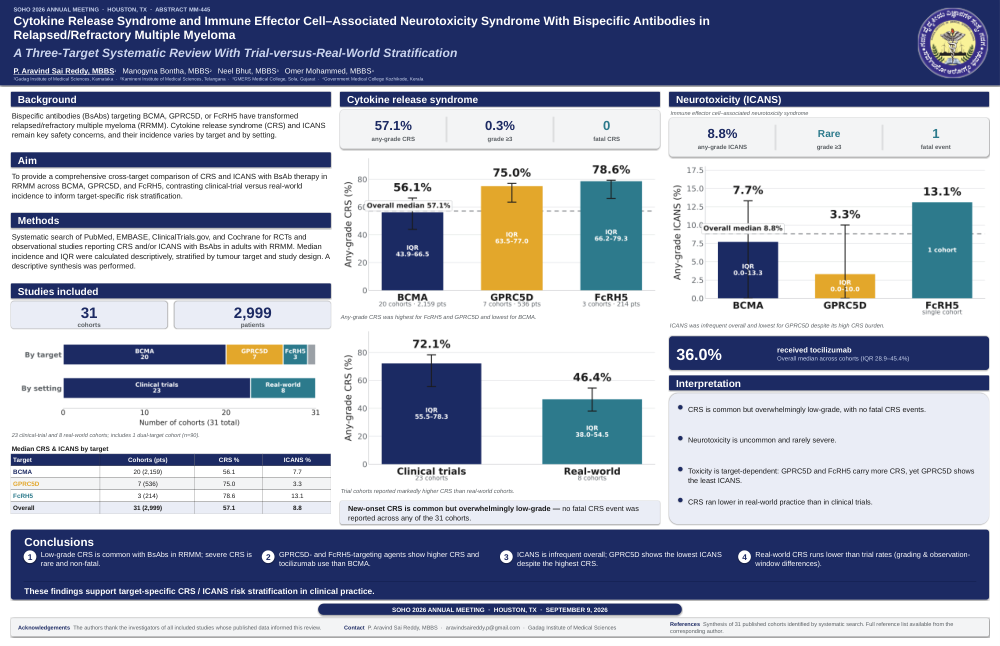
Background: Bispecific antibodies (BsAbs) targeting BCMA, GPRC5D, or FcRH5 have transformed the treatment of relapsed/refractory multiple myeloma (RRMM). Cytokine release syndrome (CRS) and immune effector cell–associated neurotoxicity syndrome (ICANS) remain key safety concerns, with incidence varying across targets and settings. However, a comprehensive cross-target comparison incorporating both clinical trial and real-world data remains limited.
Methods: A systematic search was conducted across PubMed, EMBASE, ClinicalTrials.gov, and Cochrane Library for eligible RCTs and observational studies reporting CRS and/or ICANS with BsAb therapy in adults with RRMM. Median incidence rates and interquartile ranges (IQR) of CRS and ICANS were calculated descriptively across studies, stratified by tumor target and study design. Median tocilizumab/steroid use was extracted across studies. No statistical pooling was performed.
Results: Thirty-one cohorts (2,999 patients) were included: 20 BCMA (n=2,159), 7 GPRC5D (n=536), 3 FcRH5 (n=214), and 1 dual-target (n=90); 23 from clinical trials and 8 real-world studies. Overall median any-grade CRS was 57.1% (46.9%–75.0%). By target, median CRS was highest for FcRH5 78.6% (66.2%–79.3%) and GPRC5D 75.0% (63.5%–77.0%), compared with BCMA 56.1% (43.9%–66.5%). Severe CRS (grade ≥3) was rare: overall median 0.3% (0%–1.3%), with no fatal CRS events. Trial cohorts had a higher median CRS 72.1% (55.5%–78.3%) than real-world cohorts 46.4% (38.0%–54.5%). Overall median tocilizumab use was 36.0% (28.9%–45.4%). ICANS data were available in 26 of 31 cohorts. Overall median any-grade ICANS was 8.8% (0%–11.8%): 7.7% for BCMA (0%–13.3%), 3.3% for GPRC5D (0%–10.0%), and 13.1% for FcRH5 (1 cohort). Severe ICANS (grade ≥3) was infrequent, with 1 fatal ICANS event.
Conclusions: New-onset low-grade CRS is common in RRMM with the use of BsAbs. GPRC5D- and FcRH5-targeting agents showed a higher incidence of CRS and tocilizumab use than BCMA-targeted BsAbs. ICANS was infrequent overall, with GPRC5D cohorts showing the lowest rates despite higher CRS burden. Real-world CRS rates were lower than trial rates, possibly reflecting differences in grading methodology and observation windows. These findings support target-specific CRS/ICANS risk stratification in clinical practice.
Keywords: Bispecific antibodies, multiple myeloma, cytokine release syndrome, neurotoxicity, BCMA