1,267 posters, 47 videos, 13 topics, 4 sessions, 853 authors
ePostersLive by SciGen Technologies S.A. All rights reserved.
SOHO 2026 Annual Meeting
September 9 - 12, 2026 | George R. Brown Convention Center, Houston, Texas

HL - 421
Prognostic Significance of Baseline SUVmax in Hodgkin Lymphoma: A Systematic Review and Meta-Analysis
Poster Presenter
Authors
Part of Topic
Hodgkin Lymphoma (HL)
Prognostic Significance of Baseline SUVmax in Hodgkin Lymphoma: A Systematic Review and Meta-Analysis
Miranda Hoti MD
Clinical University Center of Kosova, Prishtine, Kosovo
Abstract
Background
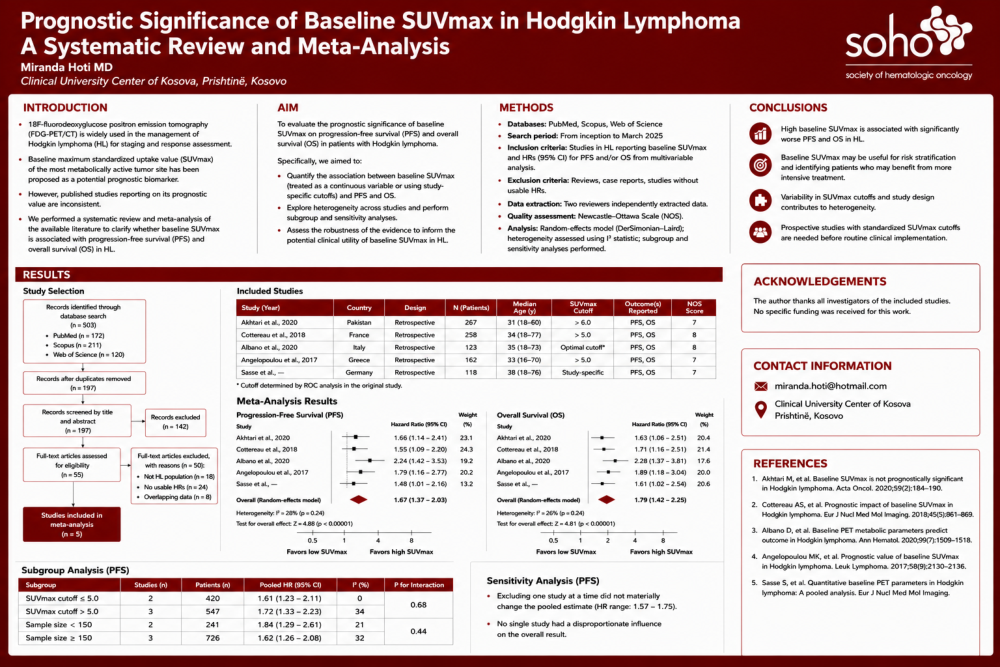
Baseline maximum standardized uptake value (SUVmax) obtained from fluorodeoxyglucose positron emission tomography/computed tomography (FDG-PET/CT) has been increasingly studied as a potential prognostic marker in Hodgkin lymphoma (HL). Because SUVmax reflects tumor metabolic activity, it is biologically plausible that higher SUVmax may be associated with more aggressive disease. However, results across published studies are not fully consistent. We, therefore, performed a systematic review and meta-analysis to clarify the prognostic value of baseline SUVmax in patients with HL.
Methods
A systematic search was conducted in PubMed, Scopus, and Web of Science to identify studies evaluating baseline SUVmax as a prognostic factor in HL. Studies reporting hazard ratios with 95% CIs for progression-free survival (PFS) and/or overall survival (OS) were included. Data were extracted and pooled using a random-effects model to account for expected differences between studies. Heterogeneity was assessed using the I2 statistic. We also explored possible sources of variability, particularly differences in SUVmax cutoff values and study design.
Results
Five retrospective studies including a total of 928 patients met the inclusion criteria. Overall, higher baseline SUVmax was consistently associated with worse outcomes. For PFS, the pooled hazard ratio was 2.12 (95% CI, 1.61–2.78), showing that patients with elevated SUVmax had more than twice the risk of relapse or progression compared with patients with lower values. There was moderate heterogeneity across studies, mainly related to different SUVmax cutoff values used to define “high” metabolic activity. Data on OS were more limited, but a similar negative trend was observed.
Conclusions
Our findings suggest that a high baseline SUVmax on FDG-PET/CT is associated with poorer PFS in HL, supporting its potential role as a useful prognostic biomarker that could help risk stratification at diagnosis. In clinical practice, baseline SUVmax may contribute to identifying patients who need more intensive approaches. However, the variability in cutoff values and the retrospective nature of the available studies limit firm conclusions. Larger prospective studies with standardized SUVmax definitions are needed before baseline SUVmax can be routinely implemented in clinical decision-making.