1,267 posters, 47 videos, 13 topics, 4 sessions, 853 authors
ePostersLive by SciGen Technologies S.A. All rights reserved.
SOHO 2026 Annual Meeting
September 9 - 12, 2026 | George R. Brown Convention Center, Houston, Texas

HL - 355
Trends in Hodgkin Lymphoma Mortality in the United States, 1999-2024: A Population-Based CDC WONDER Analysis
Poster Presenter
Authors
Part of Topic
Hodgkin Lymphoma (HL)
HL-355 · Publication and Poster presentation Trends in Hodgkin Lymphoma Mortality in the United States, 1999–2024: A Popula tion‑Based CDC WONDER Analysis
Introduction
Hodgkin lymphoma (HL) is a highly curable hematologic malignancy, yet contemporary population-based mortal ity patterns remain incompletely described. Understanding demographic and geographic disparities is essential for targeted public health interventions.
Objective
This study analyzes CDC WONDER Multiple Cause of Death (MCD) data to assess HL mortality trends in the United States from 1999 to 2024, providing a population‑based framework to identify high-risk groups and evolving disease burdens.
Methods
We conducted a retrospective CDC WONDER analysis (1999–2024). Adults aged ≥25 years were included if HL (MCD ICD-10 code, C81) was listed anywhere on the death certificate. Age-adjusted mortality rates (AAMRs) were stratified by sex, race, age group, census region, and urbanization. Joinpoint regression calculated annual percent change (APC) and average annual percent change (AAPC) with P <0.05.
Results
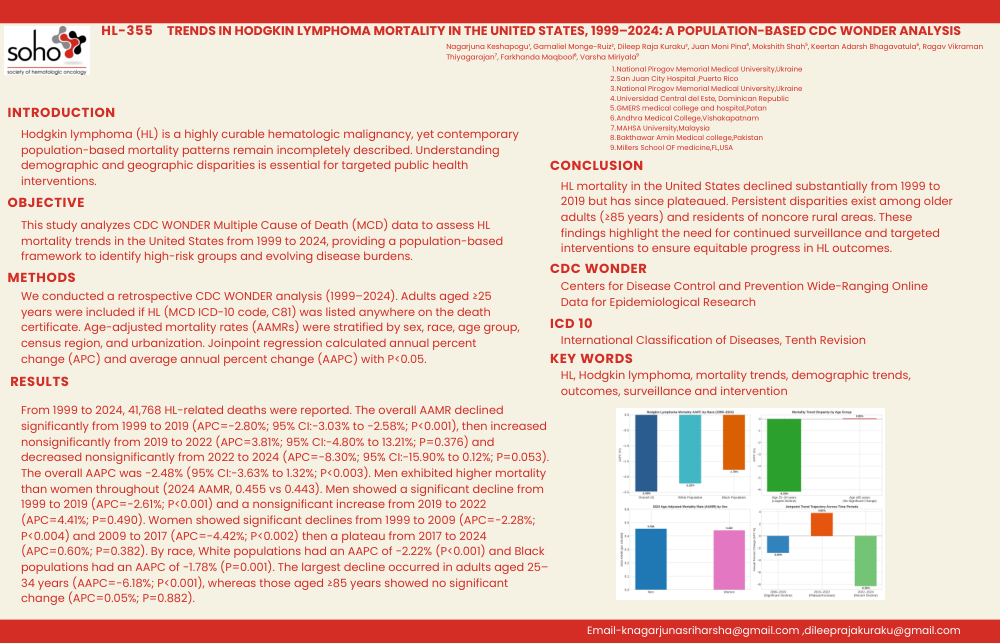
From 1999 to 2024, 41768 HL-related deaths were reported. The overall AAMR declined significantly from 1999 to 2019 (APC, −2.80%; 95% CI, −3.03% to −2.58%; P <0.001), then increased nonsignificantly from 2019 to 2022 (APC, 3.81%; 95% CI, −4.80% to 13.21%; P =0.376) and decreased nonsignificantly from 2022 to 2024 (APC, −8.30%; 95% CI, −15.90% to 0.12%; P =0.053). The overall AAPC was −2.48% (95% CI, −3.63% to −1.32%; P <0.003). Men exhibited higher mortality than women throughout (2024 AAMR, 0.455 vs 0.443). Men showed a significant decline from 1999 to 2019 (APC, −2.61%; P <0.001) and a nonsignificant increase from 2019 to 2022 (APC, 4.41%; P =0.490). Women showed significant declines from 1999 to 2009 (APC, −2.28%; P <0.004) and 2009 to 2017 (APC, −4.42%; P <0.002) then a plateau from 2017 to 2024 (APC, 0.60%; P =0.382). By race, White populations had an AAPC of −2.22% (P <0.001) and Black populations had an AAPC of −1.78% (P =0.001). The largest decline occurred in adults aged 25–34 years (AAPC, −6.18%; P <0.001), whereas those aged ≥85 years showed no significant change (APC, 0.05%; P =0.882).
Conclusion
HL mortality in the United States declined substantially from 1999 to 2019 but has since plateaued. Persistent disparities exist among older adults (≥85 years) and residents of noncore rural areas. These findings highlight the need for continued surveillance and targeted interventions to ensure equitable progress in HL outcomes. CDC WONDER: Centers for Disease Control and Prevention Wide-Ranging Online Data for Epidemiological Research, ICD-10: International Classification of Diseases, Tenth Revision Keywords HL, Hodgkin lymphoma, mortality trends, demographic trends, outcomes, surveillance and interventio