1,267 posters, 47 videos, 13 topics, 4 sessions, 853 authors
ePostersLive by SciGen Technologies S.A. All rights reserved.
SOHO 2026 Annual Meeting
September 9 - 12, 2026 | George R. Brown Convention Center, Houston, Texas

HL - 339
Trends in Mortality From Hodgkin & Non-Hodgkin Lymphoma in the United States, 1999-2024: A CDC WONDER Analysis
Part of Topic
Hodgkin Lymphoma (HL)
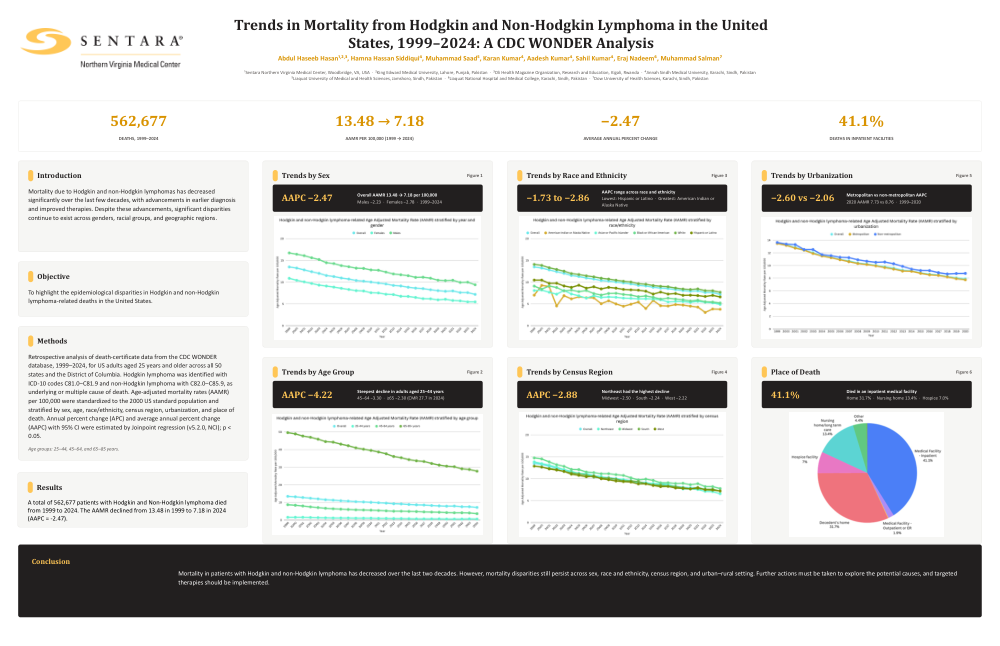
CONTEXT: Mortality due to Hodgkin and Non-Hodgkin lymphomas has decreased significantly over the last few decades, with advancements in earlier diagnosis and improved therapies. Despite recent advancements, significant disparities continue to exist across genders, racial groups, and geographic regions. This underscores the importance of further investigating these inequalities to improve access to healthcare for all populations.
OBJECTIVES: To highlight the epidemiological disparities in Hodgkin and Non-Hodgkin lymphoma-related deaths.
METHODS: Retrospective analysis of death-certificate data from the CDC WONDER database, 1999–2024, for US adults aged 25 years and older across all 50 states and the District of Columbia. Hodgkin lymphoma was identified with ICD-10 codes C81.0–C81.9 and non-Hodgkin lymphoma with C82.0–C85.9, as underlying or multiple cause of death. Age-adjusted mortality rates (AAMR) per 100,000 were standardized to the 2000 US standard population and stratified by sex, age, race/ethnicity, census region, urbanization, and place of death. Annual percent change (APC) and average annual percent change (AAPC) with 95% CI were estimated by Joinpoint regression (v5.2.0, NCI); p < 0.05.
RESULTS: A total of 562,677 patients with Hodgkin and Non-Hodgkin lymphoma died from 1999 to 2024. The AAMR declined from 13.48 in 1999 to 7.18 in 2024 (AAPC = -2.47). The males and females had a similar decreasing trend in mortality from 1999 to 2024 (AAPC Males - 2.23 vs AAPC females - 2.78). The Hispanics or Latino population showed the lowest decline in mortality from 1999 to 2024 (AAPC = -1.73), while the American Indians or Alaska natives had the greatest decline in mortality with an AAPC of −2.86. Stratification by census region showed that the Northeast region had the highest decline in mortality from 1999 to 2024 (AAPC: −2.88), while the West region had the lowest reduction in mortality during the same period (AAPC: −2.22). Metropolitan areas showed a greater decline in mortality than non-metropolitan areas (APC: −2.60 vs -2.06, respectively) from 1999 to 2020.
CONCLUSION: The mortality trends in Hodgkin and Non-Hodgkin lymphoma patients have decreased over the last 2 decades. However, mortality disparities still persist, and further actions must be taken to explore the potential causes, and targeted therapies should be implemented.