516 posters, 59 topics, 63 sessions, 1,127 authors, 353 institutions
ePostersLive by SciGen Technologies S.A. All rights reserved.
2026 SOAP Annual Meeting
April 29 - May 3, 2026 | Montreal, Quebec Canada

2338201
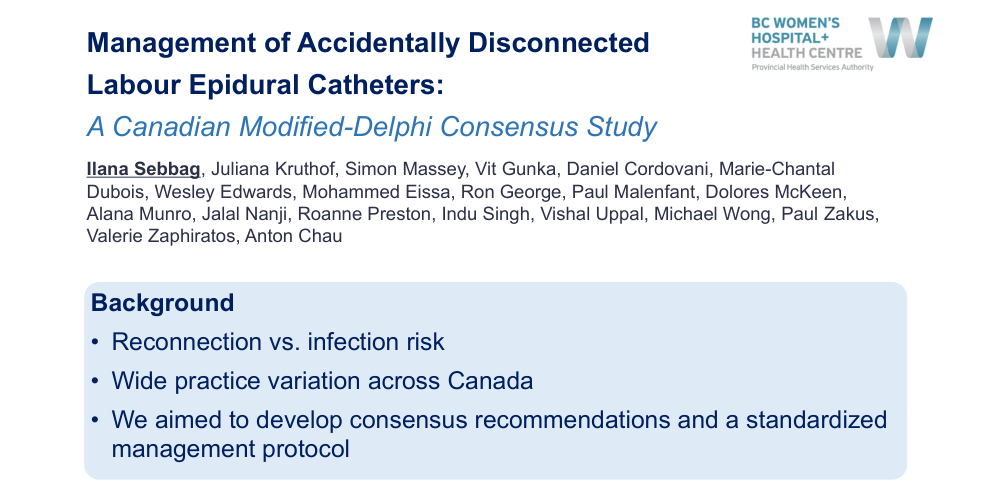
Management of Accidentally Disconnected Labour Epidural Catheters: A Canadian Modified-Delphi Consensus Study
Poster Presenter
Authors
Ilana Sebbag, Juliana Kruthof, Simon Massey, Vit Gunka, Daniel Cordovani, Marie-Chantal Dubois, Wesley Edwards, Mohammed Eissa, Ronald George, Paul-André Malenfant, Dolores McKeen, Allana Munro, Jalal Nanji, Indu Singh, Roanne Preston, Vishal Uppal, Michael Wong, Paul Zakus, Valerie Zaphiratos,
Part of Topic
Labor Analgesia Challenges and Tips
Management of accidentally disconnected labour epidural catheters remains highly variable, with clinicians balancing the risks of catheter reconnection versus replacement and potential infection. This Canadian modified Delphi consensus study aimed to develop national-level expert recommendations. Eighteen obstetric anesthesia experts from 12 academic centres across 7 provinces participated. Consensus (≥70% agreement/disagreement) was achieved for 16 of 17 statements after three rounds. Experts agreed that management should depend on the location and circumstances of disconnection. Distal disconnections should prompt replacement of filter and tubing, while proximal disconnections may be managed by disinfecting and cutting the catheter before reconnection. Reconnection decisions should consider urgent cesarean delivery, full cervical dilation, visible soiling, and whether the disconnection was witnessed. Isopropyl alcohol and chlorhexidine 2% were considered acceptable disinfectants. Recommended technique included cutting more than 5 cm from the catheter tip and disinfecting at least 5 cm beyond the cut site. Daily inpatient follow-up until discharge was recommended, while prolonged post-discharge follow-up was not supported. These findings represent the first guidance for disconnected labour epidural catheters and may support safer, standardized institutional protocols. Keywords: labour epidural, epidural catheter, obstetric anesthesia, Delphi consensus, infection prevention, patient safety.