516 posters, 59 topics, 63 sessions, 1,127 authors, 353 institutions
ePostersLive by SciGen Technologies S.A. All rights reserved.
2026 SOAP Annual Meeting
April 29 - May 3, 2026 | Montreal, Quebec Canada

2330243
Epidural catheter insertion depth of 4 cm versus 5 cm for labor analgesia: a double-blind randomized trial
Poster Presenter
Authors
William Turner, Franziska Marie Wellner, Naveed Siddiqui, Stella Wang, Kristi Downey, Mrinalini Balki
Affiliations
Department of Anaesthesia, Kingston Hospital, Kingston upon Thames, United Kingdom, Department of Anesthesia and Pain Management, Mount Sinai Hospital, University of Toronto, Biostatistics Department, University Health Network, Toronto, Canada
Part of Topic
Labor Analgesia Challenges and Tips
Here is the full text content of the poster, slide by slide:
SLIDE 1: TITLE AND BACKGROUND
Epidural Catheter Insertion to 4 cm versus 5 cm for Labour Analgesia: A Patient- and Assessor-Blinded Randomised Controlled Trial
W J Turner, F Wellner, N Siddiqui, K Downey, S Wang, M Balki Department of Anesthesia and Pain Management, Mount Sinai Hospital, University of Toronto
Background and Hypothesis
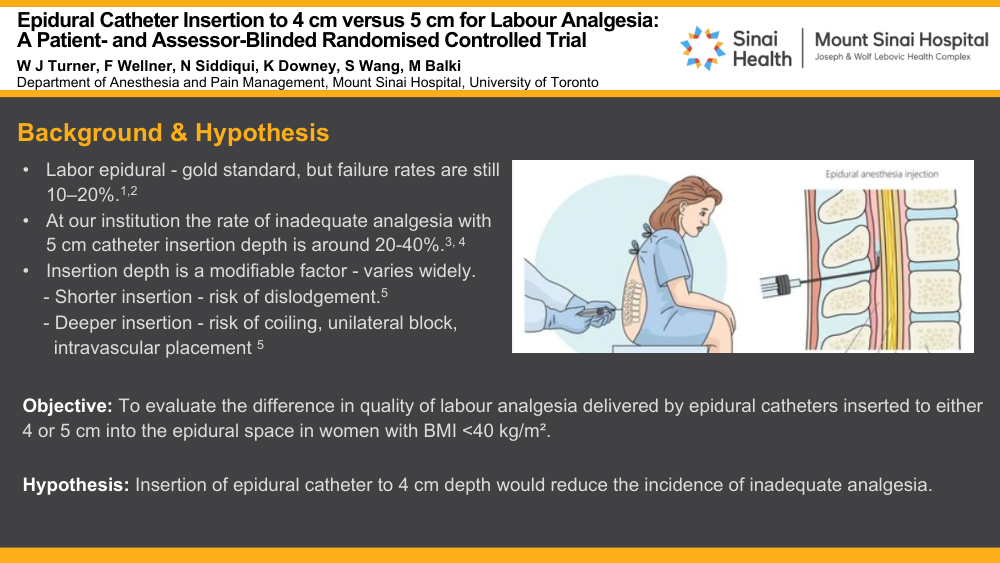
Labour epidural remains the gold standard for labour analgesia, but failure rates remain 10--20%. At the study institution, the rate of inadequate analgesia with 5 cm catheter insertion depth is approximately 20--40%. Insertion depth is a modifiable factor that varies widely. Shorter insertion carries a risk of dislodgement; deeper insertion carries a risk of coiling, unilateral block, and intravascular placement.
Objective: To evaluate the difference in quality of labour analgesia delivered by epidural catheters inserted to either 4 or 5 cm into the epidural space in women with BMI <40 kg/m².
Hypothesis: Insertion of epidural catheter to 4 cm depth would reduce the incidence of inadequate analgesia.
SLIDE 2: METHODS
Study Design: Prospective RCT, patient- and assessor-blinded. Block randomisation, 1:1 allocation. Epidural with 17G Tuohy needle, 19G FlexTip Plus catheter, advanced to 15 cm then withdrawn to 4 cm or 5 cm; secured with LockIt Plus. Inserting anaesthetist unblinded; patient, assessors, and nurse blinded.
Loading dose: bupivacaine 0.125% + fentanyl 3.3 μg/mL (3 mL test dose + 12 mL). Maintenance: bupivacaine 0.0625% + fentanyl 2 μg/mL (PIEB 10 mL q40 min, PCEA 5 mL).
Participants: Labouring women ≥18 years, BMI <40 kg/m², cervical dilatation 3--7 cm. Exclusion: prior difficult or failed epidural, planned CSE or DPE.
Primary Outcome (Composite Inadequate Analgesia): VNRS >3 or block below T10 at any time; unilateral or patchy block; catheter manipulation or replacement; abandonment or conversion to alternative.
Secondary Outcomes: Hourly VNRS, block height, motor block, catheter events, top-ups, adverse events, fetal bradycardia.
Analysis: χ² or Fisher's exact test, R version 4.2.1. Sample size: n = 200 (80% power, α = 0.05), assuming composite outcome rate 25% in 5 cm group and 10% in 4 cm group.
SLIDE 3: RESULTS
Consented n = 257. Analysed n = 193: 4 cm (n = 94), 5 cm (n = 99).
Table 1: Baseline Characteristics
| Variable | 4 cm (n=94) | 5 cm (n=99) |
|---|---|---|
| Age, yrs mean (SD) | 34.2 (3.9) | 33.8 (4.8) |
| BMI, kg/m² mean (SD) | 29.9 (4.3) | 29.3 (4.5) |
| Gestation, wks median [IQR] | 39.0 [38.0--40.0] | 39.0 [38.1--39.9] |
| Cervical dilatation, cm median [IQR] | 4 [3--4] | 4 [3--4] |
| Baseline VNRS median [IQR] | 7 [6--8] | 7 [5--8] |
| Induced labour, N (%) | 53 (57.6%) | 53 (54.1%) |
| Insertion site L3--4, N (%) | 61 (65.6%) | 65 (67.0%) |
| Skin-to-epidural depth, cm | 5.0 [4.5--6.0] | 5.0 [5.0--6.0] |
| Ultrasound-assisted, N (%) | 32 (34.0%) | 23 (23.2%) |
| Vaginal delivery, N (%) | 64 (68.1%) | 61 (61.6%) |
| Epidural-to-delivery, min | 450 [280--672] | 459 [288--751] |
Table 2: Epidural Performance and Clinical Outcomes
| Outcome | 4 cm (n=94) | 5 cm (n=99) | p |
|---|---|---|---|
| PRIMARY OUTCOME | |||
| Composite inadequate analgesia | 33 (35.1%) | 37 (37.4%) | 0.859 |
| PAIN AND BLOCK | |||
| VNRS >3 at any time | 30 (31.9%) | 32 (32.3%) | 1.000 |
| Sensory level below T10 | 18 (19.1%) | 20 (20.2%) | 0.998 |
| Patchy block | 3 (3.2%) | 2 (2.0%) | 0.676 |
| Unilateral block | 10 (10.6%) | 8 (8.1%) | 0.717 |
| EPIDURAL MANAGEMENT | |||
| Catheter manipulation | 3 (3.2%) | 3 (3.0%) | 1.000 |
| Catheter replacement | 3 (3.2%) | 3 (3.0%) | 1.000 |
| Change in PIEB regimen | 3 (3.2%) | 3 (3.0%) | 1.000 |
| Change in maintenance solution | 2 (2.1%) | 3 (3.0%) | 1.000 |
| Clinician top-ups (≥1) | 17 (18.1%) | 20 (20.2%) | 0.660 |
| Nursing top-ups (≥1) | 10 (10.8%) | 14 (14.4%) | 0.586 |
| ADVERSE EVENTS AND SURGICAL USE | |||
| Motor block | 1 (1.1%) | 1 (1.0%) | 1.000 |
| Fetal bradycardia | 0 (0.0%) | 3 (3.0%) | 0.247 |
| Surgical conversion (successful) | 19/21 (90.5%) | 30/31 (96.8%) | 0.558 |
Absolute risk difference for primary outcome: -2.3% (95% CI -15.5% to 10.9%).
Hourly pain score trajectory: in both groups average VNRS scores remained generally low over time. The 4 cm group showed slightly higher mean VNRS (1.09 vs 0.70) and greater overall variability than the 5 cm group.
SLIDE 4: DISCUSSION
Main Finding: In labouring women with BMI <40 kg/m², inserting epidural catheters to 4 cm or 5 cm produced similar rates of inadequate analgesia (35.1% vs 37.4%), catheter interventions, and adverse events. Clinician top-ups were required in 19% (37/193), catheter manipulation and re-insertion were each performed in 3% (6/193), and epidural catheters were successfully used in 94% (49/52) of caesarean sections. All secondary outcomes were similar across the two groups.
Clinical Implications: Small differences within the 4--5 cm range have limited impact on inadequate analgesia when using modern techniques (PIEB + PCEA) in patients with BMI <40 kg/m². This supports flexible, individualised depth selection in clinical practice. A high overall rate of inadequate analgesia (approximately 36%) suggests that other factors -- including patient anatomy, physiology, labour progress, epidural technique, and dosing regimen -- may also play a substantial role.
Limitations: Single-centre study; BMI <40 kg/m² only; inserting anaesthetist unblinded; findings may not be generalisable to different epidural regimens.
Future Directions: Multicentre study; evaluation of catheter depth in women with BMI ≥40 kg/m²; imaging studies of catheter trajectory; modification of epidural technique or drug regimens; use of a robust composite endpoint for future work.
References:
- Guglielminotti J, et al. Anesthesiology. 2023;139(3):274--286.
- Thangamuthu A, et al. Int J Obstet Anesth. 2013;22(4):310--315.
- Easther RG, Downey K, et al. Reg Anesth Pain Med. 2021;46(2):157--163.
- Brogly N, et al. Eur J Anaesthesiol. 2025;42(2):96--112.
- Afshan G, et al. Anaesthesia. 2011;66(10):913--918.