516 posters, 59 topics, 63 sessions, 1,127 authors, 353 institutions
ePostersLive by SciGen Technologies S.A. All rights reserved.
2026 SOAP Annual Meeting
April 29 - May 3, 2026 | Montreal, Quebec Canada

2335180
Association of Perinatal Mood and Anxiety Disorders With Anesthesia-Related Complications in Cesarean Delivery Hospitalizations
Poster Presenter
Part of Topic
Recovery: Morbidity, Depression
Slide 1
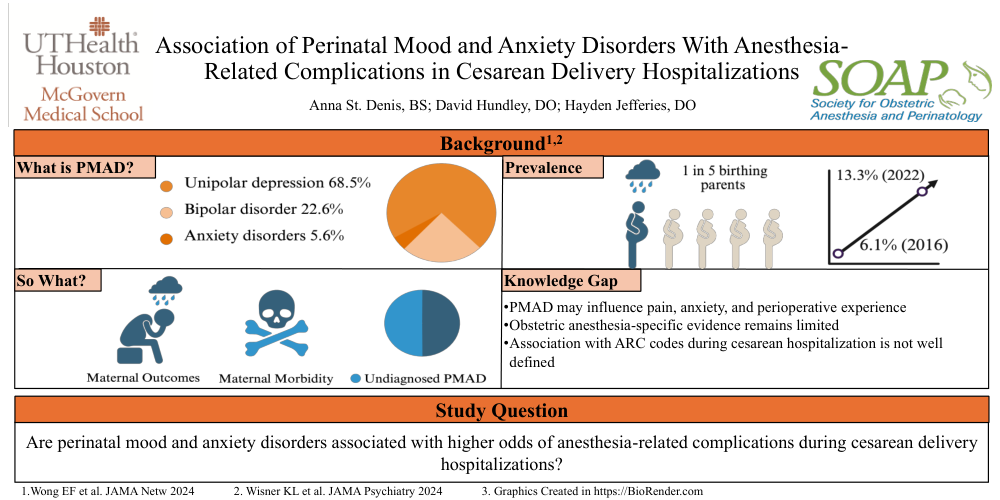
Association of Perinatal Mood and Anxiety Disorders With Anesthesia-Related Complications in Cesarean Delivery Hospitalizations
Anna St. Denis, BS; David Hundley, DO; Hayden Jefferies, DO
Background
What is PMAD?
Unipolar depression 68.5%
Bipolar disorder 22.6%
Anxiety disorders 5.6%
Prevalence
1 in 5 birthing parents
13.3% in 2022
6.1% in 2016
So What?
Maternal outcomes
Maternal morbidity
Undiagnosed PMAD
Knowledge Gap
PMAD may influence pain, anxiety, and perioperative experience
Obstetric anesthesia-specific evidence remains limited
Association with ARC codes during cesarean hospitalization is not well defined
Study Question
Are perinatal mood and anxiety disorders associated with higher odds of anesthesia-related complications during cesarean delivery hospitalizations?
Slide 2
Association of Perinatal Mood and Anxiety Disorders With Anesthesia-Related Complications in Cesarean Delivery Hospitalizations
Anna St. Denis, BS; David Hundley, DO; Hayden Jefferies, DO
Methods
National Inpatient Sample
2016-2022
(+) Cesarean delivery
(+) Age 15-49
n = 8,087,376
Analytic Cohort
(-) Missing covariates
n = 7,765,786
Exposure
PMAD ICD-10-CM codes
Outcome
ARC ICD-10 codes
neuraxial, airway, cardiopulmonary
Adjusted Analysis
Survey-weighted logistic regression
Adjusted for patient, hospital, and obstetric comorbidity factors
Slide 3
Association of Perinatal Mood and Anxiety Disorders With Anesthesia-Related Complications in Cesarean Delivery Hospitalizations
Anna St. Denis, BS; David Hundley, DO; Hayden Jefferies, DO
Results
Adjusted Association
aOR 1.10
p = 0.01
95% CI 1.02-1.19
ARC codes: 0.63% vs 0.46%
Delta 0.17%
ARC codes
PMAD: 0.63%
non-PMAD: 0.46%
Most Common ARC Code
Neuraxial headache
Slide 4
Association of Perinatal Mood and Anxiety Disorders With Anesthesia-Related Complications in Cesarean Delivery Hospitalizations
Anna St. Denis, BS; David Hundley, DO; Hayden Jefferies, DO
Conclusion
10% higher adjusted odds of ARC codes
PMAD may identify a higher-risk obstetric anesthesia population
Small absolute difference is meaningful at population scale
Next Steps
Identify higher-risk patients early
Use trauma-informed anesthetic planning
Optimize analgesia and follow-up
Focus on neuraxial headache