516 posters, 59 topics, 63 sessions, 1,127 authors, 353 institutions
ePostersLive by SciGen Technologies S.A. All rights reserved.
2026 SOAP Annual Meeting
April 29 - May 3, 2026 | Montreal, Quebec Canada

2329764
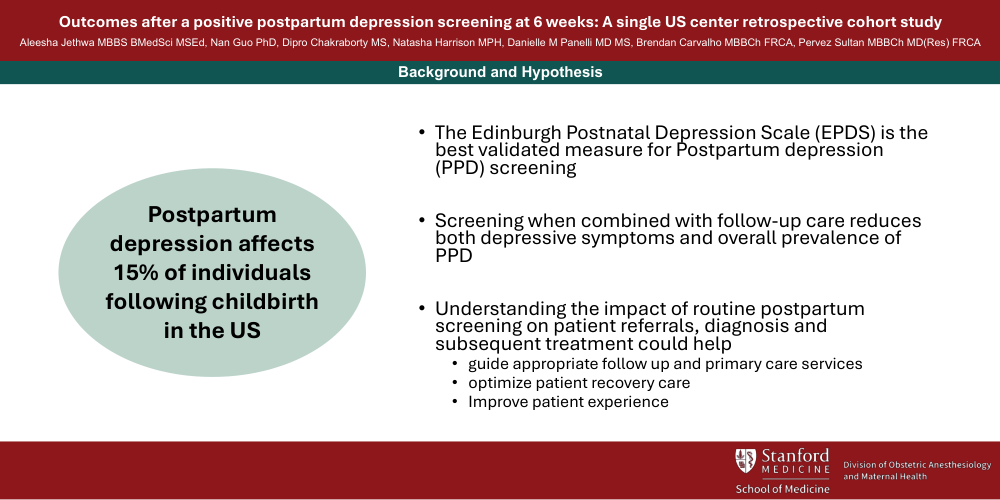
Outcomes after positive postpartum depression screening at 4–8 weeks: a single US center retrospective cohort study
Poster Presenter
Authors
Aleesha Jethwa, Nan Guo, Dipro Chakraborty, Natasha Harrison, Danielle Panelli, Brendan Carvalho, Pervez Sultan
Affiliations
Part of Topic
Recovery: Morbidity, Depression
Introduction: Postpartum depression affects approximately 15% of postpartum individuals in the United States (U.S.) and has serious maternal and infant consequences..While routine screening is recommended, screening only improves outcomes if it can ensure patients have access to timely follow-up care. Large-scale U.S. data describing downstream referrals, treatment, and serious events after a positive Edinburgh Postnatal Depression Scale (EPDS) screen remains limited. We evaluated maternal and infant outcomes following a postpartum EPDS screen.
Methods: We performed a retrospective cohort study at a single U.S. center from 2014 to 2023 using Electronic Health Record (EHR). We included adults (≥18 years) who delivered a live or non-viable infant at gestational age >20 weeks gestational age via any delivery mode who had completed all EPDS items at the obstetric follow-up clinic between 4–8 weeks postpartum. Positive screening was defined as EPDS ≥10. Outcomes were assessed from the EPDS completion date through 1 year postpartum. Primary outcomes were EHR-documented referrals to medical psychiatry specialties. Secondary outcomes included mental health ICD-10 diagnoses (overall and puerperium-associated F53 - Mental and behavioral disorders associated with the puerperium), psychiatric medication initiation, psychiatric referral/consult/visit, and infant hospital admission or new disease diagnosis up to 1 year. Groups were compared using chi-square/Fisher’s exact tests and ANOVA/Mann–Whitney U tests, as appropriate.
Results: Of 41,790 deliveries, 8,155 patients had a complete EPDS at 4–8 weeks; 13.6% (n=1,107) screened positive (EPDS ≥10). Median EPDS scores were 13 [IQR 11–16] for positive screens and 3 [IQR 1–5] for negative screens. Results are shown in Table 1. Within 1 year, compared with EPDS < 10, EPDS ≥10 was associated with higher rates of psychiatry referral/consult/visit (p< 0.001) however, only 7.2% of positively screened patients had an EHR-documented psychiatry referral/consult/visit. EPDS ≥10 was also associated with higher rates of any psychiatric diagnosis, F53 diagnosis, psychiatric medication initiation, and infant hospital admission/new disease diagnosis (all p≤0.05).
Conclusions: A positive postpartum EPDS screen within a 1 year of childbirth was associated with higher rates of psychiatric diagnoses, referral, consultation and visits, and increased infant healthcare utilization. Despite this elevated risk, fewer than 1 in 9 screen-positive patients had an EHR-documented psychiatry referral order, suggesting an actionable gap between screening and connection to specialty care. These findings support development of standardized, integrated postpartum mental health pathways following positive screening