875 posters, 25 topics, 3,440 authors, 1,061 institutions
ePostersLive by SciGen Technologies S.A. All rights reserved.
SAGES 2026 Annual Meeting Emerging Technology Session
March 25-28, 2026 | Tampa, FL, USA

P792
Surgeon Satisfaction with Preoperative Medical Clearances for Non-Emergent Intraabdominal Procedures
Poster Presenter
Authors
Affiliations
Part of Topic
Quality Improvement / Health System Outcomes
Surgeon Satisfaction With Preoperative Medical Clearances for Non-Emergent General & Colorectal Surgical Procedures
Valerie Fiore DO, Rachel Gordon MD
Department of Surgery, Episcopal Health Services
Background
Medical clearances are regularly obtained from primary care physicians or internists in the inpatient setting in preparation for surgical procedures. These evaluations of health have essentially become common practice and have been thought to aid in patient risk stratification and medical optimization. However, these clearances have been thought to convey reassurance to the operating surgeon that the procedure is safe from a medico-legal perspective.1 While there exists conflicting data on obtaining medical clearances and subsequent mortality, length of stay and other patient outcomes, no study exists to demonstrate the utility the surgeon gains from a note of clearance.2 This prospective cohort study will aim to evaluate surgeon satisfaction with preoperative medical clearances in adult patients that underwent non-emergent general and colorectal surgery procedures at a single center.
Study Design
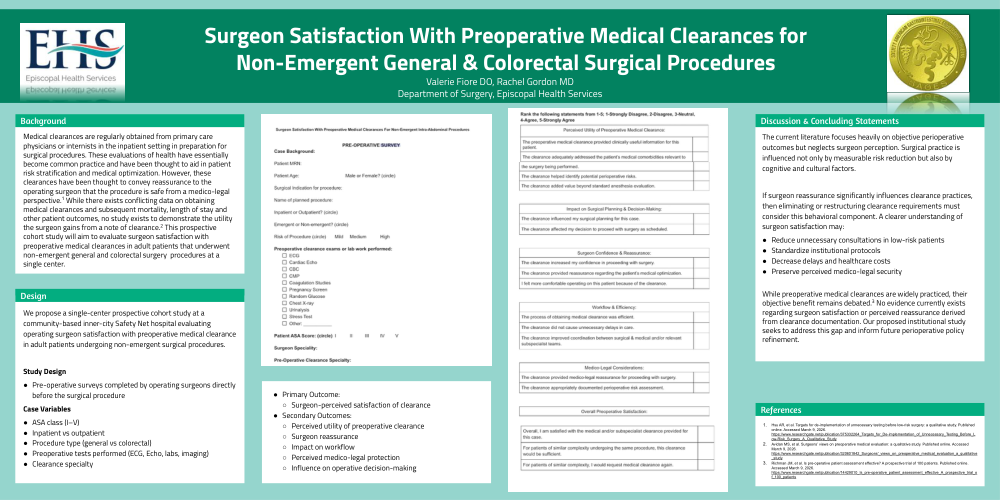
We propose a single-center prospective cohort study at a community-based inner-city Safety Net hospital evaluating operating surgeon satisfaction with preoperative medical clearance in adult patients undergoing non-emergent surgical procedures.
Study Design
-
Pre-operative surveys completed by operating surgeons directly before the surgical procedure
Case Variables
-
ASA class (I–V)
-
Inpatient vs outpatient
-
Procedure type (general vs colorectal)
-
Preoperative tests performed (ECG, Echo, labs, imaging)
-
Clearance specialty
-
Primary Outcome:
-
Surgeon-perceived satisfaction of clearance
-
Secondary Outcomes:
-
Perceived utility of preoperative clearance
-
Surgeon reassurance
-
Impact on workflow
-
Perceived medico-legal protection
-
Influence on operative decision-making
Discussion & Conclusion
The current literature focuses heavily on objective perioperative outcomes but neglects surgeon perception. Surgical practice is influenced not only by measurable risk reduction but also by cognitive and cultural factors.
If surgeon reassurance significantly influences clearance practices, then eliminating or restructuring clearance requirements must consider this behavioral component. A clearer understanding of surgeon satisfaction may:
-
Reduce unnecessary consultations in low-risk patients
-
Standardize institutional protocols
-
Decrease delays and healthcare costs
-
Preserve perceived medico-legal security
While preoperative medical clearances are widely practiced, their objective benefit remains debated.3 No evidence currently exists regarding surgeon satisfaction or perceived reassurance derived from clearance documentation. Our proposed institutional study seeks to address this gap and inform future perioperative policy refinement.
References
-
Hsu AR, et al. Targets for de-implementation of unnecessary testing before low-risk surgery: a qualitative study. Published online. Accessed March 9, 2026. https://www.researchgate.net/publication/375332264_Targets_for_De-implementation_of_Unnecessary_Testing_Before_Low-Risk_Surgery_A_Qualitative_Study
-
Avidan MS, et al. Surgeons’ views on preoperative medical evaluation: a qualitative study. Published online. Accessed March 9, 2026. https://www.researchgate.net/publication/320601842_Surgeons'_views_on_preoperative_medical_evaluation_a_qualitative_study
-
Richman JM, et al. Is pre-operative patient assessment effective? A prospective trial of 100 patients. Published online. Accessed March 9, 2026. https://www.researchgate.net/publication/14429010_Is_pre-operative_patient_assessment_effective_A_prospective_trial_of_100_patients