875 posters, 25 topics, 3,440 authors, 1,061 institutions
ePostersLive by SciGen Technologies S.A. All rights reserved.
SAGES 2026 Annual Meeting Emerging Technology Session
March 25-28, 2026 | Tampa, FL, USA

P763
Standardizing VTE prophylaxis guidelines using the Caprini Risk Score in surgical patients at an academic medical center - a pilot study
Poster Presenter
Authors
Affiliations
Part of Topic
Quality Improvement / Health System Outcomes
STANDARDIZING VTE PROPHYLAXIS GUIDELINES USING THE CAPRINI RISK SCORE IN SURGICAL PATIENTS AT AN ACADEMIC MEDICAL CENTER - A PILOT STUDY
Mary H Oh, MD; Sherif Aly, MD; Loma Linda University Health
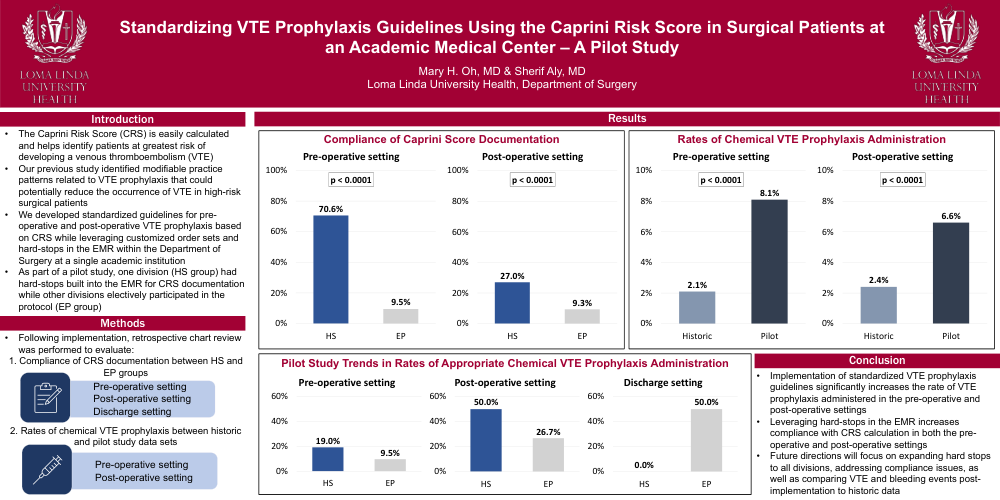
Introduction: Our previous study identified modifiable practice patterns related to venous thromboembolism (VTE) prophylaxis that could potentially reduce the occurrence of VTE in high risk surgical patients. The Caprini Risk Score (CRS) is easily calculated and helps identify patients at greatest risk of developing a VTE. We developed standardized guidelines for pre-operative and post-operative VTE prophylaxis based on the CRS while leveraging customized order sets and hard-stops in the EMR within the Department of Surgery at a single academic institution. As part of a pilot study, one division (HS group) had hard-stops built into the EMR for CRS documentation. Other divisions electively participated in the protocol (EP group).
Methods and Procedures: Following implementation, retrospective chart review was performed to evaluate compliance of CRS documentation in the pre-operative, post-operative, and discharge setting. Compliance between the HS and EP groups was compared. Additionally, appropriate use of chemical VTE prophylaxis based on documented CRS was measured. This was compared to historical data prior to implementation of the guidelines.
Results: We analyzed 724 patient records following the implementation of standardized VTE prophylaxis guidelines in May 2025 and compared them with 2958 historical records from the preceding 20 months across participating divisions. Following implementation, compliance with pre-operative CRS documentation was significantly higher in the HS group compared to the EP group (70.6% vs 9.5%, χ² = 270.0, p < 0.0001). Similarly, CRS documentation in the post-operative setting was also higher in the HS group (27.0% vs 9.3%, χ² = 35.7, p < 0.0001). Appropriate use of chemical VTE prophylaxis increased in the pre-operative (19% vs 9.5%) and post-operative (50% vs 26.7%) settings when comparing the HS and EP groups but declined in the discharge setting (0% vs 50%); none of these differences reached statistical significance. The overall rate of VTE prophylaxis administered post-implementation increased in the pre-operative (2.06% to 8.15%, χ² = 66.4, p < 0.0001) and post-operative (2.4% to 6.63%, χ² = 31.9, p < 0.0001) settings when compared to pre-implementation.
Conclusions: Implementation of standardized VTE prophylaxis guidelines significantly increases the rate of VTE prophylaxis administered in the pre-operative and post-operative settings. Leveraging hard-stops in the EMR increases compliance with CRS calculation in both the pre-operative and post-operative settings. Future directions will focus on expanding hard-stops to all divisions, addressing compliance issues, as well as comparing VTE and bleeding events post-implementation to historic data.