875 posters, 25 topics, 3,440 authors, 1,061 institutions
ePostersLive by SciGen Technologies S.A. All rights reserved.
SAGES 2026 Annual Meeting Emerging Technology Session
March 25-28, 2026 | Tampa, FL, USA

P790
Impact of Roux-en-Y Gastric Bypass and Sleeve Gastrectomy Bariatric Procedures on US Healthcare Cost
Poster Presenter
Authors
Affiliations
Part of Topic
Quality Improvement / Health System Outcomes
Introduction
While the efficacy of bariatric surgery has been well studied, the economics are less understood. With the emergence of new medical therapies, the objective of this study was to quantify the economic impact of Roux-en-Y gastric bypass (RYGB) and sleeve gastrectomy (SG) procedures on US healthcare.
Methods
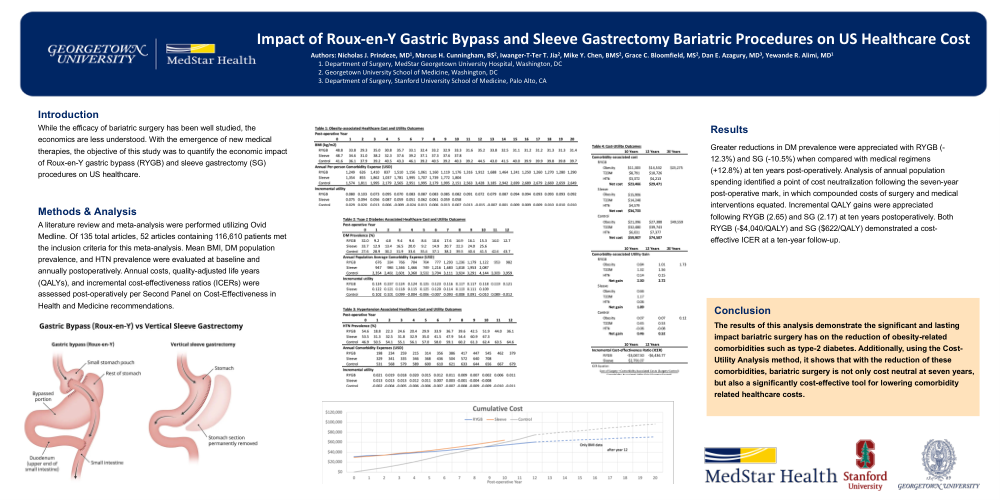
A literature review and meta-analysis were performed utilizing Ovid Medline. Of 135 total articles, 52 articles containing 116,610 patients met the inclusion criteria for this meta-analysis. Mean BMI, DM population prevalence, and HTN prevalence were evaluated at baseline and annually postoperatively. Annual costs, quality-adjusted life years (QALYs), and incremental cost-effectiveness ratios (ICERs) were assessed post-operatively per Second Panel on Cost-Effectiveness in Health and Medicine recommendations.
Results
Greater reductions in DM prevalence were appreciated with RYGB (-12.3%) and SG (-10.5%) when compared with medical regimens (+12.8%) at ten years post-operatively. Analysis of annual population spending identified a point of cost neutralization following the seven-year post-operative mark, in which compounded costs of surgery and medical interventions equated. Incremental QALY gains were appreciated following RYGB (2.65) and SG (2.17) at ten years postoperatively. Both RYGB (-$4,040/QALY) and SG ($622/QALY) demonstrated a cost-effective ICER at a ten-year follow-up.
Conclusion
The results of this analysis demonstrate the significant and lasting impact bariatric surgery has on the reduction of obesity-related comorbidities such as type-2 diabetes. Additionally, using the Cost-Utility Analysis method, it shows that with the reduction of these comorbidities, bariatric surgery is not only cost neutral at seven years, but also a significantly cost-effective tool for lowering comorbidity related healthcare costs.