875 posters, 25 topics, 3,440 authors, 1,061 institutions
ePostersLive by SciGen Technologies S.A. All rights reserved.
SAGES 2026 Annual Meeting Emerging Technology Session
March 25-28, 2026 | Tampa, FL, USA

P770
Efficiency Quality Index in Vertical Sleeve Gastrectomy - a Quality and Reliability Assessment Tool
Poster Presenter
Part of Topic
Quality Improvement / Health System Outcomes
Objective: This study aims to develop an Efficiency Quality Index (EQI) to promote high reliability in the performance of Vertical Sleeve Gastrectomy (VSG).
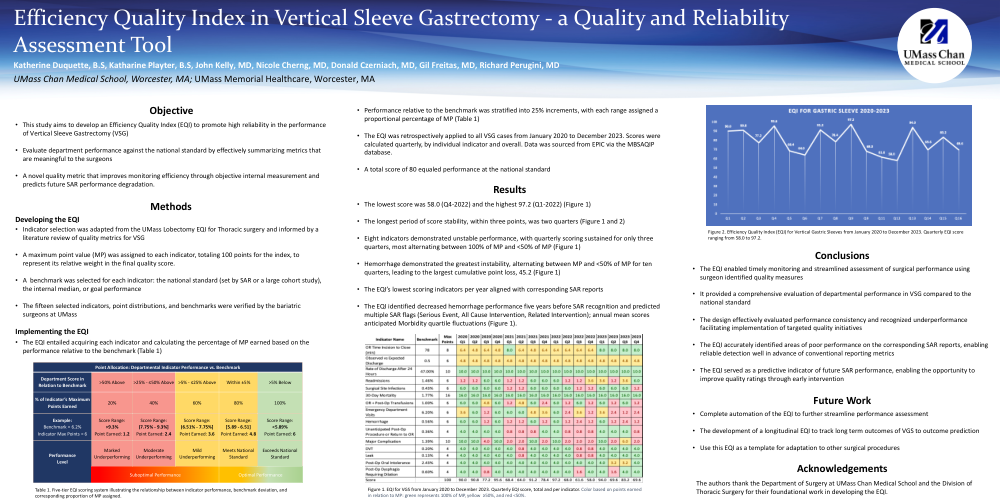
Methods: Based on a previous thoracic EQI, the EQI is composed of fifteen indicators: OR Time Incision to Close, Observed vs Expected Discharge, Rate of Discharged After 24 Hours,
Readmissions, Surgical Site Infections, 30-Day Mortality, OR + Post-Op Transfusions, Emergency Department Visits, Hemorrhage, Unanticipated Post-Op Procedure or Return to OR, Major Complication, DVT, Leak, Post-Op Oral Intolerance, and Post-Op Dysphagia Requiring Dilation. A maximum number of points (MP) was designated to each indicator, summing to 100 total points for the index. Surgeons certified this distribution. The population analyzed was VSG performed from January 2020 to December 2023. The EQI was calculated for each quarter, designed as an automated algorithm. Calculating the EQI entailed acquiring each indicator and determining the percentage of MP earned based on performance relative to internal benchmarks, derived from the national standard. MP was allotted in 25% increments with a total score of 80, representing the third quartile, equaling performance at the national standard.
Results: The EQI scores demonstrated significant variation during the timeframe assessed. The lowest score was 58.0 (Q4-2022) and the highest 97.2 (Q1-2022). The longest period of a stable score, within three points, was two quarters (Figure 1). Eight indicators demonstrated instability in performance with their quartile of performance being sustained for max three quarters, most alternating between 100% of MP and <50% of MP. Hemorrhage demonstrated the greatest instability, alternating between MP and <50% of MP for ten quarters, leading to the largest point loss across all periods (45.2).
Conclusions: The EQI is developed by the surgeons, offering the flexibility to modify variables and benchmarks as desired, ensuring it remains a meaningful tool. The proposed EQI enables timely tracking and streamlined assessment of surgical performance, augmented by the ability for automation. This design evaluates consistency while ensuring recognition of underperformance to allow for the implementation of targeted quality initiatives. The EQI serves as a predictive indicator of SAR performance, enabling improved quality ratings through early intervention.