875 posters, 25 topics, 3,440 authors, 1,061 institutions
ePostersLive by SciGen Technologies S.A. All rights reserved.
SAGES 2026 Annual Meeting Emerging Technology Session
March 25-28, 2026 | Tampa, FL, USA

P766
Prophylactic Negative Pressure Wound Therapy For Closed Abdominal Wounds After Gastrointestinal Surgery: A Systematic Review and Meta-Analysis
Poster Presenter
Authors
Chloé Thériault, Kelly Dong, Tyler McKechnie, Cagla Eskicioglu
Affiliations
Part of Topic
Quality Improvement / Health System Outcomes
INTRODUCTION
•Despite measures already in place, according to the CDC, surgical site infections (SSIs) continue to rise, making them a major ongoing healthcare and financial concern.
•Negative pressure wound therapy (NPWT) has been studied as an adjunct for wound healing and infection in abdominal surgery, showing varying results.
•Previous systematic reviews have included studies encompassing patients with abdominal surgeries from various surgical specialties. However, abdominal surgeries involving the gastrointestinal (GI) tract carry a higher risk for SSIs.
OBJECTIVE
To evaluate the effects of prophylactic use of NPWT devicescompared to standard post-surgical dressings in patients undergoing open abdominal surgery involving the GI tract only, with incisions closed primarily.
METHODS
•Major databases
•RCTs only
•Open GI surgery
•NPWT vs. standard dressing
•Main outcomes: Any SSI, seroma and wound dehiscence, within 30 days post-operatively.
•Meta-analysis: Random-effects model.
•Risk of bias assessment: Revised risk-of-bias tool for randomized trials (RoB 2).
•Certainty of evidence: Grading of Recommendations Assessment, Development and Evaluation (GRADE) approach.
RESULTS
•1728 unique patients (871 SSD; 857 NPWT).
•Nine different countries (US n=4; Turkey n=1; Italy n=2; Canada n=1; Spain n=2; Poland n=1; Malaysia n=1; South Korea n=1; India n=1), across different socio-economic statuses, in both universal and predominantly private healthcare systems.
•Fourteen RCTs: 4 studies focused on HPB surgical patients, 6 on colorectal patients, 1 study on emergency GI surgery, and 3 enrolled a mix of GI surgeries.
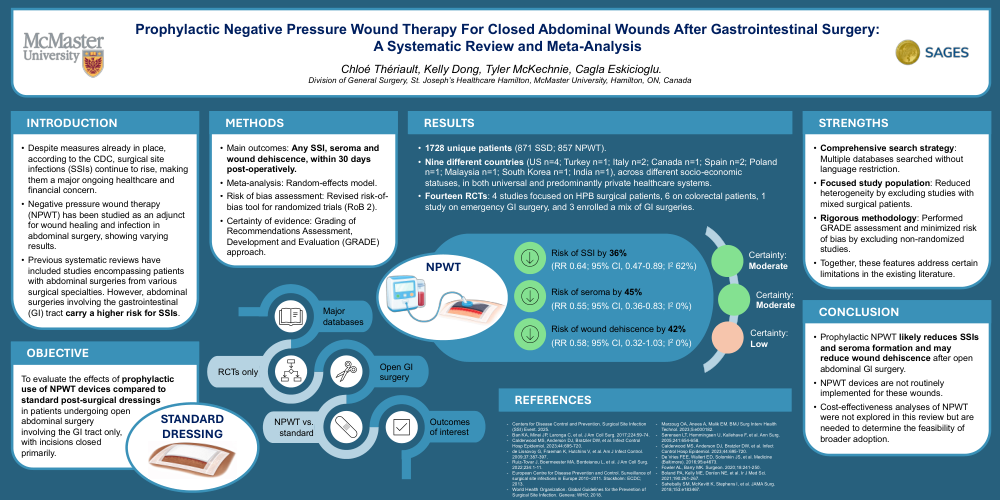
NPWT decreases:
- Risk of SSI by 36% (RR 0.64; 95% CI, 0.47-0.89; I2 62%) - Certainty of evidence: Moderate
- Risk of seroma by 45% (RR 0.55; 95% CI, 0.36-0.83; I2 0%) - Certainty of evidence: Moderate
- Risk of wound dehiscence by 42% (RR 0.58; 95% CI, 0.32-1.03; I2 0%) - Certainty of evidence: Low
STRENGTHS
•Comprehensive search strategy: Multiple databases searched without language restriction.
•Focused study population:Reduced heterogeneity by excluding studies with mixed surgical patients.
•Rigorous methodology: PerformedGRADE assessment and minimizedrisk of bias by excluding non-randomized studies.
•Together, these features address certain limitations in the existing literature.
CONCLUSION
•Prophylactic NPWT likely reduces SSIs and seroma formation and may reduce wound dehiscence after open abdominal Gl surgery.
•NPWT devices are not routinely implemented for these wounds.
•Cost-effectiveness analyses of NPWT were not explored in this review but are needed to determine the feasibility of broader adoption.
REFERENCES
-Centers for Disease Control and Prevention. Surgical Site Infection (SSI) Event. 2025.
-Ban KA, Minei JP, Laronga C, et al. J Am Coll Surg. 2017;224:59-74.
-Calderwood MS, Anderson DJ, Bratzler DW, et al. Infect Control Hosp Epidemiol. 2023;44:695-720.
-de Lissovoy G, Fraeman K, Hutchins V, et al. Am J Infect Control. 2009;37:387-397.
-Ruiz-Tovar J, Boermeester MA, Bordeianou L, et al. J Am Coll Surg. 2022;234:1-11.
-European Centre for Disease Prevention and Control. Surveillance of surgical site infections in Europe 2010–2011. Stockholm: ECDC; 2013.
-World Health Organization. Global Guidelines for the Prevention of Surgical Site Infection. Geneva: WHO; 2018.
-Marzoug OA, Anees A, Malik EM. BMJ Surg Interv Health Technol. 2023;5:e000182.
-Sørensen LT, Hemmingsen U, Kallehave F, et al. Ann Surg. 2005;241:654-658.
-Calderwood MS, Anderson DJ, Bratzler DW, et al. Infect Control Hosp Epidemiol. 2023;44:695-720.
-De Vries FEE, Wallert ED, Solomkin JS, et al. Medicine (Baltimore). 2016;95:e4673.
-Fowler AL, Barry MK. Surgeon. 2020;18:241-250.
-Boland PA, Kelly ME, Donlon NE, et al. Ir J Med Sci. 2021;190:261-267.
-Sahebally SM, McKevitt K, Stephens I, et al. JAMA Surg. 2018;153:e183467.