875 posters, 25 topics, 3,440 authors, 1,061 institutions
ePostersLive by SciGen Technologies S.A. All rights reserved.
SAGES 2026 Annual Meeting Emerging Technology Session
March 25-28, 2026 | Tampa, FL, USA

P764
The Biliary Board: Mitigating Care Fragmentation for Patients with Complex Benign Biliary Disease
Poster Presenter
Part of Topic
Quality Improvement / Health System Outcomes
The Biliary Board: Mitigating Care Fragmentation for Patients with Complex Benign Biliary Disease
E Caraballo Torrealba, BSE; S Kalsotra, MD; J Burlen, MD; J Knight Davis, MD; A Young, MD; A Varone, MD; L Stepp, MD; C Valdez, MD; M Makary, MD; E Swei, MD; P Lewis, MD; D O'Neal, MD; P Sweigert, MD; H Baselice, MPH; N Mowery, MD; JR Coleman, MD, MPH; The Ohio State University Wexner Medical Center
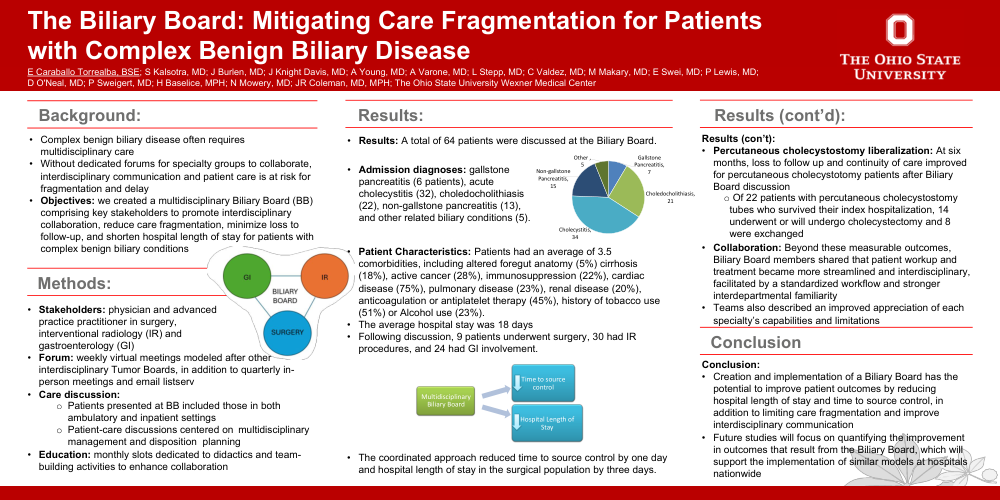
Introduction: Patients with complex benign biliary disease often require multidisciplinary care. Without existing forums for various specialty groups to collaborate, communication fragmentation occurs, and patient care is often disjointed. Therefore, we created a multidisciplinary Biliary Board comprised of key stakeholders with the goal of promoting interdisciplinary collaboration, reducing fragmentation of care, minimizing loss to follow-up, and shortening hospital length of stay for medically complex patients with benign biliary conditions.
Background:
- Complex benign biliary disease often requires multidisciplinary care
- Without dedicated forums for specialty groups to collaborate, interdisciplinary communication and patient care is at risk for fragmentation and delay
- Objectives: we created a multidisciplinary Biliary Board (BB) comprising key stakeholders to promote interdisciplinary collaboration, reduce care fragmentation, minimize loss to follow-up, and shorten hospital length of stay for patients with complex benign biliary conditions
Methods:
- Stakeholders: physician and advanced practice practitioner in surgery, interventional radiology (IR) and gastroenterology (GI)
- Forum: weekly virtual meetings modeled after other interdisciplinary Tumor Boards, in addition to quarterly in-person meetings and email listserv
- Care discussion:
- Patients presented at BB included those in both ambulatory and inpatient settings
- Patient-care discussions centered on multidisciplinary management and disposition planning
- Education: monthly slots dedicated to didactics and team-building activities to enhance collaboration
Results:
- Results: A total of 64 patients were discussed at the Biliary Board.
- Admission diagnoses: gallstone pancreatitis (6 patients), acute cholecystitis (32), choledocholithiasis (22), non-gallstone pancreatitis (13), and other related biliary conditions (5).
- Patient Characteristics: Patients had an average of 3.5 comorbidities, including altered foregut anatomy (5%) cirrhosis (18%), active cancer (28%), immunosuppression (22%), cardiac disease (75%), pulmonary disease (23%), renal disease (20%), anticoagulation or antiplatelet therapy (45%), history of tobacco use (51%) or Alcohol use (23%).
- The average hospital stay was 18 days
- Following discussion, 9 patients underwent surgery, 30 had IR procedures, and 24 had GI involvement.
- The coordinated approach reduced time to source control by one day and hospital length of stay in the surgical population by three days.
Results (cont’d):
- Percutaneous cholecystostomy liberalization: At six months, loss to follow up and continuity of care improved for percutaneous cholecystotomy patients after Biliary Board discussion
- Of 22 patients with percutaneous cholecystostomy tubes who survived their index hospitalization, 14 underwent or will undergo cholecystectomy and 8 were exchanged
- Collaboration: Beyond these measurable outcomes, Biliary Board members shared that patient workup and treatment became more streamlined and interdisciplinary, facilitated by a standardized workflow and stronger interdepartmental familiarity
- Teams also described an improved appreciation of each specialty’s capabilities and limitations
Conclusion:
- Creation and implementation of a Biliary Board has the potential to improve patient outcomes by reducing hospital length of stay and time to source control, in addition to limiting care fragmentation and improve interdisciplinary communication
- Future studies will focus on quantifying the improvement in outcomes that result from the Biliary Board, which will support the implementation of similar models at hospitals nationwide