875 posters, 25 topics, 3,440 authors, 1,061 institutions
ePostersLive by SciGen Technologies S.A. All rights reserved.
SAGES 2026 Annual Meeting Emerging Technology Session
March 25-28, 2026 | Tampa, FL, USA

P730
Polyp clearance via combined endoscopic-surgical technique in a patient with Peutz-Jeghers syndrome
Poster Presenter
Part of Topic
New Technologies / Techniques
POLYP CLEARANCE VIA COMBINED ENDOSCOPIC-SURGICAL TECHNIQUE IN A PATIENT WITH PEUTZ-JEGHERS SYNDROME
Chong-Chi Chiu, MD
Department of General Surgery, E-Da Cancer Hospital, I-Shou University, Kaohsiung, Taiwan
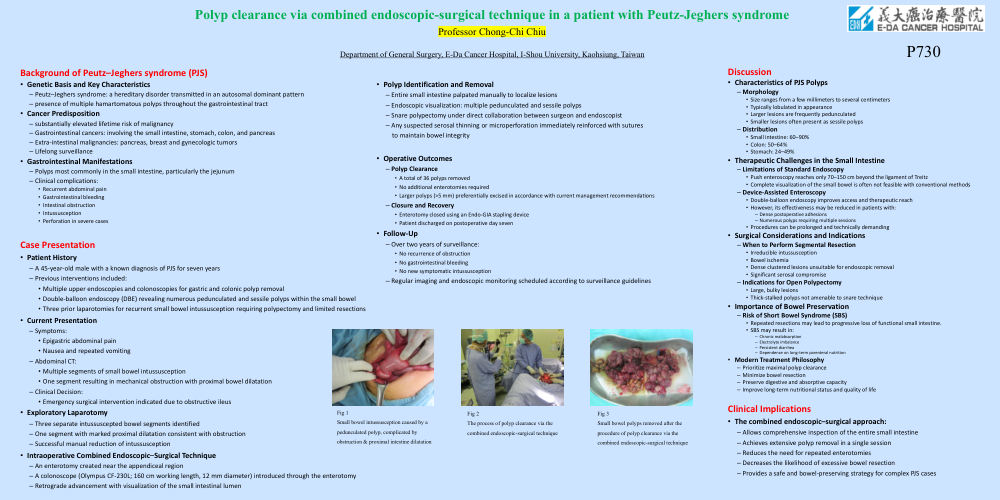
A 45-year-old male diagnosed with Peutz-Jeghers syndrome (PJS) underwent three episodes of surgeries for polypectomy and small intestine resections due to recurrent episodes of small bowel intussusception. This time, he complained of epigastric pain, nausea, and vomiting, symptoms suggestive of bowel obstruction. Abdominal computed tomography revealed multiple segments of small bowel intussusception, consistent with obstructive ileus. As a result, emergency surgery was planned to alleviate the obstruction.
A midline laparotomy was performed, revealing three distinct segments of intussusception in the small intestine. However, only one segment was obstructed. The intussuscepted segments were successfully reduced manually. Previous surgical adhesions were noted and relieved after careful dissection. The whole small intestine was palpated to identify the polyps, which were subsequently visualized using a colonoscope (Olympus CF-230L: 160 cm working length, 12 mm diameter) introduced through an enterotomy incision near the appendix base. The colonoscope was advanced in a retrograde direction to reach the polyps. A snare polypectomy technique was employed to excise the polyps, with the surgeon and endoscopist coordinating to ensure optimal visibility and safety. If there was any
suspicious or impending perforation, the surgeon immediately sutured the serosal and muscular layers to preserve the integrity of the bowel wall.
This combined endoscopic-surgical approach removed 36 polyps. Notably, no additional enterotomies were performed. After the polyps were excised, the enterotomy was closed using an Endo-GIA stapler. The postoperative recovery was uneventful, and the patient was discharged after one week. He continued to receive regular follow-up care for two years without any complications. This combined endoscopic-surgical technique can remove polyps, reduce the need for repeated intestine resections, and lower the risk of leakage from enterotomies.