875 posters, 25 topics, 3,440 authors, 1,061 institutions
ePostersLive by SciGen Technologies S.A. All rights reserved.
SAGES 2026 Annual Meeting Emerging Technology Session
March 25-28, 2026 | Tampa, FL, USA

P731
Use of Apple Vision Pro (AVP) as a Virtual Monitor for 3D/4K Laparoscopic Procedures
Poster Presenter
Authors
Affiliations
Part of Topic
New Technologies / Techniques
The Use of Apple Vision Pro (AVP) as a Virtual Monitor for 3D/4K Laparoscopic Procedures
Background
3D, stereoscopic vision is the natural state for humans. 3D laparoscopy is widely believed to confer advantages to surgeons. 3D/4K laparoscopic cameras and monitors are available for viewing laparoscopic procedures. Due to the inherent limits of the human eye, surgeons may be unable to view 3D images at 4K resolution on standard monitors in the OR, because of distance limitations. The use of the AVP allows surgeons to overcome these viewing distance limitations and view surgeries in 3D at full 4K resolution. The virtual monitor confers ergonomic benefits, as well.
Methods
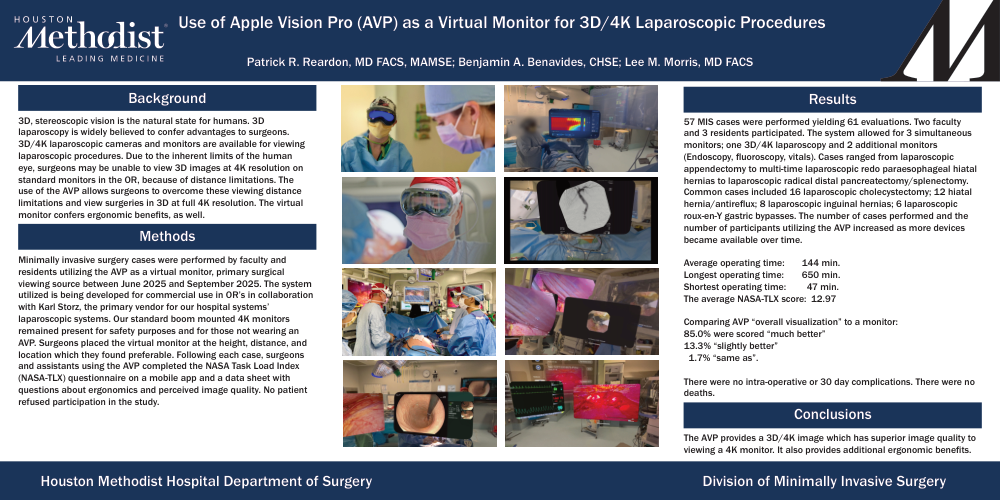
Minimally invasive surgery cases were performed by faculty and residents utilizing the AVP as a virtual monitor, primary surgical viewing source between June 2025 and September 2025. The system utilized is being developed for commercial use in OR’s in collaboration with Karl Storz, the primary vendor for our hospital systems’ laparoscopic systems. Our standard boom mounted 4K monitors remained present for safety purposes and for those not wearing an AVP. Surgeons placed the virtual monitor at the height, distance, and location which they found preferable. Following each case, surgeons and assistants using the AVP completed the NASA Task Load Index (NASA-TLX) questionnaire on a mobile app and a data sheet with questions about ergonomics and perceived image quality. No patient refused participation in the study.
Results
57 MIS cases were performed yielding 61 evaluations. Two faculty and 3 residents participated. The system allowed for 3 simultaneous monitors; one 3D/4K laparoscopy and 2 additional monitors (Endoscopy, fluoroscopy, vitals). Cases ranged from laparoscopic appendectomy to multi-time laparoscopic redo paraesophageal hiatal hernias to laparoscopic radical distal pancreatectomy/splenectomy. Common cases included 16 laparoscopic cholecystectomy; 12 hiatal hernia/antireflux; 8 laparoscopic inguinal hernias; 6 laparoscopic roux-en-Y gastric bypasses. The number of cases performed and the number of participants utilizing the AVP increased as more devices became available over time.
Average operating time: 144 min.
Longest operating time: 650 min.
Shortest operating time: 47 min.
The average NASA-TLX score: 12.97
Comparing AVP “overall visualization” to a monitor:
85.0% were scored “much better”
13.3% “slightly better”
1.7% “same as”.
There were no intra-operative or 30 day complications. There were no deaths.
Conclusion
The AVP provides a 3D/4K image which has superior image quality to viewing a 4K monitor. It also provides additional ergonomic benefits.