875 posters, 25 topics, 3,440 authors, 1,061 institutions
ePostersLive by SciGen Technologies S.A. All rights reserved.
SAGES 2026 Annual Meeting Emerging Technology Session
March 25-28, 2026 | Tampa, FL, USA

P728
Updated Outcomes of Minilaparoscopic Appendectomy Using Percutaneous MiniLap Instruments: A Prospective Cohort Study
Part of Topic
New Technologies / Techniques
Introduction:
Needlescopic or minilaparoscopic surgery employs instruments with a diameter ≤3 mm. The MiniLap System (Teleflex, Morrisville, NC, USA) utilizes a 2.4 mm percutaneous shaft with an integrated tip, eliminating the need for a trocar and producing a tissue defect up to 12 times smaller than a conventional 5 mm trocar. Several studies have demonstrated the safety and feasibility of minilaparoscopic appendectomy (MLA) for acute appendicitis (AA). Our group previously reported the feasibility and safety of percutaneous MiniLap instruments across different grades of AA. This study presents updated prospective results, highlighting outcomes, safety, and patient satisfaction.
Methods:
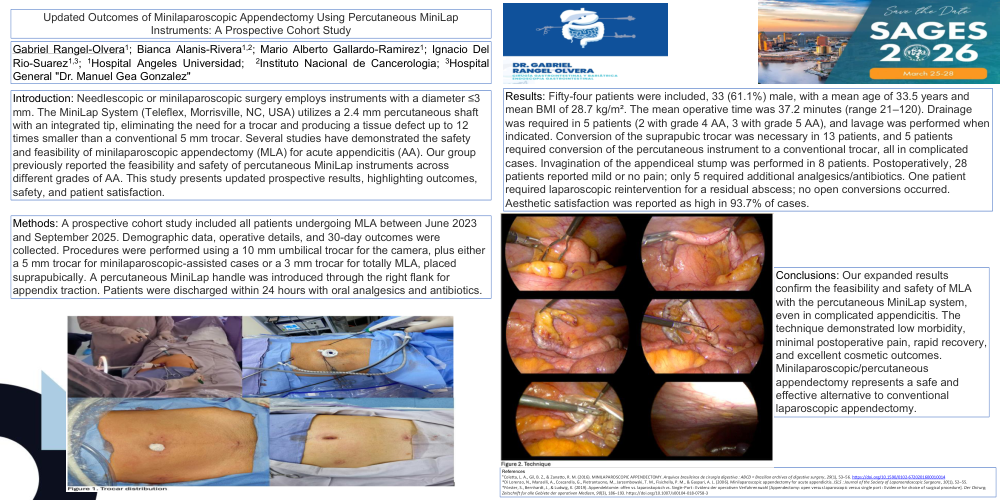
A prospective cohort study included all patients undergoing MLA between June 2023 and September 2025. Demographic data, operative details, and 30-day outcomes were collected. Procedures were performed using a 10 mm umbilical trocar for the camera, plus either a 5 mm trocar for minilaparoscopic-assisted cases or a 3 mm trocar for totally MLA, placed suprapubically. A percutaneous MiniLap handle was introduced through the right flank for appendix traction. Patients were discharged within 24 hours with oral analgesics and antibiotics.
Results:
Fifty-four patients were included, 33 (61.1%) male, with a mean age of 33.5 years and mean BMI of 28.7 kg/m². The mean operative time was 37.2 minutes (range 21–120). Drainage was required in 5 patients (2 with grade 4 AA, 3 with grade 5 AA), and lavage was performed when indicated. Conversion of the suprapubic trocar was necessary in 13 patients, and 5 patients required conversion of the percutaneous instrument to a conventional trocar, all in complicated cases. Invagination of the appendiceal stump was performed in 8 patients. Postoperatively, 28 patients reported mild or no pain; only 5 required additional analgesics/antibiotics. One patient required laparoscopic reintervention for a residual abscess; no open conversions occurred. Aesthetic satisfaction was reported as high in 93.7% of cases.
Conclusions:
Our expanded results confirm the feasibility and safety of MLA with the percutaneous MiniLap system, even in complicated appendicitis. The technique demonstrated low morbidity, minimal postoperative pain, rapid recovery, and excellent cosmetic outcomes. Minilaparoscopic/percutaneous appendectomy represents a safe and effective alternative to conventional laparoscopic appendectomy.