875 posters, 25 topics, 3,440 authors, 1,061 institutions
ePostersLive by SciGen Technologies S.A. All rights reserved.
SAGES 2026 Annual Meeting Emerging Technology Session
March 25-28, 2026 | Tampa, FL, USA

P590
Meeting in the Middle: Rendezvous Procedure for Severe Esophageal Stricture
Part of Topic
Foregut
Introduction: Severe esophageal strictures may occur after cancer treatment, caustic injury, or other benign conditions, and are associated with dysphagia, aspiration and malnutrition. The rendezvous procedure offers an endoscopic solution to re-establish esophageal luminal patency.
Objective: To evaluate the feasibility and therapeutic outcomes of the rendezvous procedure in patients with severe esophageal strictures
Methods: We retrospectively reviewed 38 patients with complete esophageal obstruction who underwent rendezvous procedures from 2000 to 2024. Three cases failed the rendezvous procedure and were excluded. Access to the stomach was required to perform retrograde endoscopy, which was most commonly via the gastrostomy tube site. Antegrade and retrograde endoscopes were advanced simultaneously to the proximal and distal ends of the stricture. An endoscopic instrument was passed from one side until it could be visualized from the other side. Once a common pathway was established, antegrade dilation was performed.
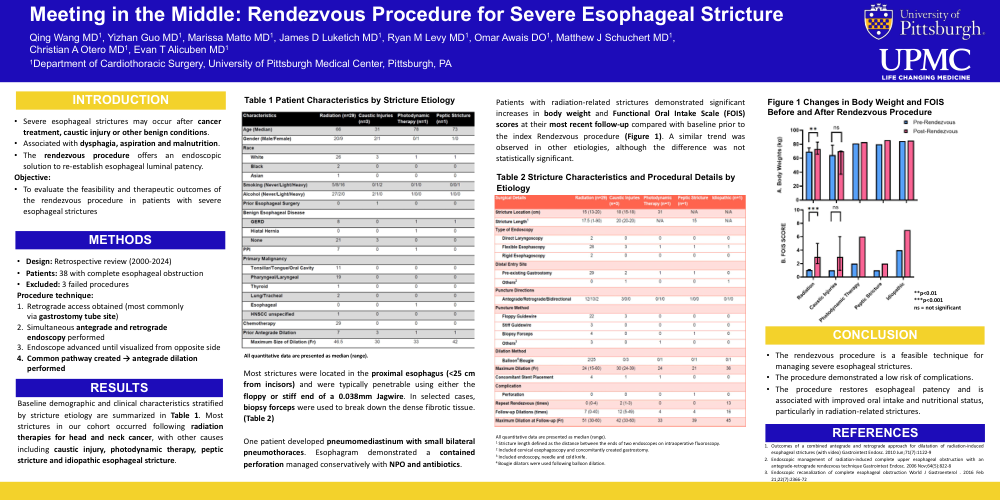
Results: The majority of patients developed esophageal stricture secondary to radiation therapies for head and neck cancer, with other etiologies including caustic injuries, photodynamic therapy, peptic stricture, and idiopathic esophageal stricture. Most strictures were located in the proximal esophagus (<25 cm from incisors) and were typically penetrable using either the floppy or stiff end of a 0.038mm Jagwire. In selected cases, biopsy forceps were used to break down the dense fibrotic tissue. One patient developed pneumomediastinum with small bilateral pneumothoraces. Esophagram demonstrated a contained perforation managed conservatively with NPO and antibiotics. Patients with radiation-related strictures demonstrated significant increases in body weight and Functional Oral Intake Scale (FOIS) scores at their most recent follow-up compared with baseline prior to the index Rendezvous procedure. A similar trend was observed in other etiologies, although the difference was not statistically significant.
Conclusion: The rendezvous procedure is a feasible technique for managing severe esophageal strictures with a low complication risk. The procedure restores esophageal patency and is associated with improved oral intake and nutritional status, particularly in radiation-related strictures.