875 posters, 25 topics, 3,440 authors, 1,061 institutions
ePostersLive by SciGen Technologies S.A. All rights reserved.
SAGES 2026 Annual Meeting Emerging Technology Session
March 25-28, 2026 | Tampa, FL, USA

P560
Comparison of Long-Term Recurrence Rates of Paraesophageal Hernias with Mesh vs Cruroplasty Alone Using Medicare Data
Poster Presenter
Part of Topic
Foregut
No Difference in Long-Term Recurrence Rates After Paraesophageal Hernia Repair with Mesh vs Cruroplasty Alone, Using Medicare Data
Jonathan Levy, Joshua Sinamo, Jenny Shao, Sean O’Neill, Dana Telem, Annie Ehlers
Introduction
The utility of mesh use during laparoscopic paraesophageal hernia is widely debated. The impact of mesh on long-term recurrence remains unknown as current evidence is limited by short-term patient follow-up, single institution studies, and one randomized control study which represents ideal rather than typical circumstances. In this context, we leveraged existing Medicare data, which benefits from continuous patient enrollment, to evaluate up to 10-year outcomes of mesh placement following paraesophageal hernia repair.
Methods
We identified 18,325 fee-for-service beneficiaries between 2011-2022 receiving index minimally invasive paraesophageal hernia repair in an elective setting using the 20% sample of the Medicare data (CPT: 43281 vs 43282). The primary outcome metric was operative recurrence up to 10 years after surgery. Secondary outcomes included: 30-day operative recurrence, complications, and mortality. We analyzed the data descriptively and used Royston-Parmar survival model to assess the adjusted time-dependent recurrence rates.
Results
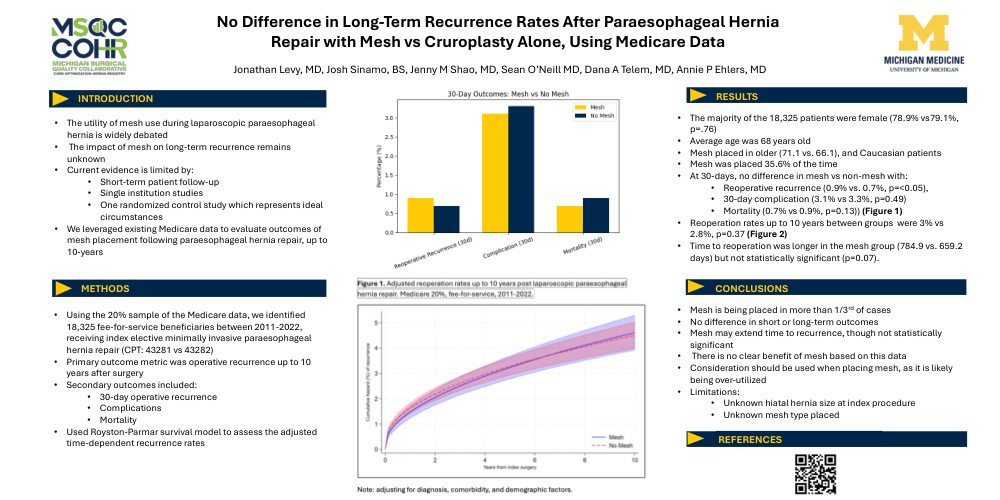
Among 18,325 patients, the majority were female (78.9% vs79.1%, p=.76) and the average age was 68.0. Mesh was placed 35.6% of the time. Patients who had mesh placed were more often older (71.1 vs. 66.1), and Caucasian. At 30-days, mesh placement was associated with no difference in reoperative recurrence (0.9% vs. 0.7%, p=<0.05), 30-day complication (3.1% vs 3.3%, p=0.49), or mortality (0.7% vs 0.9%, p=0.13). Adjusting for diagnosis, comorbidity, and demographic factors, reoperation rates up to 10 years between groups (mesh vs. no mesh) were similar were (3% vs 2.8%, p=0.37). Time to reoperation was longer in the mesh group (784.9 vs. 659.2 days) but not statistically significant (p=0.07).
Conclusion
In this study of older adults, we found that mesh was used in more than one-third of patients during laparoscopic paraesophageal hernias repair, without a difference in short or long-term reoperative recurrence. Although mesh may extend the time to recurrence, the results are not statistically significant. Our findings suggest mesh is being placed frequently, without any clear advantage over cruroplasty. Consideration should be used when deciding to place mesh, as it is likely being over-utilized and without clear benefit. Limitations for this study include unknown hiatal hernia size at the index procedure, and unknown mesh type being placed.