875 posters, 25 topics, 3,440 authors, 1,061 institutions
ePostersLive by SciGen Technologies S.A. All rights reserved.
SAGES 2026 Annual Meeting Emerging Technology Session
March 25-28, 2026 | Tampa, FL, USA

P581
Navigating the Distal Duodenum: Organ-Preserving Resection of a D3/D4 Gastrointestinal Stromal Tumor
Poster Presenter
Part of Topic
Foregut
Navigating the Distal Duodenum: Organ-Preserving Resection of a D3/D4 Gastrointestinal Stromal Tumor
Awinita Barpujari MD1, Franklin Burg MD1, Sameh Yousef MD1, Augustus Koch MD1, Tul Maya Gurung MD1, Pooja Shah MD1, Prashanth Ramachandra MD1.
1. Department of Surgery, Mercy Catholic Medical Center, Darby, PA.
Introduction
Duodenal gastrointestinal stromal tumors (GISTs) represent a rare subset of mesenchymal neoplasms, comprising 3-5% of all GISTs, with most escuring in the stomach or proximal small intestine. Tumors in the third and fourth portions of the duodenum (D3/D4) are uncommon and their retroperitoneal location and proximity to critical vascular and pancreatic structures pose unique surgical challenges. Historically, the standard approach was pancreaticoduodenectomy; however, evidence now supports the safety and oncologic adequacy of pancreas-preserving wedge or segmental duodenal resection with reconstruction. Surgical strategy is primarily dictated by tumor size, location, and relationship to adjacent structures. In select cases, neoadjuvant imatinib therapy can facilitate less extensive surgery.
Presentation
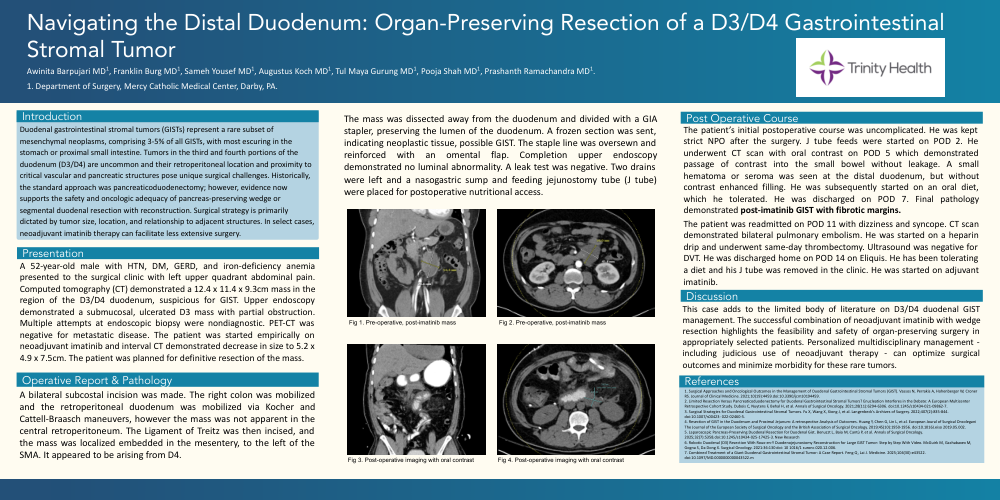
A 52-year-old male with HTN, DM, GERD, and iron-deficiency anemia presented to the surgical clinic with left upper quadrant abdominal pain. Computed tomography (CT) demonstrated a 12.4 x 11.4 x 9.3cm mass in the region of the D3/D4 duodenum, suspicious for GIST. Upper endoscopy demonstrated a submucosal, ulcerated D3 mass with partial obstruction. Multiple attempts at endoscopic biopsy were nondiagnostic. PET-CT was negative for metastatic disease. The patient was started empirically on neoadjuvant imatinib and interval CT demonstrated decrease in size to 5.2 x 4.9 x 7.5cm. The patient was planned for definitive resection of the mass.
Operative Report & Pathology
A bilateral subcostal incision was made. The right colon was mobilized and the retroperitoneal duodenum was mobilized via Kocher and Cattell-Braasch maneuvers, however the mass was not apparent in the central retroperitoneum. The Ligament of Treitz was then incised, and the mass was localized embedded in the mesentery, to the left of the SMA. It appeared to be arising from D4.
The mass was dissected away from the duodenum and divided with a GIA stapler, preserving the lumen of the duodenum. A frozen section was sent, indicating neoplastic tissue, possible GIST. The staple line was oversewn and reinforced with an omental flap. Completion upper endoscopy demonstrated no luminal abnormality. A leak test was negative. Two drains were left and a nasogastric sump and feeding jejunostomy tube (J tube) were placed for postoperative nutritional access.
Fig 1. Pre-operative, post-imatinib mass
Fig 2. Pre-operative, post-imatinib mass
Fig 3. Post-operative imaging with oral contrast
Fig 4. Post-operative imaging with oral contrast
Post Operative Course & Pathology
The patient’s initial postoperative course was uncomplicated. He was kept strict NPO after the surgery. J tube feeds were started on POD 2. He underwent CT scan with oral contrast on POD 5 which demonstrated passage of contrast into the small bowel without leakage. A small hematoma or seroma was seen at the distal duodenum, but without contrast enhanced filling. He was subsequently started on an oral diet, which he tolerated. He was discharged on POD 7. Final pathology demonstrated post-imatinib GIST with fibrotic margins.
The patient was readmitted on POD 11 with dizziness and syncope. CT scan demonstrated bilateral pulmonary embolism. He was started on a heparin drip and underwent same-day thrombectomy. Ultrasound was negative for DVT. He was discharged home on POD 14 on Eliquis. He has been tolerating a diet and his J tube was removed in the clinic. He was started on adjuvant imatinib.
Discussion
This case adds to the limited body of literature on D3/D4 duodenal GIST management. The successful combination of neoadjuvant imatinib with wedge resection highlights the feasibility and safety of organ-preserving surgery in appropriately selected patients. Personalized multidisciplinary management - including judicious use of neoadjuvant therapy - can optimize surgical outcomes and minimize morbidity for these rare tumors.
References
1. Surgical Approaches and Oncological Outcomes in the Management of Duodenal Gastrointestinal Stromal Tumors (GIST). Vassos N, Perrakis A, Hohenberger W, Croner RS. Journal of Clinical Medicine. 2021;10(19):4459.doi:10.3390/jcm10194459.
2. Limited Resection Versus Pancreaticoduodenectomy for Duodenal Gastrointestinal Stromal Tumors? Enucleation Interferes in the Debate: A European Multicenter Retrospective Cohort Study. Dubois C, Nuytens F, Behal H, et al. Annals of Surgical Oncology. 2021;28(11):6294-6306. doi:10.1245/s10434-021-09862-7.
3. Surgical Strategies for Duodenal Gastrointestinal Stromal Tumors. Fu X, Wang X, Xiong J, et al. Langenbeck's Archives of Surgery. 2022;407(2):835-844. doi:10.1007/s00423- 022-02460-5.
4. Resection of GIST in the Duodenum and Proximal Jejunum: A retrospective Analysis of Outcomes. Huang Y, Chen G, Lin L, et al. European Joural of Surgical Oncolegani The Journal of the European Society of Surgical Oncology and the British Association of Surgical Oncology. 2019;45(10):1950-1956. doi:10.1016J.eiso 2019.05.002.
5. Laparoscopic Pancreas-Preserving Duodenal Resection for Duodenal Gist. Benuzzt L, Baia M, Cantù P, et al. Annals of Surgical Oncology. 2025;32(7):5358.doi:10.1245/s10434-025-17425-3. New Research
6. Robotic Duodenal (D3) Resection With Roux-en-Y Duodenojejunostomy Reconstruction for Large GIST Tumor: Step by Step With Video. McGuirk M, Gachabaxex M, Gogna S, Da Dong X. Surgical Oncology. 2021:36:130 doi: 10 1016/1 suronc.020.12.006.
7. Combined Treatment of a Giant Duodenal Gastrointestinal Stromal Tumor: A Case Report. Feng Q, Lai J. Medicine. 2025;104(30):e43522. doi:10.1097/MD.0000000000043522.m