875 posters, 25 topics, 3,440 authors, 1,061 institutions
ePostersLive by SciGen Technologies S.A. All rights reserved.
SAGES 2026 Annual Meeting Emerging Technology Session
March 25-28, 2026 | Tampa, FL, USA

P577
Robotic Heller Myotomy with Toupet Fundoplication and Hiatal Hernia Repair, Partial Gastrectomy for Incidental Gastrointestinal Stromal Tumor, Repair of Separate Incidental Diaphragmatic Hernia Defect in a Patient with Achalasia Type II
Poster Presenter
Authors
Affiliations
Part of Topic
Foregut
Robotic Heller Myotomy, Toupet Fundoplication, Hiatal Hernia Repair, Wedge Gastrectomy for Incidental GIST, and Repair of Congenital Diaphragmatic Defect: A Single-Stage Foregut Reconstruction
Anton Simorov, MD FACS
Introduction: Achalasia with concurrent hiatal hernia, GIST, and congenital diaphragmatic defects presents rare operative challenge Robotic platforms allow precise management of separate foregut and gastric pathologies during same setup
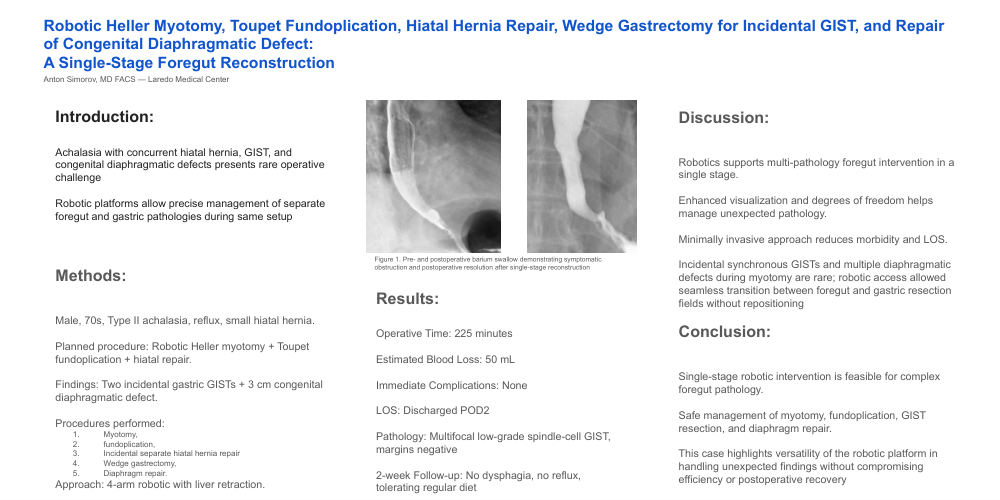
Methods: Male, 70s, Type II achalasia, reflux, small hiatal hernia. Planned procedure: Robotic Heller myotomy + Toupet fundoplication + hiatal repair. Findings: Two incidental gastric GISTs + 3 cm congenital diaphragmatic defect. Procedures performed: 1. Myotomy, 2. fundoplication, 3. Incidental separate hiatal hernia repair 4. Wedge gastrectomy, 5. Diaphragm repair. Approach: 4-arm robotic with liver retraction
Results: Operative Time: 225 minutes Estimated Blood Loss: 50 mL Immediate Complications: None LOS: Discharged POD2 Pathology: Multifocal low-grade spindle-cell GIST, margins negative 2-week Follow-up: No dysphagia, no reflux, tolerating regular diet
Discussion: Robotics supports multi-pathology foregut intervention in a single stage. Enhanced visualization and degrees of freedom helps manage unexpected pathology. Minimally invasive approach reduces morbidity and LOS. Incidental synchronous GISTs and multiple diaphragmatic defects during myotomy are rare; robotic access allowed seamless transition between foregut and gastric resection fields without repositioning
Conclusion: Single-stage robotic intervention is feasible for complex foregut pathology. Safe management of myotomy, fundoplication, GIST resection, and diaphragm repair. This case highlights versatility of the robotic platform in handling unexpected findings without compromising efficiency or postoperative recovery