875 posters, 25 topics, 3,440 authors, 1,061 institutions
ePostersLive by SciGen Technologies S.A. All rights reserved.
SAGES 2026 Annual Meeting Emerging Technology Session
March 25-28, 2026 | Tampa, FL, USA

P556
ENDOSCOPIC MANAGEMENT OF POST-CHOLECYSTECTOMY BILE LEAKS: A SINGLE CENTER EXPERIENCE
Poster Presenter
Authors
Affiliations
Part of Topic
Flexible Endoscopy
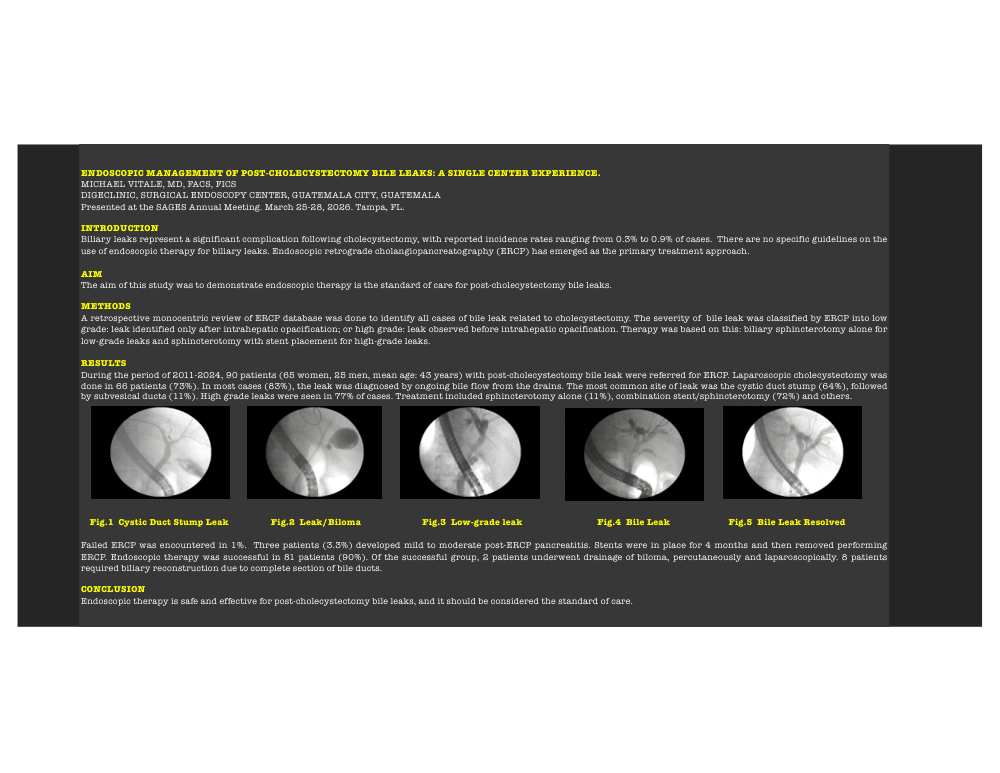
Background: Biliary leaks represent a significant complication following cholecystectomy, with reported incidence rates ranging from 0.3% to 0.9% of cases. There are no specific guidelines on the use of endoscopic therapy for biliary leaks. Endoscopic retrograde cholangiopancreatography (ERCP) has emerged as the primary treatment approach. The aim of this study was to demonstrate endoscopic therapy is the standard of care for post-cholecystectomy bile leaks.
Methods: A retrospective monocentric review of ERCP database was done to identify all cases of bile leak related to cholecystectomy. The severity of bile leak was classified by ERCP into low grade (leak identified only after intrahepatic opacification) or high grade (leak observed before intrahepatic opacification). Therapy was based on this: biliary sphincterotomy alone for low-grade leaks and sphincterotomy with stent placement for high-grade leaks.
Results: During the period of 2011-2024, 90 patients (65 women, 25 men; mean age, 43 years) with post-cholecystectomy bile leak were referred for ERCP. Laparoscopic cholecystectomy was done in 66 patients (73%). In most cases (83%), the leak was diagnosed by ongoing bile flow from the drains. The most common site of leak was the cystic duct stump (64%) followed by subvesical ducts (11%). High grade leaks were seen in 77% of cases. Treatment included sphincterotomy alone (11%), combination stent/sphincterotomy (72%) and others. Failed ERCP was encountered in 1%. Endoscopic therapy was successful in 81 patients (90%). Of the successful group, 2 patients underwent drainage of biloma, percutaneously and laparoscopically. 8 patients required biliary reconstruction due to complete section of bile ducts. Three patients (3.3%) developed mild to moderate post-ERCP pancreatitis.
Conclusion: Endoscopic therapy is safe and effective for post-cholecystectomy biliary leaks and should include temporary placement of a biliary stent.