875 posters, 25 topics, 3,440 authors, 1,061 institutions
ePostersLive by SciGen Technologies S.A. All rights reserved.
SAGES 2026 Annual Meeting Emerging Technology Session
March 25-28, 2026 | Tampa, FL, USA

P553
POEM is Associated with Similar Short- and Long-term Outcomes when Stratified by Achalasia Subtype
Poster Presenter
Authors
Kayvan Barekatain, Natalie N Chakraborty, Emily F Simon, Joshua L Lyons, Christina S Boutros, Trisha Lal, Ayesha Siddiq, Maham Babur, Hamza N Chatha, Saher-Zahra S Khan, Patrick M Wieland, Jamie R Benson, Nicolette M Winder, Samuel J Zolin, Jeffrey Marks
Affiliations
University Hospitals Cleveland Medical Center, Case Western Reserve University School of Medicine
Part of Topic
Flexible Endoscopy
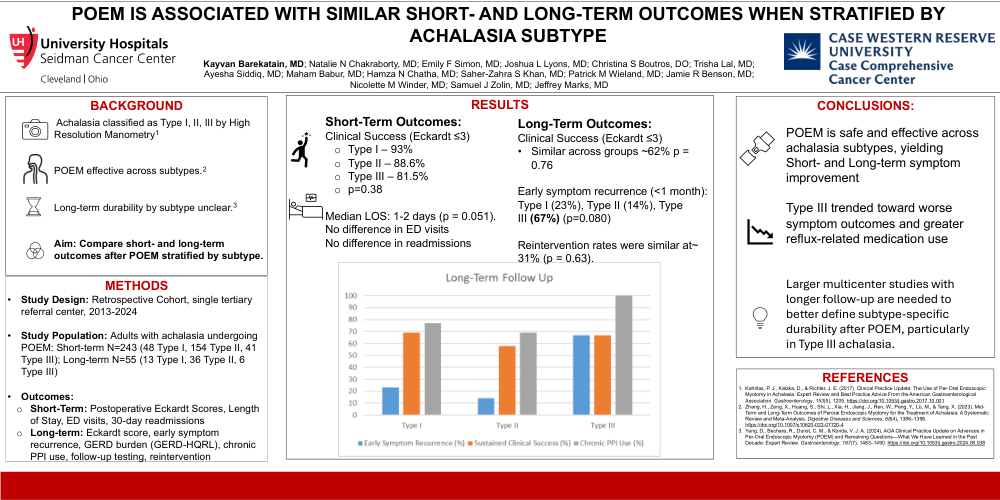
POEM IS ASSOCIATED WITH SIMILAR SHORT- AND LONG-TERM OUTCOMES WHEN STRATIFIED BY ACHALASIA SUBTYPE
Background:
Achalasia classified as Type I, II, III by HighResolution Manometry1
POEM effective across subtypes.2
Long-term durability by subtype unclear.3
Aim: Compare short- and long-term outcomes after POEM stratified by subtype.
METHODS: Study Design: Retrospective Cohort, single tertiaryreferral center, 2013-2024. Study Population: Adults with achalasia undergoingPOEM: Short-term N=243 (48 Type I, 154 Type II, 41Type III); Long-term N=55 (13 Type I, 36 Type II, 6Type III). Outcomes: Short-Term: Postoperative Eckardt Scores, Lengthof Stay, ED visits, 30-day readmissions Long-term: Eckardt score, early symptomrecurrence, GERD burden (GERD-HQRL), chronicPPI use, follow-up testing, reintervention
Results:Short-Term Outcomes:Clinical Success (Eckardt ≤3): Type I – 93%, Type II – 88.6%, Type III – 81.5%, p=0.38. Median LOS: 1-2 days (p = 0.051). No difference in ED visits. No difference in readmissions
Long-Term Outcomes: Clinical Success (Eckardt ≤3): Similar across groups ~62% p = 0.76. Early symptom recurrence (<1 month): Type I (23%), Type II (14%), Type III (67%) (p=0.080). Reintervention rates were similar at~ 31% (p = 0.63).
Conclusions: POEM is safe and effective across achalasia subtypes, yielding Short- and Long-term symptom improvement. Type III trended toward worse symptom outcomes and greater reflux-related medication use. Larger multicenter studies with longer follow-up are needed to better define subtype-specific durability after POEM, particularly in Type III achalasia.