875 posters, 25 topics, 3,440 authors, 1,061 institutions
ePostersLive by SciGen Technologies S.A. All rights reserved.
SAGES 2026 Annual Meeting Emerging Technology Session
March 25-28, 2026 | Tampa, FL, USA

P548
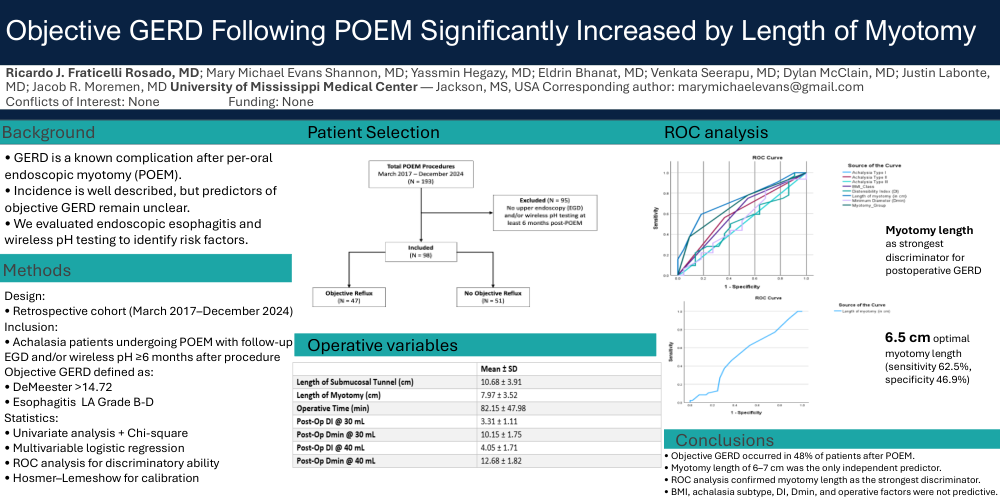
OBJECTIVE GERD FOLLOWING POEM SIGNIFICANTLY INCREASED BY LENGTH OF MYOTOMY
Poster Presenter
Part of Topic
Flexible Endoscopy
Objective GERD Following POEM Significantly Increased by Length of Myotomy
Ricardo J. Fraticelli Rosado, MD; Mary Michael Evans Shannon, MD; Yassmin Hegazy, MD; Eldrin Bhanat, MD; Venkata
Seerapu, MD; Dylan McClain, MD; Justin Labonte, MD; Jacob R. Moremen, MD University of Mississippi Medical Center —
Jackson, MS, USA Corresponding author: marymichaelevans@gmail.com Conflicts of Interest: None Funding:
None
Background:
• GERD is a known complication after per‑oral endoscopic
myotomy (POEM).
• Incidence is well described, but predictors of objective
GERD remain unclear.
• We evaluated endoscopic esophagitis and wireless pH
testing to identify risk factors.
Methods
Design:
• Retrospective cohort (March 2017–December 2024)
Inclusion:
• Achalasia patients undergoing POEM with follow‑up
EGD and/or Bravo pH ≥6 months
Objective GERD defined as:
• DeMeester >14.72
• Endoscopic esophagitis
Statistics:
• Univariate analysis + Chi‑square
• Multivariable logistic regression
• ROC analysis for discriminatory ability
• Hosmer–Lemeshow for calibration
Conclusions
• Objective GERD occurred in 48% of patients after POEM.
• Myotomy length of 6–7 cm was the only independent predictor.
• ROC analysis confirmed myotomy length as the strongest discriminator.
• BMI, achalasia subtype, DI, Dmin, and operative factors were not predictive.