875 posters, 25 topics, 3,440 authors, 1,061 institutions
ePostersLive by SciGen Technologies S.A. All rights reserved.
SAGES 2026 Annual Meeting Emerging Technology Session
March 25-28, 2026 | Tampa, FL, USA

P529
BEYOND HUMAN CODING: COMPARING HUMAN EXPERTS VS ARTIFICIAL INTELLIGENCE IN INTERPRETING SURGEON-PROVIDED FEEDBACK DURING RESIDENT-PERFORMED LAPAROSCOPIC CHOLECYSTECTOMY
Poster Presenter
Part of Topic
Education / Simulation
BEYOND HUMAN CODING: COMPARING HUMAN EXPERTS VS ARTIFICIAL INTELLIGENCE IN INTERPRETING SURGEON-PROVIDED FEEDBACK DURING RESIDENT-PERFORMED LAPAROSCOPIC CHOLECYSTECTOMY
Rui-Wamba J, MD; Vildósola C; Becker B, MD; Aguilera M, MD; Castiglioni E, MD; Gaete M, MD, MSc; Jarry C, MD, MSc; Varas J, MD, MSc; Pontificia Universidad Católica de Chile
INTRODUCTION
• Structured feedback after resident-performed laparoscopic cholecystectomy can reveal recurrent technical errors and teachable micro-skills.
• Human coding remains the educational gold standard, but it is labor-intensive and difficult to scale.
• Large language models may enable rapid, taxonomy-based analysis of narrative faculty feedback.
OBJECTIVE
• Compare qualitative concordance and complementarity between human experts and ChatGPT when interpreting surgeon-provided feedback during resident-performed cholecystectomy.
METHODS
•Methodological comparative study of 46 laparoscopic cholecystectomies performed by 20 residents.
• Source material: asynchronous expert feedback linked to video review.
• Human pathway: triple independent coding with adjudication.
• AI pathway: ChatGPT multilabel classification using a predefined surgical taxonomy.
• Compared macro-categories, timestamped representative examples, and coding density.
RESULTS
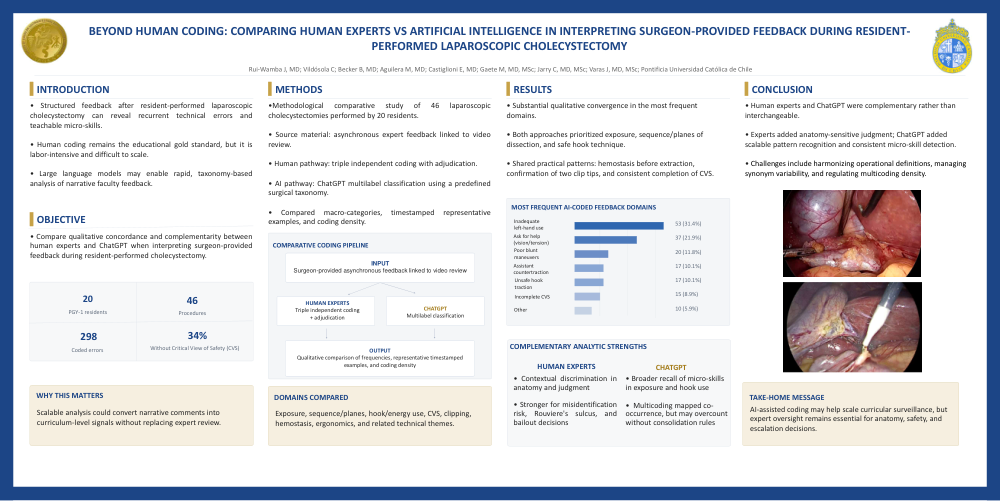
• Substantial qualitative convergence in the most frequent domains.
• Both approaches prioritized exposure, sequence/planes of dissection, and safe hook technique.
• Shared practical patterns: hemostasis before extraction, confirmation of two clip tips, and consistent completion of CVS
CONCLUSION
• Human experts and ChatGPT were complementary rather than interchangeable.
• Experts added anatomy-sensitive judgment; ChatGPT added scalable pattern recognition and consistent micro-skill detection.
• Challenges include harmonizing operational definitions, managing synonym variability, and regulating multicoding density.
TAKE-HOME MESSAGE
AI-assisted coding may help scale curricular surveillance, but expert oversight remains essential for anatomy, safety, and escalation decisions.