875 posters, 25 topics, 3,440 authors, 1,061 institutions
ePostersLive by SciGen Technologies S.A. All rights reserved.
SAGES 2026 Annual Meeting Emerging Technology Session
March 25-28, 2026 | Tampa, FL, USA

P490
Robot as the Great Equalizer: Rethinking Psychomotor Barriers in Surgical Training
Poster Presenter
Authors
William T Head, Kristen Quinn, Claire Griffiths, Syed Husain
Affiliations
Center for Abdominal Core Health, The Ohio State University Wexner Medical Center, Columbus, OH, Department of Surgery, The Ohio State University Wexner Medical Center, Columbus, OH, Department of Surgical Oncology, The University of Texas MD Anderson Cancer Center, Houston, TX, Department of Family Medicine, Grant Medical Center, Columbus, OH
Part of Topic
Education / Simulation
Background
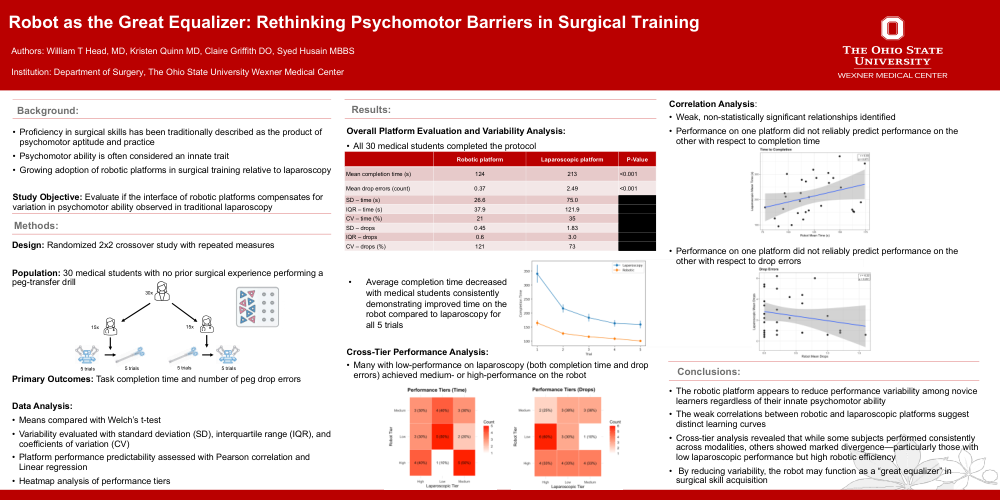
Proficiency in surgical skills has been traditionally described as the product of psychomotor aptitude and practice, with psychomotor ability often considered an innate trait. Increasing adoption of robotic platforms in surgical training raises the question: can the intuitive interface of robotic platforms compensate for variation in psychomotor ability observed in traditional laparoscopy.
Methods
Thirty medical students with no prior surgical experience were randomized into two arms. Arm 1 performed peg transfer task on a robotic platform first followed by laparoscopy. Arm 2 performed the tasks in reversed order. Each subject completed five consecutive trials perplatform. Task completion time and number of peg drop errors were recorded. Means were compared with Welch’s t-tests. Variability was evaluated with descriptive statistics: standard deviation (SD), interquartile range (IQR), and coefficients of variation (CV). Platform performance predictability was assessed with Pearson correlation and Linear regression.Performance tiers (High, Medium, Low) were compared across platforms using heatmap analysis.
Results
All thirty medical students completed the protocol. The mean completion time was significantly longer, and mean drop errors were significantly higher on the laparoscopic platform (213s vs 124s; p<0.001 and 2.49 vs 0.37; p<0.001, respectively).
The robotic platform demonstrated significantly lower variability for completion time (SD: 26.6s vs 75.0s; IQR: 37.9s vs. 121.9s; CV: 21% vs. 35%). Drop errors were also less variable in absolute terms on the robot (SD 0.45 vs 1.83; IQR 0.6 vs 3.0), though relative variability was greater given the low mean (CV 121% vs 73%).
The correlation analysis showed weak, nonsignificant relationships. Performance on one platform did not reliably predict performance on the other with respect to both completion time (Pearson r=0.33, p=0.071; R2=0.11) and drop errors (Pearson r=-0.22, p=0.25; R2=0.05). Cross-tier analysis revealed that many low-performing laparoscopic trainees achieved medium or high performance on the robot, suggesting divergent skill profiles.
Conclusion
The robotic platform appears to reduce performance variability among novice learners regardless of their innate psychomotor ability. The weak correlations between robotic and laparoscopic platforms suggest distinct learning curves. Cross-tier analysis revealed that while some subjects performed consistently across modalities, others showed marked divergence—particularly those with low laparoscopic performance but high robotic efficiency. By reducing variability, the robot may function as a “great equalizer” in surgical skill acquisition.