875 posters, 25 topics, 3,440 authors, 1,061 institutions
ePostersLive by SciGen Technologies S.A. All rights reserved.
SAGES 2026 Annual Meeting Emerging Technology Session
March 25-28, 2026 | Tampa, FL, USA

P519
From Box-Trainers to Robotics: A Pilot Survey of Simulation-Based Surgical Training in Qatar
Poster Presenter
Authors
Nitasha Saleem, Hamza Bin Saleem, Usama Bin Saleem, Hussein Aly Touny, Syed Muhammad Ali
Affiliations
Part of Topic
Education / Simulation
Title:
From Box-Trainers to Robotics: A Pilot Survey of Simulation-Based Surgical Training in Qatar
Background:
For most surgical trainees, the first steps in learning laparoscopy begin in simulation labs before reaching the operating room. Simulation is now a cornerstone of surgical education worldwide, with programs like FLS and SAGES strongly endorsing its role in building safe, reproducible skills. In Qatar, trainees have access to box trainers, cadaveric, animal, and robotic labs, but availability is inconsistent, and no baseline data exist on how these opportunities are being used or how they shape confidence. This study set out to capture that landscape; to measure exposure, confidence, and barriers, and to highlight where our curriculum could be strengthened.
Methods:
We conducted a cross-sectional, anonymous survey of general surgery residents, fellows, and consultants across Hamad Medical Corporation in September 2025. The survey included demographics; exposure to different simulation modalities; confidence ratings across eight laparoscopic tasks (1–7 Likert scale); perceived transfer to the operating room; barriers; and preferences for hybrid curricula. Subgroup analyses were performed with Mann–Whitney U and Spearman correlation. Reliability was assessed with Cronbach’s α.
Results:
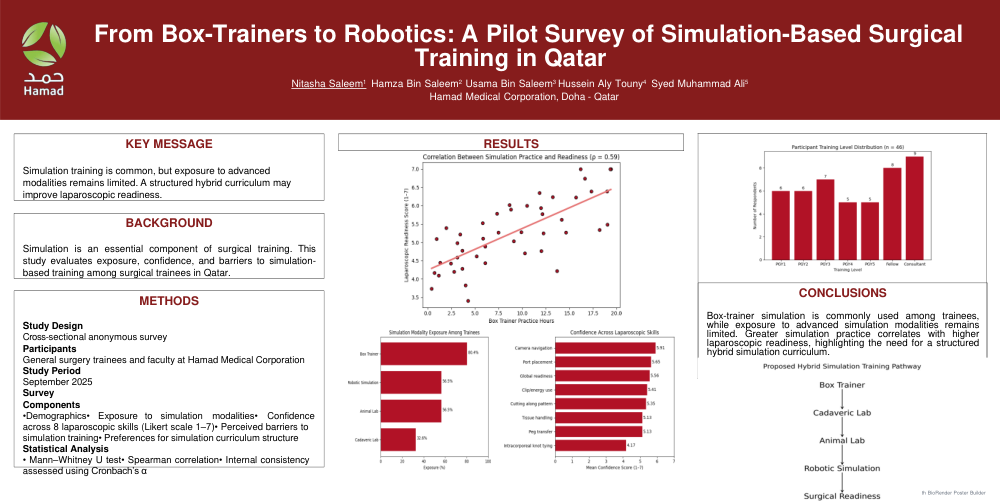
Forty-six responses were received (residents n≈29, fellows n=8, consultants n=9). Box-trainer use was common, but cadaveric, animal, and robotic exposure remained limited. Faculty supervision was variable. The most frequently cited barriers were lack of time, scheduling conflicts, and restricted lab access.
The confidence scale showed excellent internal consistency (Cronbach’s α=0.95). Median confidence across individual skills ranged 4–6, with global laparoscopic readiness at 6 (IQR 4–7). Readiness was significantly higher among seniors compared with juniors (median 7.0 vs 4.0; U=43, p<0.001). Those with external course exposure also reported higher readiness (median 7.0 vs 6.0; U=75, p=0.018). Greater box-trainer practice correlated strongly with readiness (Spearman ρ=0.59, p<0.001).
Conclusions:
This first study of its kind in Qatar highlights strong engagement with box-trainer simulation but limited exposure to cadaveric, animal, and robotic labs. Confidence increases with seniority, external exposure, and more hours of practice. The barriers identified point to structural challenges of time and access. These findings support developing a hybrid curriculum — structured, proficiency-based box training as the core, with cadaveric, animal, and robotic sessions as capstones. Aligning local curricula with international standards may enhance skill transfer, and larger multi-institutional studies are warranted to validate outcomes and inform regional and global surgical education strategies