875 posters, 25 topics, 3,440 authors, 1,061 institutions
ePostersLive by SciGen Technologies S.A. All rights reserved.
SAGES 2026 Annual Meeting Emerging Technology Session
March 25-28, 2026 | Tampa, FL, USA

P502
Exploring metrics of resident autonomy in the era of robotic surgery
Part of Topic
Education / Simulation
Exploring metrics of resident autonomy in the era of robotic surgery
Introduction
•Operative autonomy is an essential element of surgical residency training.
•Objective measurement of factors influencing autonomy remains difficult.
•Increasing integration of robotic platforms introduces another new, easily measurable variable.
•This study aims to identify patient, case, and operative factors associated with resident autonomy during inguinal hernia repair.
Methods and Procedures
•Resident operative participation (% of case performed) was used as a surrogate for operative autonomy.
•64 inguinal hernia repairs (20 laparoscopic, 44 robotic) were directly observed and resident-attending interactions, participation, and operative handoffs were documented
•Variables assessed included:
•Patient demographics
•Operative time
•Attending ratings (performance, case difficulty, prompting, specific procedural domains) and resident self-assessments (performance, confidence)
•Resident experience (number of prior laparoscopic and robotic cases)
•Statistical analysis:
•Beta regression was used to assess factors associated with resident participation.
•Univariate models were used to screen individual variable significance
•Seven variables were chosen for a multivariate model based on effect direction, significance, and educational relevance
Results
•Mean resident operative participation across 64 cases was 57% ± 23
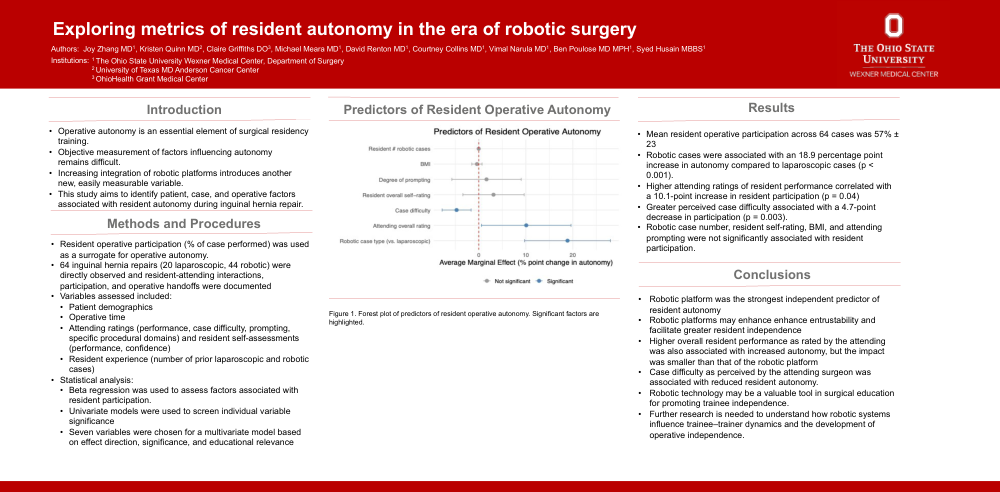
•Robotic cases were associated with an 18.9 percentage point increase in autonomy compared to laparoscopic cases (p < 0.001).
•Higher attending ratings of resident performance correlated with a 10.1-point increase in resident participation (p = 0.04)
•Greater perceived case difficulty associated with a 4.7-point decrease in participation (p = 0.003).
•Robotic case number, resident self-rating, BMI, and attending prompting were not significantly associated with resident participation.
Conclusions
•Robotic platform was the strongest independent predictor of resident autonomy
•Robotic platforms may enhance enhance entrustability and facilitate greater resident independence
•Higher overall resident performance as rated by the attending was also associated with increased autonomy, but the impact was smaller than that of the robotic platform
•Case difficulty as perceived by the attending surgeon was associated with reduced resident autonomy.
•Robotic technology may be a valuable tool in surgical education for promoting trainee independence.
•Further research is needed to understand how robotic systems influence trainee–trainer dynamics and the development of operative independence.