875 posters, 25 topics, 3,440 authors, 1,061 institutions
ePostersLive by SciGen Technologies S.A. All rights reserved.
SAGES 2026 Annual Meeting Emerging Technology Session
March 25-28, 2026 | Tampa, FL, USA

P489
Surgeons Struggle Interpreting ICG Fluorescence Imaging During Laparoscopic Cholecystectomy
Poster Presenter
Part of Topic
Education / Simulation
Surgeons Struggle Interpreting Indocyanine Green (ICG) Fluorescence Imaging During Laparoscopic Cholecystectomy
Introduction:
•Visual misperception accounts for up to 97% of surgical errors in laparoscopic cholecystectomy1
•Eye-tracking studies show experts demonstrate more efficient gaze patterns (target-focused fixations, shorter fixation durations, faster orientation to relevant anatomy) compared to novices 2–5, though findings in video-based contexts are mixed 6–11
•ICG enhances visualization of biliary tree12 , but alters the appearance of the surgical scene
Objective:Explore how expertise level and imaging modality (white light vs. ICG fluorescence) influence anatomical identification accuracy and eye-tracking measures during laparoscopic cholecystectomy video viewing
Methods:
•61 surgeons (20 experts, 16 intermediates, 25 novices) recruited at SAGES 2025; grouped by years of experience
•Task: Viewed video clips (white light & ICG). Videos paused randomly for verbal anatomical identification. Eye movements recorded at 120 Hz (Tobii Pro Fusion) (Fig. 1)
•Measures: Anatomical identification accuracy (correct, suggestive, and incorrect) and eye-tracking measures
•The suggestive category included those who verbalized uncertainty by proposing one or more possible anatomical structures
Results:
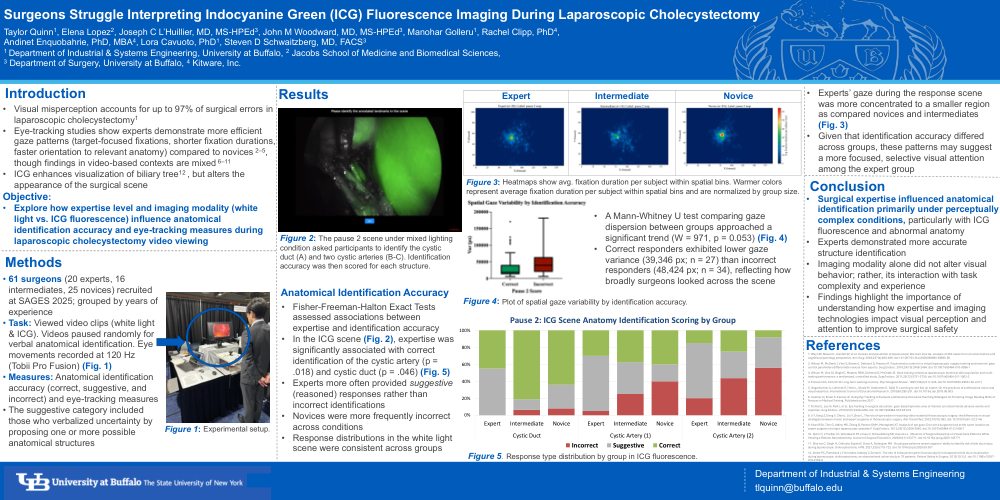
•Fisher-Freeman-Halton Exact Tests assessed associations between expertise and identification accuracy
•In the ICG scene (Fig. 2), expertise was significantly associated with correct identification of the cystic artery (p = .018) and cystic duct (p = .046) (Fig. 5)
•Experts more often provided suggestive (reasoned) responses rather than incorrect identifications
•Novices were more frequently incorrect across conditions
•Response distributions in the white light scene were consistent across groups
•A Mann-Whitney U test comparing gaze dispersion between groups approached a significant trend (W = 971, p = 0.053) (Fig. 4)
•Correct responders exhibited lower gaze variance (39,346 px; n = 27) than incorrect responders (48,424 px; n = 34), reflecting how broadly surgeons looked across the scene
•Experts’ gaze during the response scene was more concentrated to a smaller region as compared novices and intermediates (Fig. 3)
•Given that identification accuracy differed across groups, these patterns may suggest a more focused, selective visual attention among the expert group
Conlcusion:
•Surgical expertise influenced anatomical identification primarily under perceptually complex conditions, particularly with ICG fluorescence and abnormal anatomy
•Experts demonstrated more accurate structure identification
•Imaging modality alone did not alter visual behavior; rather, its interaction with task complexity and experience
•Findings highlight the importance of understanding how expertise and imaging technologies impact visual perception and attention to improve surgical safety