875 posters, 25 topics, 3,440 authors, 1,061 institutions
ePostersLive by SciGen Technologies S.A. All rights reserved.
SAGES 2026 Annual Meeting Emerging Technology Session
March 25-28, 2026 | Tampa, FL, USA

P135
Transabdominal Wall Sutures for Prevention of PEG Tube Dislodgement: a Feasibility Study
Poster Presenter
Authors
Affiliations
Part of Topic
Acute Care
Introduction
•Percutaneous endoscopic gastrostomy (PEG) tube dislodgement is a rare, but devastating complication
•Are transabdominal wall sutures (TWS) a feasible technique for preventing PEG tube dislodgement?
Methods
•Single-center retrospective study of adults who underwent PEG placement from November 2023 to March 2025
•Demographics, clinical characteristics, and outcomes compared between standard PEG (stand-PEG) and PEG placement with TWS (PEG-TWS)
Surgical Technique
•All PEG tubes placed via pull technique
•Transabdominal wall sutures:
•were placed under direct visualization using a gastroscope after PEG placement
•were placed using “Suture Passer” like needle
•used only absorbable sutures
Results
•116 patients met inclusion
•Median age 70 years
•58.6% male
•Median BMI of 24.6
•10 patients (8.6%) underwent laparoscopic-assisted PEG placement
•Complications included dislodgement, tube malfunction, peristomal and intraabdominal leakage, aspiration, bleeding, infection, ileus, buried bumper syndrome, unplanned ICU admission, organ dysfunction, sepsis
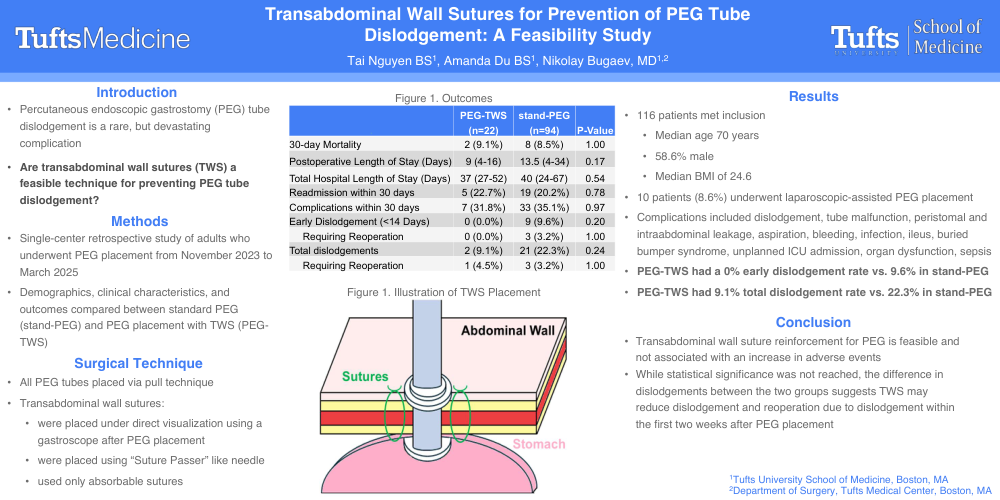
•PEG-TWS had a 0% early dislodgement rate vs. 9.6% in stand-PEG
•PEG-TWS had 9.1% total dislodgement rate vs. 22.3% in stand-PEG
Conclusion
•Transabdominal wall suture reinforcement for PEG is feasible and not associated with an increase in adverse events
•While statistical significance was not reached, the difference in dislodgements between the two groups suggests TWS may reduce dislodgement and reoperation due to dislodgement within the first two weeks after PEG placement