119 posters, 6 topics, 524 authors, 243 institutions
ePostersLive by SciGen Technologies S.A. All rights reserved.
RCR Global AI Conference 2026
29-30 June, 2026 | QEII Centre, Westminster

197
<p>Post-Market Surveillance of Generative AI Reporting Tools: A Comparative Error Taxonomy Analysis with Diagnostic Imaging AI</p>
Poster Presenter
Authors
Affiliations
Part of Topic
Transforming practice and leadership: pilot or test data on implementation of AI into clinical practice, clinical feedback or patient perspectives
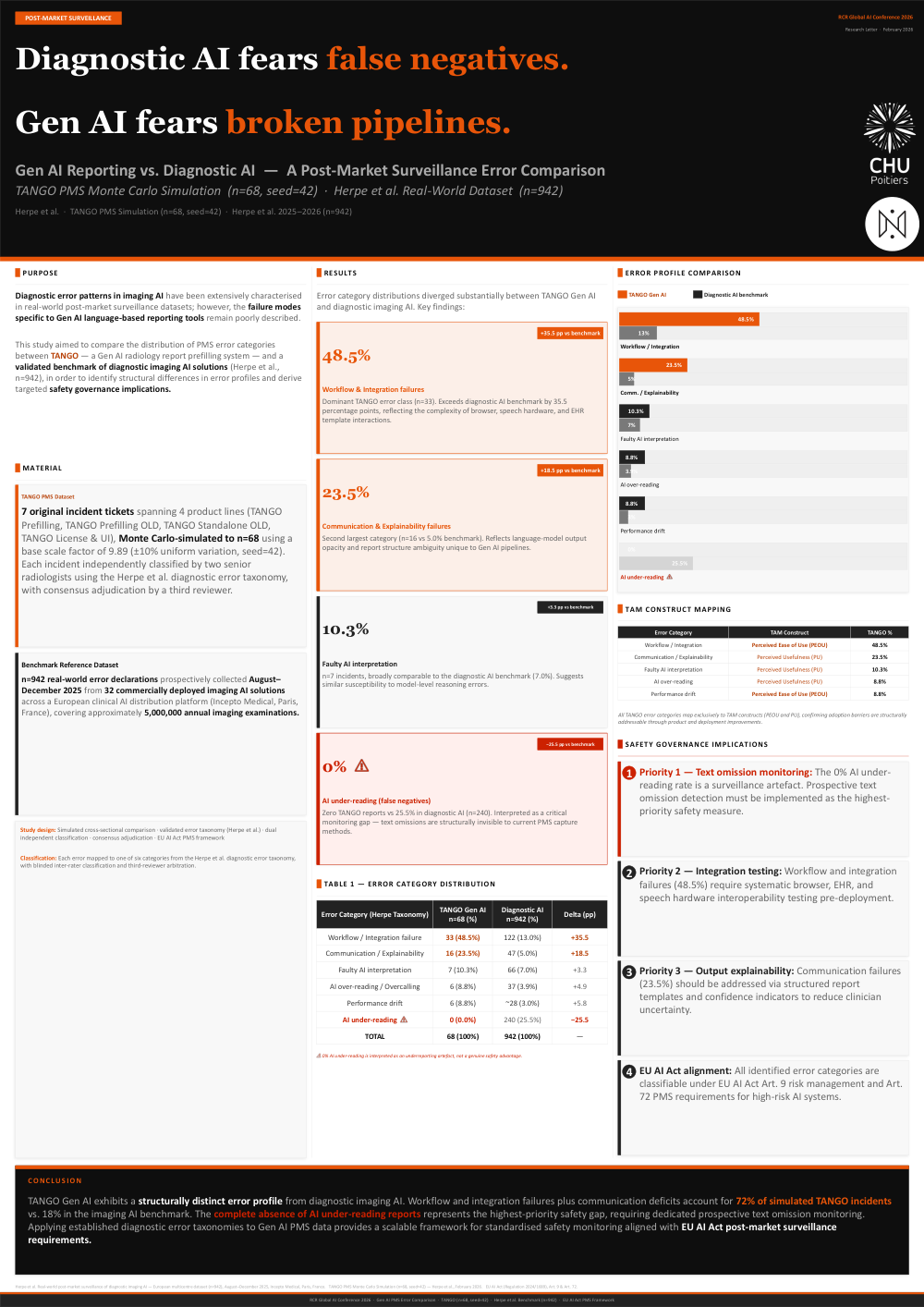
Gen AI Reporting vs. Diagnostic AI — A Post-Market Surveillance Error Comparison
Authors Herpe, Rheins, Cohen, Noguero. · TANGO PMS Simulation (n=68, seed=42) · Herpe et al. Benchmark (n=942) · February 2026
Summary Using a validated diagnostic error taxonomy, we compared failure modes between TANGO — a Gen AI radiology report prefilling system — and 942 real-world incidents from 32 deployed imaging AI solutions. Workflow and integration failures dominated TANGO errors (48.5% vs. 13.0% benchmark). Communication and explainability deficits accounted for a further 23.5% (vs. 5.0%). Critically, AI under-reading — the leading failure mode in diagnostic AI (25.5%) — was entirely absent in TANGO reports, interpreted as a surveillance blind spot, not a safety advantage. All TANGO error categories mapped exclusively to TAM constructs, confirming barriers are structurally addressable. A scalable PMS framework aligned with EU AI Act requirements is proposed.
Keywords generative AI, radiology reporting, post-market surveillance, diagnostic error, TANGO, AI safety, EU AI Act, Technology Acceptance Model, false negatives, workflow integration, error taxonomy