119 posters, 6 topics, 524 authors, 243 institutions
ePostersLive by SciGen Technologies S.A. All rights reserved.
RCR Global AI Conference 2026
29-30 June, 2026 | QEII Centre, Westminster

119
<p>Shifting Horizons: How Pakistani Radiologists in Pakistan and the UK View AI’s Impact on Radiology Practice</p>
Poster Presenter
Authors
Ali Mansoor, Rabia Shaukat, Suneela Shaukat, Sadaf Arooj, Sarah Harrison
Affiliations
Eastern Medical Technology Services, Lahore General Hospital / Ameer ud Din Medical College/ Post Graduate Medical Institute, Eastern Medical Technology Services, Torbay and South Devon Hospital, UK, Jinnah Hospital/ Allama Iqbal Medical College, Lahore
Part of Topic
Transforming practice and leadership: pilot or test data on implementation of AI into clinical practice, clinical feedback or patient perspectives
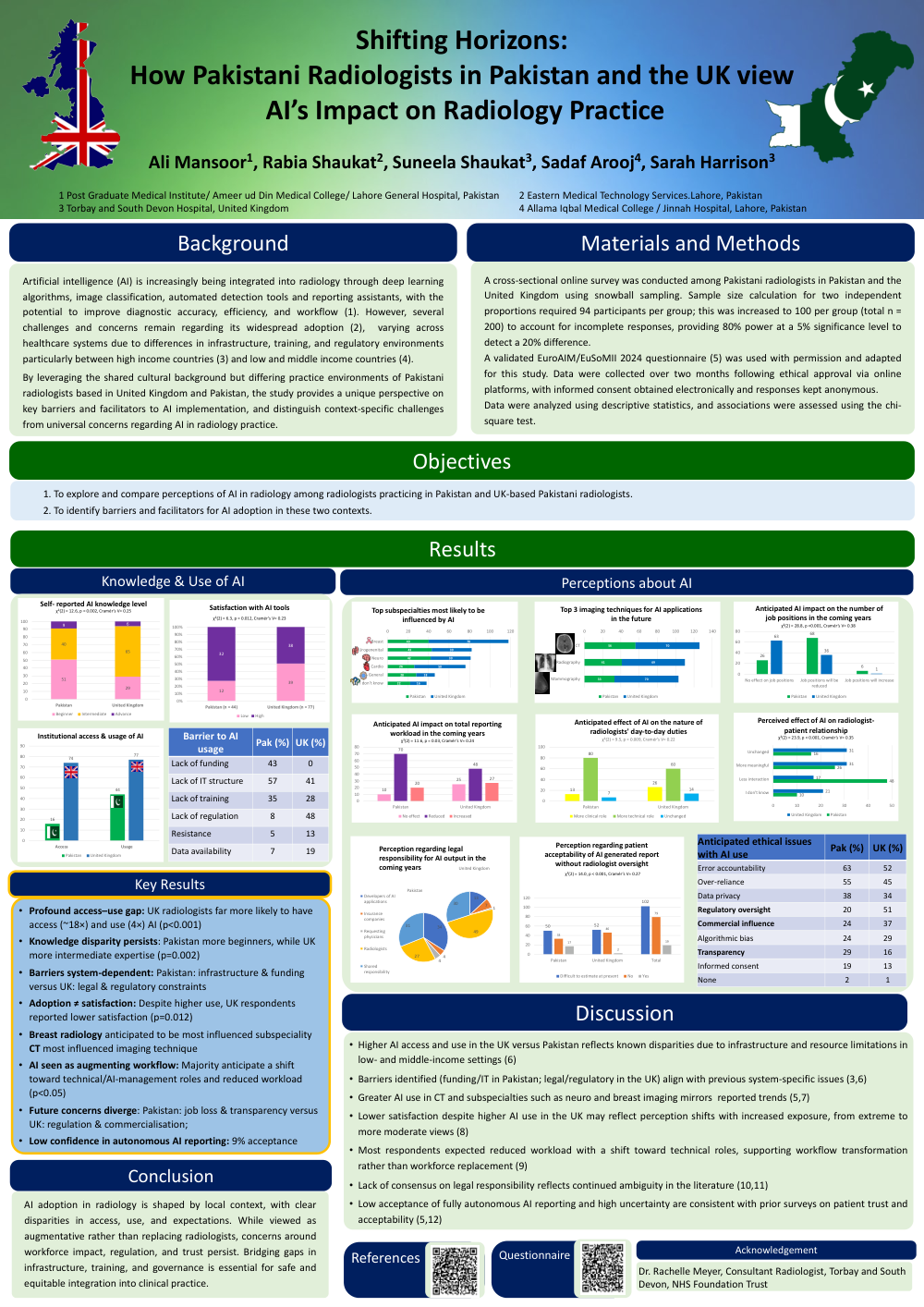
Shifting Horizons: How Pakistani Radiologists in Pakistan and the UK view AI’s Impact on Radiology Practice
Background:
Artificial intelligence (AI) is increasingly being integrated into radiology through deep learning algorithms, image classification, automated detection tools and reporting assistants, with the potential to improve diagnostic accuracy, efficiency, and workflow (1). However, several challenges and concerns remain regarding its widespread adoption (2), varying across healthcare systems due to differences in infrastructure, training, and regulatory environments particularly between high income countries (3) and low and middle income countries (4). By leveraging the shared cultural background but differing practice environments of Pakistani radiologists based in United Kingdom and Pakistan, the study provides a unique perspective on key barriers and facilitators to AI implementation, and distinguish context-specific challenges from universal concerns regarding AI in radiology practice.
Materials and Methods:
A cross-sectional online survey was conducted among Pakistani radiologists in Pakistan and the United Kingdom using snowball sampling. Sample size calculation for two independent proportions required 94 participants per group; this was increased to 100 per group (total n = 200) to account for incomplete responses, providing 80% power at a 5% significance level to detect a 20% difference. A validated EuroAIM/EuSoMII 2024 questionnaire (5) was used with permission and adapted for this study. Data were collected over two months following ethical approval via online platforms, with informed consent obtained electronically and responses kept anonymous. Data were analyzed using descriptive statistics, and associations were assessed using the chi-square test.
Key results:
•Profound access–use gap: UK radiologists far more likely to have access (~18×) and use (4×) AI (p<0.001)
•Knowledge disparity persists: Pakistan more beginners, while UK more intermediate expertise (p=0.002)
•Barriers system-dependent: Pakistan: infrastructure & funding versus UK: legal & regulatory constraints
•Adoption ≠ satisfaction: Despite higher use, UK respondents reported lower satisfaction (p=0.012)
•Breast radiology anticipated to be most influenced subspeciality CT most influenced imaging technique
•AI seen as augmenting workflow: Majority anticipate a shift toward technical/AI-management roles and reduced workload (p<0.05)
•Future concerns diverge: Pakistan: job loss & transparency versus UK: regulation & commercialisation;
•Low confidence in autonomous AI reporting: 9% acceptance
Discussion:
•Higher AI access and use in the UK versus Pakistan reflects known disparities due to infrastructure and resource limitations in low- and middle-income settings (6)
•Barriers identified (funding/IT in Pakistan; legal/regulatory in the UK) align with previousl system-specific issues (3,6)
•Greater AI use in CT and subspecialties such as neuro and breast imaging mirrors reported ternds (5,7)
•Lower satisfaction despite higher AI use in the UK may reflect perception shifts with increased exposure, from extreme to more moderated views (8)
•Most respondents expected reduced workload with a shift toward technical roles, supporting workflow transformation rather than workforce replacement (9)
•Lack of consensus on legal responsibility reflects continued ambiguity in the literature (10,11)
•Low acceptance of fully autonomous AI reporting and high uncertainty are consistent with prior surveys on patient trust and acceptability (5,12)
Conclusion:
AI adoption in radiology is shaped by local context, with clear disparities in access, use, and expectations. While viewed as augmentative rather than replacing radiologists, concerns around workforce impact, regulation, and trust persist. Bridging gaps in infrastructure, training, and governance is essential for safe and equitable integration into clinical practice.