119 posters, 6 topics, 524 authors, 243 institutions
ePostersLive by SciGen Technologies S.A. All rights reserved.
RCR Global AI Conference 2026
29-30 June, 2026 | QEII Centre, Westminster

151
<p>Integrating an Institutional Large Language Model into Magnetic Resonance Imaging Requests</p>
Poster Presenter
Part of Topic
Transforming practice and leadership: pilot or test data on implementation of AI into clinical practice, clinical feedback or patient perspectives
Background
Objectives
Initial Insights Into a Secure Large Language Model for MRI Examination Requests: A Retrospective Study
James Thomas Patrick Decourcy Hallinan¹˒², MBChB; Naomi Wenxin Leow³, BComp, MComp; Yi Xian Low¹, MBBS; Aric Lee¹, MBBS; Wilson Ong¹, MBBS; Matthew Ding Zhou Chan¹, BmedSc, MD; Gordan Toh Cheong Zheng⁵, Diploma in Biomedical Science; Ganakirthana Kalpenya Devi¹, MbBchBao; Stephanie Shengjie He¹, MBBS; Daniel De-Liang Loh¹, MBBS, MRCS; Desmond Shi Wei Lim¹, MBBS; Xi Zhen Low¹, MBBS; Mei Chin Lim¹, MBBS; Clement Yong¹, MBBS; Weizhong Jonathan Sng¹, MBBS; Ee Chin Teo¹, MMRT; Jiong Hao Tan⁴, MBBS, MMed, MRCS; Naresh Kumar⁴, MBBS, MS, DNB, DM; Andrew Makmur¹˒³, BmedSc, MBBS, MMed; Yonghan Ting¹, MBBS
¹ Dept. of Diagnostic Imaging, NUH, Singapore
² Dept. of Diagnostic Radiology, YLL School of Medicine, NUS, Singapore
³ AI Office, NUHS, Singapore
⁴ National University Spine Institute, NUH, Singapore
⁵ Republic Polytechnic, Singapore
For all MRI subspecialty modalities (Musculoskeletal, Neuroradiology, body):
- Does sLLM augmentation improve clinical information quality of MRI examination requests?
- Can sLLM match radiologist-level MRI protocol accuracy?
Main Findings
Discussion
Materials and Methods
Limitations
Conclusion
Rule-Based Protocol Assignment
Maps extracted elements → MRI region, coverage & contrast using institutional protocol library
Institutional sLLM based on Claude 3.5 · Temp 0
RI-RADS graded [1] · Retrospective
Sept 2023 – Jul 2024
n= 608 MRIs · 528 patients
| Grade | Description | Information included in the requisition |
| RI-RADS A | Adequate | All key categories of information included. |
| RI-RADS B | Barely adequate | All key categories of information included, some clinical findings missing. |
| RI-RADS C | Considerably limited | Two categories of information included. |
| RI-RADS D | Deficient | One or no category of information included. |
- Incomplete Magnetic Resonance Imaging (MRI) requests lead to suboptimal protocols, repeat studies & reduced accuracy.
- LLMs can interpret clinical text at scale, but privacy constraints limit direct clinical use
- Institutional sLLMs operate behind firewalls, protecting patient data while enabling augmentation
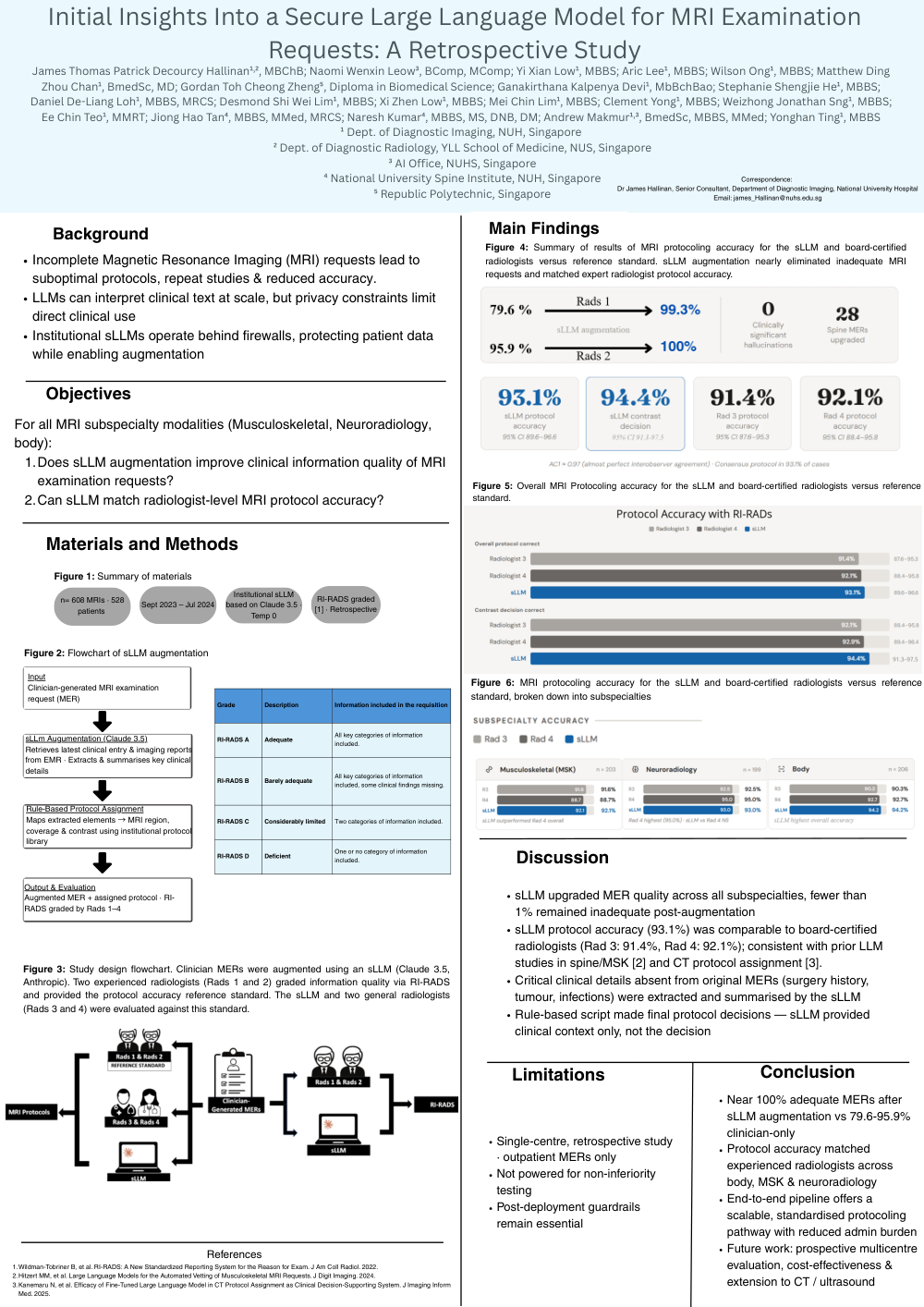
- sLLM upgraded MER quality across all subspecialties, fewer than 1% remained inadequate post-augmentation
- sLLM protocol accuracy (93.1%) was comparable to board-certified radiologists (Rad 3: 91.4%, Rad 4: 92.1%); consistent with prior LLM studies in spine/MSK [2] and CT protocol assignment [3].
- Critical clinical details absent from original MERs (surgery history, tumour, infections) were extracted and summarised by the sLLM
- Rule-based script made final protocol decisions — sLLM provided clinical context only, not the decision
- Near 100% adequate MERs after sLLM augmentation vs 79.6-95.9% clinician-only
- Protocol accuracy matched experienced radiologists across body, MSK & neuroradiology
- End-to-end pipeline offers a scalable, standardised protocoling pathway with reduced admin burden
- Future work: prospective multicentre evaluation, cost-effectiveness & extension to CT / ultrasound
- Single-centre, retrospective study · outpatient MERs only
- Not powered for non-inferiority testing
- Post-deployment guardrails remain essential
References
- Wildman-Tobriner B, et al. RI-RADS: A New Standardized Reporting System for the Reason for Exam. J Am Coll Radiol. 2022.
- Hitzert MM, et al. Large Language Models for the Automated Vetting of Musculoskeletal MRI Requests. J Digit Imaging. 2024.
- Kanemaru N, et al. Efficacy of Fine-Tuned Large Language Model in CT Protocol Assignment as Clinical Decision-Supporting System. J Imaging Inform Med. 2025.
Correspondence:
Dr James Hallinan, Senior Consultant, Department of Diagnostic Imaging, National University Hospital
Email: james_Hallinan@nuhs.edu.sg
Input
Clinician-generated MRI examination request (MER)
sLLm Augumentation (Claude 3.5)
Retrieves latest clinical entry & imaging reports from EMR · Extracts & summarises key clinical details
Output & Evaluation
Augmented MER + assigned protocol · RI-RADS graded by Rads 1–4
Figure 1: Summary of materials
Figure 2: Flowchart of sLLM augmentation
Figure 3: Study design flowchart. Clinician MERs were augmented using an sLLM (Claude 3.5, Anthropic). Two experienced radiologists (Rads 1 and 2) graded information quality via RI-RADS and provided the protocol accuracy reference standard. The sLLM and two general radiologists (Rads 3 and 4) were evaluated against this standard.
Figure 4: Summary of results of MRI protocoling accuracy for the sLLM and board-certified radiologists versus reference standard. sLLM augmentation nearly eliminated inadequate MRI requests and matched expert radiologist protocol accuracy.
Figure 5: Overall MRI Protocoling accuracy for the sLLM and board-certified radiologists versus reference standard.
Figure 6: MRI protocoling accuracy for the sLLM and board-certified radiologists versus reference standard, broken down into subspecialties