119 posters, 6 topics, 524 authors, 243 institutions
ePostersLive by SciGen Technologies S.A. All rights reserved.
RCR Global AI Conference 2026
29-30 June, 2026 | QEII Centre, Westminster

135
<p>Enhancing Quality of Screening Mammography in University Training Centers Through AI Integration: A Prospective Analysis</p>
Poster Presenter
Authors
Elham Keshavarz, Masoumeh Gity, Mehran Arab Ahmadi, Melika Boroomand-Saboor, Hamed Dashti, Mandana Pourian
Affiliations
Shahid Beheshti University Of Medical Sciences, Tehran University Of Medical Sciences, Department of Computer Engineering, Sharif University of Technology, Shahid Beheshti University Of Medical Sciences
Part of Topic
Transforming practice and leadership: pilot or test data on implementation of AI into clinical practice, clinical feedback or patient perspectives
Enhancing Quality of Screening Mammography in University Training Centers Through AI Integration: A Prospective Analysis
Masoumeh. Gity, Mehran. Arab Ahmadi, Elham. Keshawarz, Melika. Boroomand-Saboor, Rassa. Ghavami Modegh, Hamed. Dashti, Mandana Pourian. Presenter: Elham Keshawarz
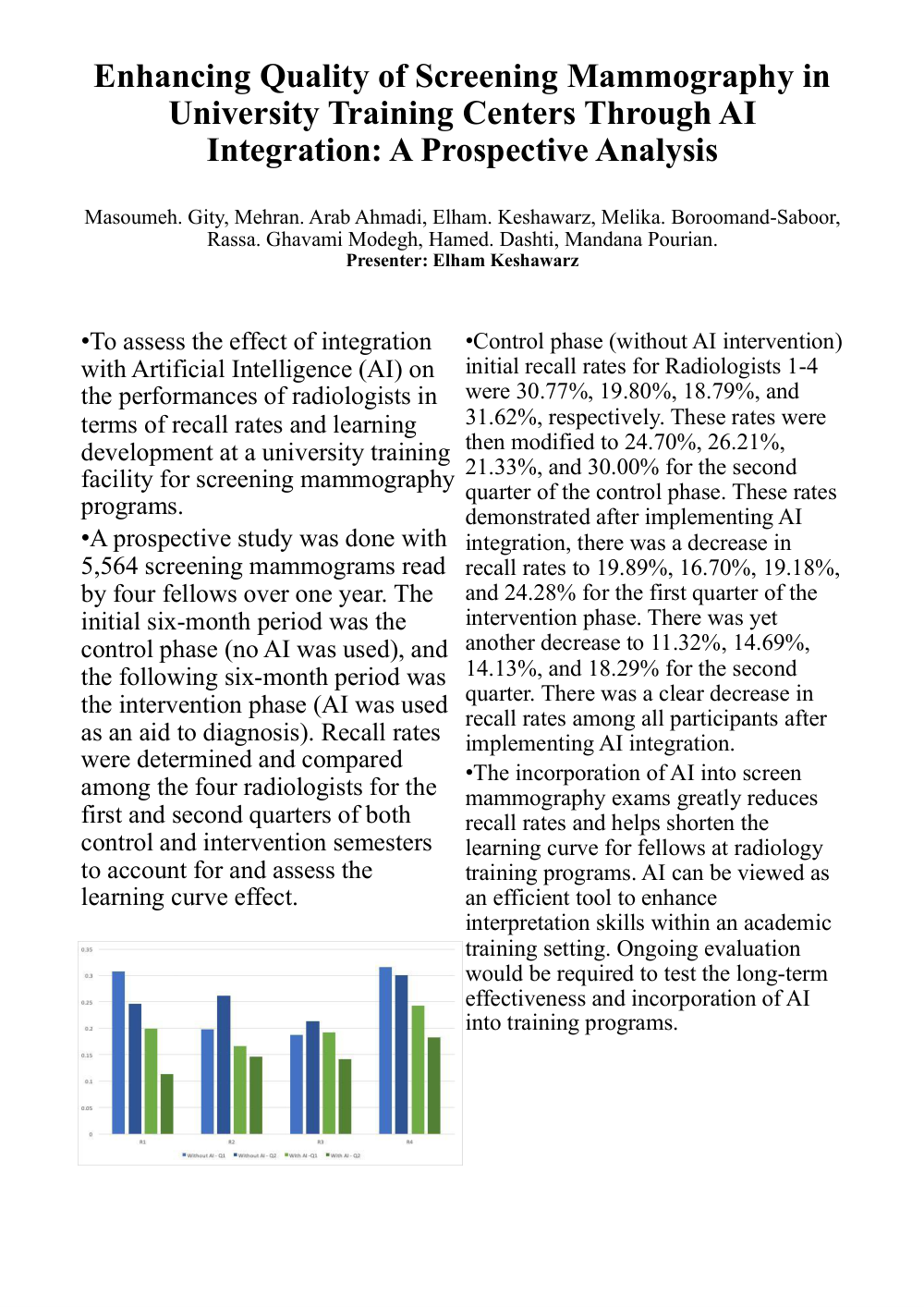
• To assess the effect of integration with Artificial Intelligence (AI) on the performances of radiologists in terms of recall rates and learning development at a university training facility for screening mammography programs. • A prospective study was done with 5,564 screening mammograms read by four fellows over one year. The initial six-month period was the control phase (no AI was used), and the following six month period was the intervention phase (AI was used as an aid to diagnosis). Recall rates were determined and compared among the four radiologists for the first and second quarters of both control and intervention semesters to account for and assess the learning curve effect. • Control phase (without AI intervention) initial recall rates for Radiologists 1-4 were 30.77%, 19.80%, 18.79%, and 31.62%, respectively. These rates were then modified to 24.70%, 26.21%, 21.33%, and 30.00% for the second quarter of the control phase. These rates demonstrated after implementing AI integration, there was a decrease in recall rates to 19.89%, 16.70%, 19.18%, and 24.28% for the first quarter of the intervention phase. There was yet another decrease to 11.32%, 14.69%, 14.13%, and 18.29% for the second quarter. There was a clear decrease in recall rates among all participants after implementing AI integration. • The incorporation of AI into screen mammography exams greatly reduces recall rates and helps shorten the learning curve for fellows at radiology training programs. AI can be viewed as an efficient tool to enhance interpretation skills within an academic training setting. Ongoing evaluation would be required to test the long-term effectiveness and incorporation of AI into training programs