296 posters, 7 videos, 13 audios, 14 topics, 10 sessions, 1,019 authors, 260 institutions
ePostersLive by SciGen Technologies S.A. All rights reserved.
RCOphth Annual Congress 2026
18 - 21 May, 2026 | Manchester Central, Manchester

P264
Long Term Outcomes of Anti VegF In treatment of Retinopathy of Prematurity in Northern Ireland � A 13 Year Retrospective Case Series
Poster Presenter
Authors
Part of Topic
Paediatric ophthalmology
Long Term Outcomes of Anti VegF in Treatment of Retinopathy of Prematurity in Northern Ireland; A 13 Year Retrospective Case Series
Ms N Parker, Ms C Shute, Ms K Shirley
Study Design
This was a retrospective case series on all patients who had received anti VegF injections for retinopathy of prematurity (ROP) in Northern Ireland from its introduction in 2014 until the time of data collection in 2024. The main data for identification was whether the babies had had FFA and subsequent laser to the peripheral retina, and if not were they still under review. This is due to the long term outcomes of antiVegF for ROP being relatively unknown since it was only started in the NHS in 2011.
Data Collection
Records of all babies who had received antiVegf by the department ROP screening coordinator, on an excel spreadsheet.
The data was missing from Western trust up to 2021 but the Belfast trust dataset was complete.
Data was kept from 2011- September 2024 and patients notes were checked on their electronic care record and Epic to see if any further investigations, treatment or follow up had been done.
Results
32 babies were identified from January 2011 to October 2024 who had
received bilateral anti vegF injections at initial treatment for ROP.
The mean gestational age at birth was 25+3 weeks.
The mean birth weight was 700grams
The mean gestational age at first treatment was 35+2 weeks.
7 babies went on to have further anti vegF injections.
6 had 2 bilateral, one had a third in the right eye.
Monitoring without Laser
16 babies did not go on to have laser.
3 passed away
One was discharged age 9, vascularised to within 2DD of ora
10 others still under review, 8 of whom are under 2 years of age
Of these, 7 are vascularised to within 2DD of ora on FFA, and 2 have an FFA planned.
One not vascularised to 2DD but no leaking of vessels on FFA, age 11m.
The other 2 cases are presented on this poster.
Laser
17/32 (53%) babies had diode laser after antiVegF to peripheral avascular retina (PAR) .
Mean interval was 14 months for all laser.
Mean interval for PAR/early recurrence was 4.2 months.
The range 2-114 months due to Case1 on this poster having laser at age 10.
Early laser (2 months post (AntiVegF) for ROP recurrence, later laser (4-12 months) was for PAR on FFA.
The other 2 children who did not have laser as babies are presented here.
Recommendations and Conclusion
AntiVegF is now a common initial treatment for ROP.
Residual peripheral avascular retina is common.
Every patient needs close follow up initially, usually including fundus fluorescein angiography, and long term follow up of at least 10 years is particularly required in those who have not had laser to peripheral avascular retina due to risk of neovascularisation.
General advice from GOSH is to electively laser any that have more than 2 DD PAR or associated vascular abnormalities/leakage. High myopes may also be considered.
High risk of DNA or too difficult to examine should would also have low tolerance for considering laser.
Be aware of risks associated with laser especially CMO, inflammation, bleeding and anisocoria.
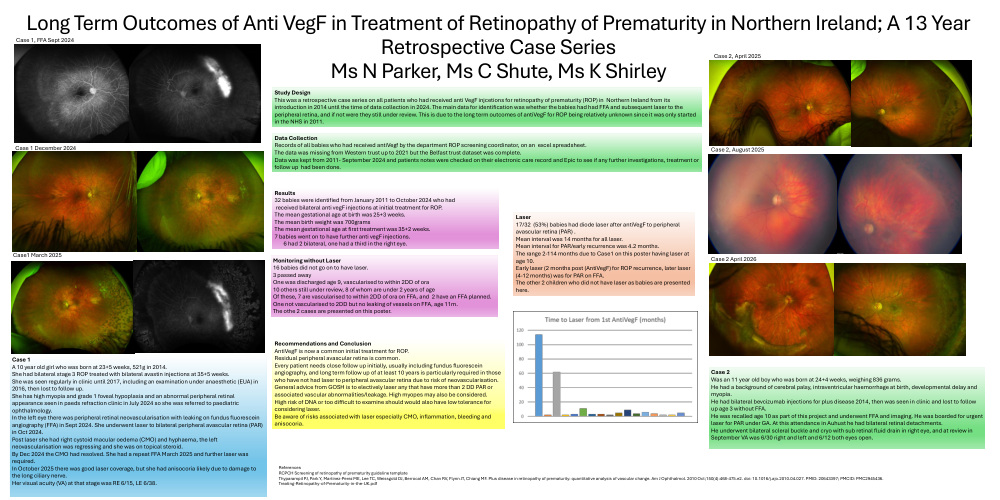
Case 1
A 10 year old girl who was born at 23+5 weeks, 521g in 2014.
She had bilateral stage 3 ROP treated with bilateral avastin injections at 35+5 weeks.
She was seen regularly in clinic until 2017, including an examination under anaesthetic (EUA) in 2016, then lost to follow up.
She has high myopia and grade 1 foveal hypoplasia and an abnormal peripheral retinal appearance seen in paeds refraction clinic in July 2024 so she was referred to paediatric ophthalmology.
In the left eye there was peripheral retinal neovascularisation with leaking on fundus fluorescein angiography (FFA) in Sept 2024. She underwent laser to bilateral peripheral avascular retina (PAR) in Oct 2024.
Post laser she had right cystoid macular oedema (CMO) and hyphaema, the left neovascularisation was regressing and she was on topical steroid.
By Dec 2024 the CMO had resolved. She had a repeat FFA March 2025 and further laser was required.
In October 2025 there was good laser coverage, but she had anisocoria likely due to damage to the long ciliary nerve.
Her visual acuity (VA) at that stage was RE 6/15, LE 6/38.
Case 2
Was an 11 year old boy who was born at 24+4 weeks, weighing 836 grams.
He had a background of cerebral palsy, intraventricular haemorrhage at birth, developmental delay and myopia.
He had bilateral bevcizumab injections for plus disease 2014, then was seen in clinic and lost to follow up age 3 without FFA.
He was recalled age 10 as part of this project and underwent FFA and imaging. He was boarded for urgent laser for PAR under GA. At this attendance in August he had bilateral retinal detachments.
He underwent bilateral scleral buckle and cryo with sub retinal fluid drain in right eye, and at review in September VA was 6/30 right and left and 6/12 both eyes open.