301 posters, 50 videos, 13 topics, 13 sessions, 734 authors, 193 institutions
ePostersLive by SciGen Technologies S.A. All rights reserved.
ISMICS 2026 Annual Meeting
10 - 13 June, 2026 | Miami, Florida

P84
Robotic Mitral Valve Replacement In Extreme Risk - A Preoperative Biventricular Parameter Strategy For Mechanical Support Integration -
Poster Presenter
Authors
Part of Topic
Heart Failure Assist Devices, Heart Transplantation & Perfusion
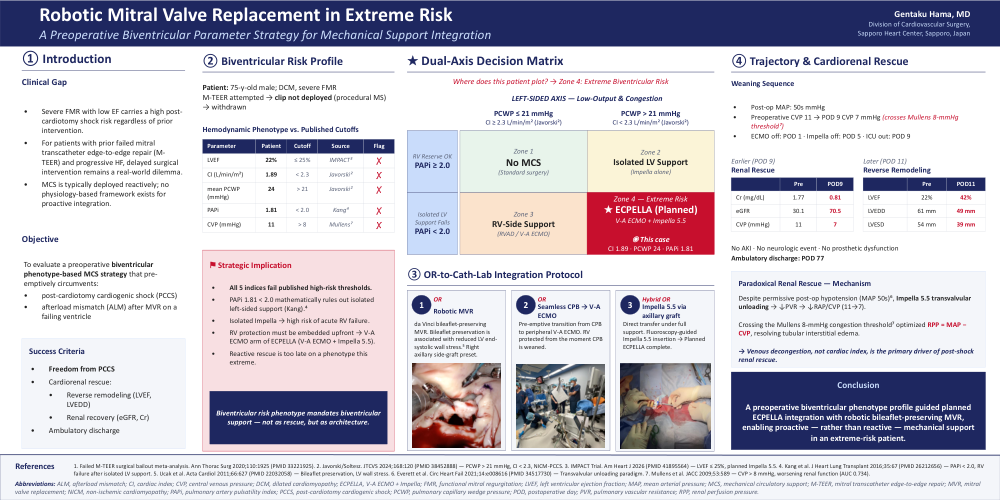
BACKGROUND: Severe functional mitral regurgitation with low ejection fraction frequently involves combined ventricular dysfunction and a high risk of postcardiotomy shock. Mechanical circulatory support (MCS) is usually applied reactively, and no physiology-based method exists to proactively integrate MCS with minimally invasive or robotic leaflet-preserving mitral valve replacement (MVR). We aimed to establish a reproducible LV/RV assessment strategy to guide planned support during high-risk robotic MVR.
METHODS: A dual-axis framework was created using major and minor predictors of LV and RV failure derived from echocardiography and right-heart catheterization. LV metrics included contractile reserve, end-systolic dimension, forward-flow indices, and filling pressures. RV metrics included contractility, venous congestion, pulmonary artery pulsatility, and ventriculo-arterial coupling. An elderly patient meeting major criteria on both axes underwent robotic anterior leaflet-preserving MVR. Support escalation followed the predefined physiology-based plan: LV afterload intolerance prompted ventricular unloading, while RV failure or oxygenation impairment triggered extracorporeal support.
RESULTS: The patient presented with severe biventricular dysfunction (EF 22%; LV 61/54 mm). During separation from cardiopulmonary bypass, anticipated hemodynamic instability led to planned venoarterial extracorporeal support with inhaled nitric oxide. Early after surgery, progressive LV distension and left atrial stagnation were identified as afterload intolerance, prompting LV unloading with a microaxial device. This planned escalation strategy allowed controlled hemodynamic stabilization and early de-escalation of mechanical support. Extracorporeal support was discontinued on postoperative day (POD1), and Impella support was removed on POD 5. Echocardiography on POD 11 demonstrated early reverse remodeling with improved LV geometry (49/39 mm) and EF of 42 percent. No neurologic injury, renal dysfunction, or prosthetic valve abnormalities occurred.
CONCLUSIONS: A preoperative dual-axis LV/RV framework enabled planned, physiology-guided integration of mechanical circulatory support with high-risk robotic mitral valve surgery. This approach supports a shift from reactive rescue to proactive support and may facilitate more standardized and anticipatory decision-making for extreme-risk patients undergoing minimally invasive mitral procedures.