301 posters, 50 videos, 13 topics, 13 sessions, 734 authors, 193 institutions
ePostersLive by SciGen Technologies S.A. All rights reserved.
ISMICS 2026 Annual Meeting
10 - 13 June, 2026 | Miami, Florida

P43
Single-center Retrospective Review Of Patients Undergoing Robotic Minimally Invasive Direct Coronary Artery Bypass As A Cardiac Reoperation
Poster Presenter
Part of Topic
Coronary Revascularization
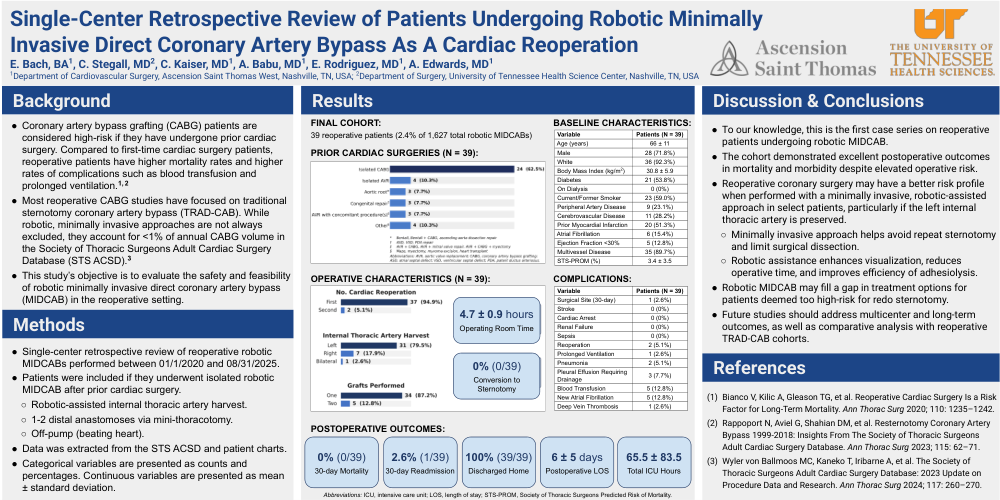
Objective: Coronary artery bypass grafting (CABG) patients are considered high-risk if they have undergone prior cardiac surgery. Although robotic minimally invasive direct coronary artery bypass (MIDCAB) is increasingly used for coronary revascularization, the literature has largely centered on first-time cardiac surgeries, with limited data describing its use in the reoperative setting. The objective of this study is to evaluate the safety and feasibility of robotic MIDCAB in patients who have previously undergone cardiac surgery.
Methods: This is a single-center retrospective review of robotic MIDCAB procedures performed between January 1, 2020 and August 31, 2025. Patients were included if they underwent robotic, non-sternotomy, isolated CABG in the study period and had a history of prior cardiac surgery. The primary endpoint was perioperative mortality. Secondary endpoints were ICU and hospital length of stay (LOS), blood transfusions, and postoperative morbidity.
Results: Among the 1,627 patients who underwent robotic MIDCAB, 39 (2.4%) were cardiac reoperations. The cohort had a mean age of 66 years and was predominantly male (28/39, 71.8%). There was no perioperative mortality (0/39, 0%) and only one readmission (2.6%). The mean postoperative LOS was 6 days, with 65.5 mean ICU hours. Five patients (12.8%) required intraoperative or postoperative blood products, and two (5.1%) underwent reoperation for bleeding or tamponade.
Conclusions: Robotic MIDCAB appears to be a safe and feasible revascularization strategy for selected patients undergoing reoperative cardiac surgery, with excellent postoperative outcomes in mortality and morbidity. These findings suggest that reoperative coronary surgery may have a better risk profile when performed with a robotic-assisted, minimally invasive approach.
Keywords: robotic-assisted MIDCAB; non-sternotomy revascularization; off-pump coronary surgery; reoperative cardiac surgery; redo CABG