301 posters, 50 videos, 13 topics, 13 sessions, 734 authors, 193 institutions
ePostersLive by SciGen Technologies S.A. All rights reserved.
ISMICS 2026 Annual Meeting
10 - 13 June, 2026 | Miami, Florida

D112
Predictors Of Postoperative Atrial Fibrillation In Robotic Cabg: A Regression Analysis
Poster Presenter
Part of Topic
Coronary Revascularization
Predictors of Postoperative Atrial Fibrillation in Robotic CABG: A Regression Analysis
Massimo Baudo1, Amanda Yakobitis2, Dana Foley2, Courtney Murray2, Gianluca Torregrossa1,2
1.Department of Cardiac Surgery Research, Lankenau Institute for Medical Research, Main Line Health, Wynnewood, PA, USA
2.Department of Cardiac Surgery, Lankenau Heart Institute, Main Line Health, Wynnewood, PA, USA
Background
Postoperative atrial fibrillation (POAF) remains a common complication after coronary artery bypass grafting (CABG), and is associated with increased risk of stroke, prolonged ICU stay, and greater hospital resource utilization. It most commonly develops within the first two to four postoperative days, driven by mechanisms including perioperative inflammation, oxidative stress, and autonomic dysregulation.
Robotic CABG has been associated with reduced inflammatory response and faster recovery compared to open surgery. However, evidence regarding POAF incidence and its predictors specific to the robotic approach remains limited.
This study sought to define the incidence of POAF and identify independent predictors in patients undergoing robotic CABG.
Methods
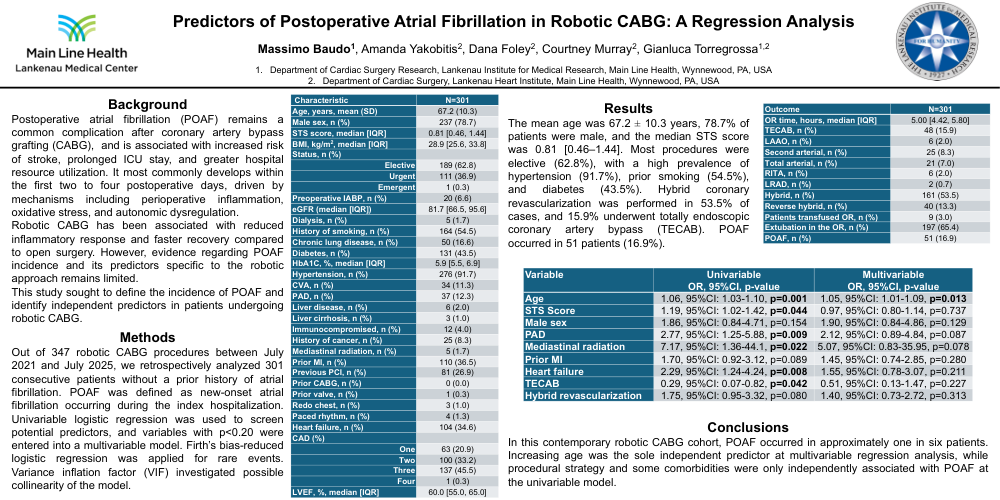
Out of 347 robotic CABG procedures between July 2021 and July 2025, we retrospectively analyzed 301 consecutive patients without a prior history of atrial fibrillation. POAF was defined as new-onset atrial fibrillation occurring during the index hospitalization. Univariable logistic regression was used to screen potential predictors, and variables with p<0.20 were entered into a multivariable model. Firth’s bias-reduced logistic regression was applied for rare events. Variance inflation factor (VIF) investigated possible collinearity of the model.
Results
The mean age was 67.2 ± 10.3 years, 78.7% of patients were male, and the median STS score was 0.81 [0.46–1.44]. Most procedures were elective (62.8%), with a high prevalence of hypertension (91.7%), prior smoking (54.5%), and diabetes (43.5%). Hybrid coronary revascularization was performed in 53.5% of cases, and 15.9% underwent totally endoscopic coronary artery bypass (TECAB). POAF occurred in 51 patients (16.9%).
Conclusions
In this contemporary robotic CABG cohort, POAF occurred in approximately one in six patients. Increasing age was the sole independent predictor at multivariable regression analysis, while procedural strategy and some comorbidities were only independently associated with POAF at the univariable model.