301 posters, 50 videos, 13 topics, 13 sessions, 734 authors, 193 institutions
ePostersLive by SciGen Technologies S.A. All rights reserved.
ISMICS 2026 Annual Meeting
10 - 13 June, 2026 | Miami, Florida

D126
A Feasibility Study Comparing Current Endoscopic Vein Harvesting Training With A Structured Training Programme
Poster Presenter
Authors
Bhuvaneswari Krishnamoorthy, Sam Raaj, Rick Air, Raquel Enriquez, Cristina Ruiz Segria, Azita Rajai
Affiliations
Directorate of Nursing, Midwifery & Social Care, University of Salford, England, United Kingdom, Faculty of Medicine, Medical School, Imperial College of London, England, United Kingdom, Department of Cardiothoraic Surgery, Manchester Foundation Trust, Manchester, England, United Kingdom, Department of Cardiothoracic Surgery, St. James Cook hospital, SouthTeeside, England, United Kingdom, Department of Medical Statistics, University of Manchester, England, United Kingdom
Part of Topic
Coronary Revascularization
Background
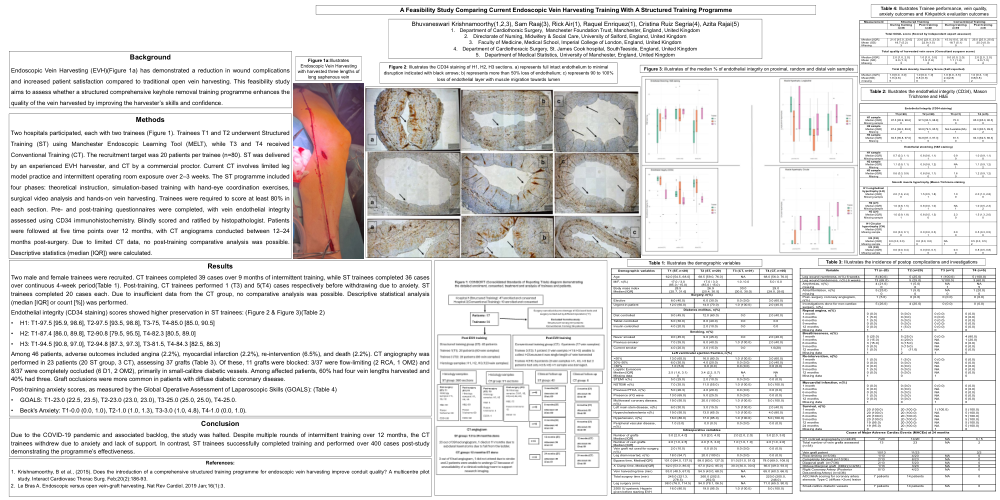
Endoscopic Vein Harvesting (EVH)(Figure 1a) has demonstrated a reduction in wound complications and increased patient satisfaction compared to traditional open vein harvesting. This feasibility study aims to assess whether a structured comprehensive keyhole removal training programme enhances the quality of the vein harvested by improving the harvester’s skills and confidence.
Methods
Two hospitals participated, each with two trainees (Figure 1). Trainees T1 and T2 underwent Structured Training (ST) using Manchester Endoscopic Learning Tool (MELT), while T3 and T4 received Conventional Training (CT). The recruitment target was 20 patients per trainee (n=80). ST was delivered by an experienced EVH harvester, and CT by a commercial proctor. Current CT involves limited leg model practice and intermittent operating room exposure over 2–3 weeks. The ST programme included four phases: theoretical instruction, simulation-based training with hand-eye coordination exercises, surgical video analysis and hands-on vein harvesting. Trainees were required to score at least 80% in each section. Pre- and post-training questionnaires were completed, with vein endothelial integrity assessed using CD34 immunohistochemistry. Blindly scored and ratified by histopathologist. Patients were followed at five time points over 12 months, with CT angiograms conducted between 12–24 months post-surgery. Due to limited CT data, no post-training comparative analysis was possible. Descriptive statistics (median [IQR]) were calculated.
Results
Two male and female trainees were recruited. CT trainees completed 39 cases over 9 months of intermittent training, while ST trainees completed 36 cases over continuous 4-week period(Table 1). Post-training, CT trainees performed 1 (T3) and 5(T4) cases respectively before withdrawing due to anxiety. ST trainees completed 20 cases each. Due to insufficient data from the CT group, no comparative analysis was possible. Descriptive statistical analysis (median [IQR] or count [%]) was performed.
Endothelial integrity (CD34 staining) scores showed higher preservation in ST trainees: (Figure 2 & Figure 3)(Table 2)
• H1: T1-97.5 [95.9, 98.6], T2-97.5 [93.5, 98.8], T3-75, T4-85.0 [85.0, 90.5]
• H2: T1-87.4 [86.0, 89.8], T2-90.8 [79.5, 95.5], T4-82.3 [80.5, 89.0]
• H3: T1-94.5 [90.8, 97.0], T2-94.8 [87.3, 97.3], T3-81.5, T4-84.3 [82.5, 86.3]
Among 46 patients, adverse outcomes included angina (2.2%), myocardial infarction (2.2%), re-intervention (6.5%), and death (2.2%). CT angiography was performed in 23 patients (20 ST group, 3 CT), assessing 37 grafts (Table 3). Of these, 11 grafts were blocked: 3/37 were flow-limiting (2 RCA, 1 OM2) and 8/37 were completely occluded (6 D1, 2 OM2), primarily in small-calibre diabetic vessels. Among affected patients, 60% had four vein lengths harvested and 40% had three. Graft occlusions were more common in patients with diffuse diabetic coronary disease.
Post-training anxiety scores, as measured by the Global Operative Assessment of Laparoscopic Skills (GOALS): (Table 4)
• GOALS: T1-23.0 (22.5, 23.5), T2-23.0 (23.0, 23.0), T3-25.0 (25.0, 25.0), T4-25.0.
• Beck's Anxiety: T1-0.0 (0.0, 1.0), T2-1.0 (1.0, 1.3), T3-3.0 (1.0, 4.8), T4-1.0 (0.0, 1.0).
Conclusion
Due to the COVID-19 pandemic and associated backlog, the study was halted. Despite multiple rounds of intermittent training over 12 months, the CT trainees withdrew due to anxiety and lack of support. In contrast, ST trainees successfully completed training and performed over 400 cases post-study demonstrating the programme’s effectiveness.