206 posters, 13 topics, 5 sessions, 713 authors, 294 institutions
ePostersLive by SciGen Technologies S.A. All rights reserved.
AAPS 104th Annual Meeting
May 2-5, 2026 | Lihue, HI

D5
Plastic Surgery Involvement In Pediatric Upper And Lower Extremity Oncologic Reconstruction: Patterns And Outcomes From The National Surgical Quality Improvement Program (2012-2023)
Poster Presenter
Part of Topic
Craniofacial/Peds
TITLE
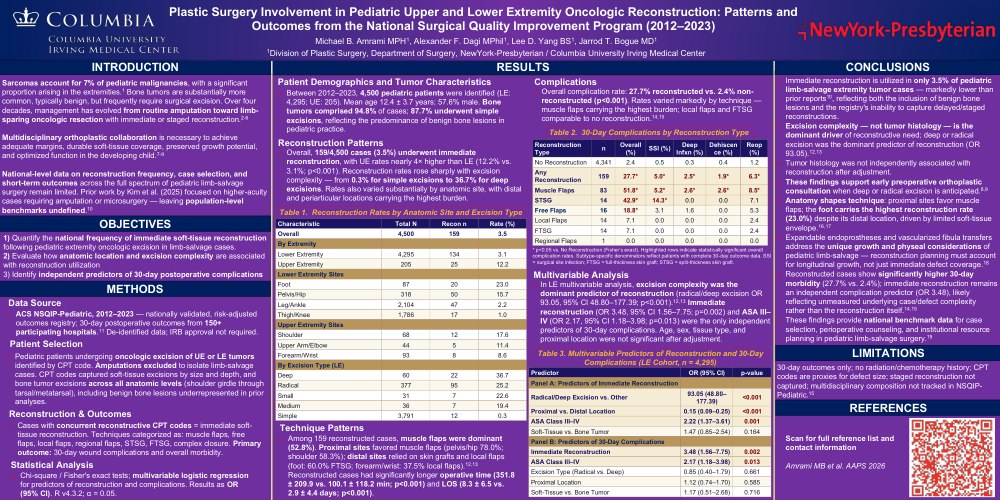
Plastic Surgery Involvement in Pediatric Upper and Lower Extremity Oncologic Reconstruction: Patterns and Outcomes from the National Surgical Quality Improvement Program (2012–2023)
Michael B. Amrami MPH1, Alexander F. Dagi MPhil1, Lee D. Yang BS1, Jarrod T. Bogue MD1
1Division of Plastic Surgery, Department of Surgery, NewYork-Presbyterian / Columbia University Irving Medical Center
INTRODUCTION
Sarcomas account for 7% of pediatric malignancies, with a significant proportion arising in the extremities.1 Bone tumors are substantially more common, typically benign, but frequently require surgical excision. Over four decades, management has evolved from routine amputation toward limb-sparing oncologic resection with immediate or staged reconstruction.2-6
Multidisciplinary orthoplastic collaboration is necessary to achieve adequate margins, durable soft-tissue coverage, preserved growth potential, and optimized function in the developing child.7-9
National-level data on reconstruction frequency, case selection, and short-term outcomes across the full spectrum of pediatric limb-salvage surgery remain limited. Prior work by Kim et al. (2025) focused on higher-acuity cases requiring amputation or microsurgery — leaving population-level benchmarks undefined.10
OBJECTIVES
1) Quantify the national frequency of immediate soft-tissue reconstruction following pediatric extremity oncologic excision in limb-salvage cases.
2) Evaluate how anatomic location and excision complexity are associated with reconstruction utilization
3) Identify independent predictors of 30-day postoperative complications
METHODS
Data Source
o ACS NSQIP-Pediatric, 2012–2023 — nationally validated, risk-adjusted outcomes registry; 30-day postoperative outcomes from 150+ participating hospitals.11 De-identified data; IRB approval not required.
Patient Selection
o Pediatric patients undergoing oncologic excision of UE or LE tumors identified by CPT code. Amputations excluded to isolate limb-salvage cases. CPT codes captured soft-tissue excisions by size and depth, and bone tumor excisions across all anatomic levels (shoulder girdle through tarsal/metatarsal), including benign bone lesions underrepresented in prior analyses.
Reconstruction & Outcomes
o Cases with concurrent reconstructive CPT codes = immediate soft-tissue reconstruction. Techniques categorized as: muscle flaps, free flaps, local flaps, regional flaps, STSG, FTSG, complex closure. Primary outcome: 30-day wound complications and overall morbidity.
Statistical Analysis
o Chi-square / Fisher's exact tests; multivariable logistic regression for predictors of reconstruction and complications. Results as OR (95% CI). R v4.3.2; α = 0.05.
RESULTS
Patient Demographics and Tumor Characteristics
o Between 2012–2023, 4,500 pediatric patients were identified (LE: 4,295; UE: 205). Mean age 12.4 ± 3.7 years; 57.6% male. Bone tumors comprised 94.8% of cases; 87.7% underwent simple excisions, reflecting the predominance of benign bone lesions in pediatric practice.
Reconstruction Patterns
o Overall, 159/4,500 cases (3.5%) underwent immediate reconstruction, with UE rates nearly 4× higher than LE (12.2% vs. 3.1%; p<0.001). Reconstruction rates rose sharply with excision complexity — from 0.3% for simple excisions to 36.7% for deep excisions. Rates also varied substantially by anatomic site, with distal and periarticular locations carrying the highest burden.
Technique Patterns
o Among 159 reconstructed cases, muscle flaps were dominant (52.8%). Proximal sites favored muscle flaps (pelvis/hip 78.0%; shoulder 58.3%); distal sites relied on skin grafts and local flaps (foot: 60.0% FTSG; forearm/wrist: 37.5% local flaps).12,13 Reconstructed cases had significantly longer operative time (351.8 ± 209.9 vs. 100.1 ± 118.2 min; p<0.001) and LOS (8.3 ± 6.5 vs. 2.9 ± 4.4 days; p<0.001).
Complications
o Overall complication rate: 27.7% reconstructed vs. 2.4% non-reconstructed (p<0.001). Rates varied markedly by technique — muscle flaps carrying the highest burden; local flaps and FTSG comparable to no reconstruction.14,15
Multivariable Analysis
o In LE multivariable analysis, excision complexity was the dominant predictor of reconstruction (radical/deep excision OR 93.05, 95% CI 48.80–177.39; p<0.001).12,13 Immediate reconstruction (OR 3.48, 95% CI 1.56–7.75; p=0.002) and ASA III–IV (OR 2.17, 95% CI 1.18–3.98; p=0.013) were the only independent predictors of 30-day complications. Age, sex, tissue type, and proximal location were not significant after adjustment.
CONCLUSIONS
o Immediate reconstruction is utilized in only 3.5% of pediatric limb-salvage extremity tumor cases — markedly lower than prior reports10, reflecting both the inclusion of benign bone lesions and the registry's inability to capture delayed/staged reconstructions.
oExcision complexity — not tumor histology — is the dominant driver of reconstructive need; deep or radical excision was the dominant predictor of reconstruction (OR 93.05).12,13
o Tumor histology was not independently associated with reconstruction after adjustment.
o These findings support early preoperative orthoplastic consultation when deep or radical excision is anticipated.8,9
o Anatomy shapes technique: proximal sites favor muscle flaps; the foot carries the highest reconstruction rate (23.0%) despite its distal location, driven by limited soft-tissue envelope.16,17
o Expandable endoprostheses and vascularized fibula transfers address the unique growth and physeal considerations of pediatric limb-salvage — reconstruction planning must account for longitudinal growth, not just immediate defect coverage.18
o Reconstructed cases show significantly higher 30-day morbidity (27.7% vs. 2.4%); immediate reconstruction remains an independent complication predictor (OR 3.48), likely reflecting unmeasured underlying case/defect complexity rather than the reconstruction itself.14,15
oThese findings provide national benchmark data for case selection, perioperative counseling, and institutional resource planning in pediatric limb-salvage surgery.19
LIMITATIONS
30-day outcomes only; no radiation/chemotherapy history; CPT codes are proxies for defect size; staged reconstruction not captured; multidisciplinary composition not tracked in NSQIP-Pediatric.15
REFERENCES
-
American Cancer Society. Key statistics for soft tissue sarcomas. American Cancer Society website. 2025. Available at:https://www.cancer.org/cancer/types/soft-tissue-sarcoma/about/key-statistics.html. Accessed [April 5, 2026].
-
Zastrow RK, El Sayed M, LiBrizzi CL, et al. Progressive improvement in 5-year survival rates for extremity soft tissue sarcomas from 1999 to 2019. Sarcoma. 2024;2024:8880609.
-
Koulaxouzidis G, Simunovic F, Bannasch H. Soft tissue sarcomas of the arm: oncosurgical and reconstructive principles within a multimodal, interdisciplinary setting. Front Surg. 2016;3:12.
-
Rosenberg SA, Tepper J, Glatstein E, et al. The treatment of soft-tissue sarcomas of the extremities: prospective randomized evaluations of (1) limb-sparing surgery plus radiation therapy compared with amputation and (2) the role of adjuvant chemotherapy. Ann Surg. 1982;196:305–315.
-
Keus RB, Rutgers EJ, Ho GH, et al. Limb-sparing therapy of extremity soft tissue sarcomas: treatment outcome and long-term functional results. Eur J Cancer. 1994;30A:1459–1463.
-
Azoury SC, Stranix JT, Kovach SJ, et al. Principles of orthoplastic surgery for lower extremity reconstruction: why is this important? J Reconstr Microsurg. 2021;37:42–50.
-
Levin LS. The reconstructive ladder: an orthoplastic approach. Orthop Clin North Am. 1993;24:393–409.
-
Hoyt BW, Wade SM, Harrington CJ, et al. Institutional experience and orthoplastic collaboration associated with improved flap-based limb salvage outcomes. Clin Orthop Relat Res. 2021;479:2388–2396.
-
Dagi AF, Amrami MB, Gangoli NA, et al. Orthoplastic surgery research: three decades of growth and future directions. JPRAS Open. 2025;43:506–509.
-
Kim DK, Gu K, Rohde CH, et al. Reconstructive approaches to oncologic upper and lower extremity resection in pediatric populations: a retrospective NSQIP-P analysis of 428 patients. J Plast Reconstr Aesthet Surg. 2025;213:100–101.
-
American College of Surgeons. ACS NSQIP participant use data files (2009–2022). American College of Surgeons website. 2023. Available at:https://www.facs.org/quality-programs/data-and-registries/acs-nsqip/. Accessed [April 5, 2026].
-
Stiles ZE, Lohman RF, Mann GN. Plastic surgery reconstruction of sarcoma resection defects: form and function. Surg Clin North Am. 2022;102:583–599.
-
Parikh RP, Sacks JM. Lower extremity reconstruction after soft tissue sarcoma resection. Clin Plast Surg. 2021;48:307–319.
-
Slump J, Ferguson PC, Wunder JS, et al. Patient, tumour and treatment factors affect complication rates in soft tissue sarcoma flap reconstruction in a synergistic manner. Eur J Surg Oncol. 2017;43:1126–1133.
-
Chang EI, Nguyen AT, Hughes JK, et al. Optimization of free-flap limb salvage and maximizing function and quality of life following oncologic resection: 12-year experience. Ann Surg Oncol. 2016;23:1036–1043.
-
Piper M, Irwin C, Sbitany H. Pediatric lower extremity sarcoma reconstruction: a review of limb salvage procedures and outcomes. J Plast Reconstr Aesthet Surg. 2016;69:91–96.
-
Ruiz-Moya A, Lagares-Borrego A, Sicilia-Castro D, et al. Pediatric extremity bone sarcoma reconstruction with the vascularized fibula flap: observational study assessing long-term functional outcomes, complications, and survival. J Plast Reconstr Aesthet Surg. 2019;72:1887–1899.
-
Morrison SG, Binite OT, Donnan LT. Endoprosthetic use in pediatric and adolescent lower limb sarcoma treatment. J Am Acad Orthop Surg. 2026;34:e636–e647.
-
Augustine HFM, Hu J, Najarali Z, et al. Scoping review of the National Surgical Quality Improvement Program in plastic surgery research. Plast Surg (Oakv). 2019;27:54–65.
***
Contact information
Name: Michael Amrami
Email: mba2159@cumc.columbia.edu
Medical School: Columbia University Vagelos College of Physicians and Surgeons, 630 W 168th St, New York, NY 10032