206 posters, 13 topics, 5 sessions, 713 authors, 294 institutions
ePostersLive by SciGen Technologies S.A. All rights reserved.
AAPS 104th Annual Meeting
May 2-5, 2026 | Lihue, HI

D102
Preliminary Insights Into Specialty-specific Management Of Craniofacial Fractures Across Four Urban Trauma Centers
Poster Presenter
Part of Topic
Craniofacial/Peds
Craniofacial trauma care spans multiple surgical specialties, including plastic and reconstructive surgery (PRS), otolaryngology (ENT), and oral and maxillofacial surgery (OMFS), each with overlapping yet distinct clinical roles. However, differences in perioperative management and outcomes across these service lines remain underexplored.
This study aimed to evaluate whether specialty is independently associated with clinical outcomes following craniofacial fracture repair after accounting for differences in fracture type and case mix.
We performed a retrospective review of adult patients undergoing operative craniofacial fracture repair between 2019 and 2025 across four urban trauma centers. Data collected included demographics, fracture location, injury mechanism, comorbidities, and hospital course. Outcomes of interest included time to intervention, length of stay (LOS), operative time, complication rates, readmissions, and follow-up adherence. Statistical comparisons were performed using chi-square and nonparametric tests, with multivariable adjustment for fracture pattern.
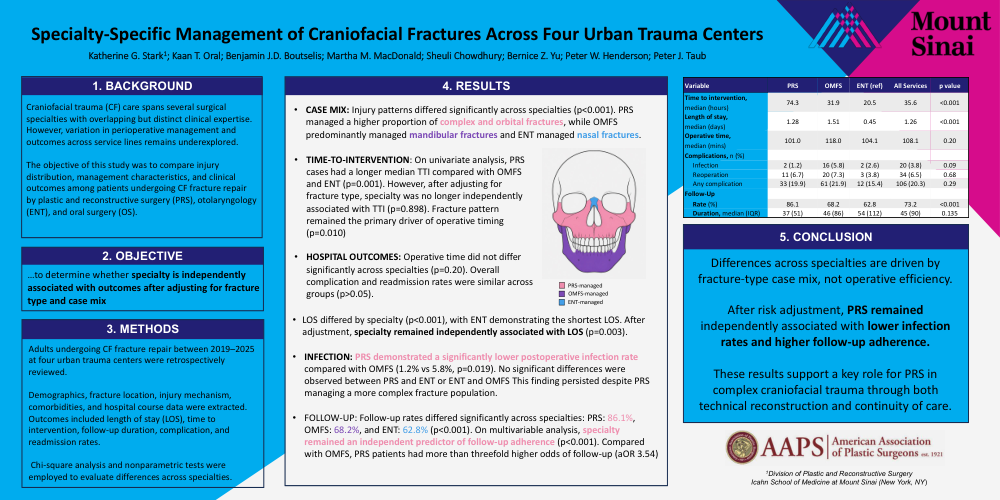
Injury distribution differed significantly across specialties (p<0.001). PRS managed a higher proportion of complex and orbital fractures, OMFS primarily managed mandibular fractures, and ENT predominantly managed nasal fractures. On univariate analysis, PRS cases had longer time to intervention; however, after adjustment for fracture type, specialty was no longer independently associated with operative timing (p=0.898), with fracture pattern remaining the primary driver (p=0.010).
Operative time, overall complications, and readmission rates were similar across specialties (p>0.05). Length of stay differed (p<0.001), with ENT demonstrating the shortest LOS; this remained significant after adjustment (p=0.003). PRS demonstrated a significantly lower postoperative infection rate compared to OMFS (1.2% vs 5.8%, p=0.019), despite managing more complex injuries. Follow-up rates also differed significantly (PRS 86.1%, OMFS 68.2%, ENT 62.8%; p<0.001), with PRS remaining an independent predictor of follow-up adherence (aOR 3.54 vs OMFS).
Overall, differences in management across specialties are largely driven by fracture-type case mix rather than operative efficiency. After risk adjustment, PRS is independently associated with lower infection rates and improved follow-up adherence. These findings support a central role for PRS in the management of complex craniofacial trauma, emphasizing both technical reconstruction and continuity of care.