206 posters, 13 topics, 5 sessions, 713 authors, 294 institutions
ePostersLive by SciGen Technologies S.A. All rights reserved.
AAPS 104th Annual Meeting
May 2-5, 2026 | Lihue, HI

D89
Blood Loss In Craniosynostosis Repair: Technique-dependent Patterns Of Underestimation
Part of Topic
Craniofacial/Peds
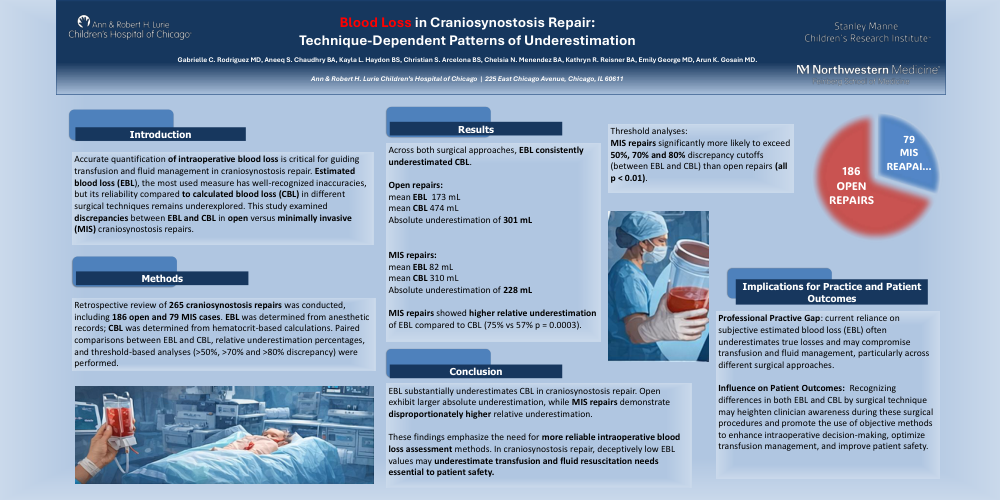
Accurate quantification of intraoperative blood loss is critical for guiding transfusion and fluid management in craniosynostosis repair. Estimated blood loss (EBL), the most used measure has well-recognized inaccuracies, but its reliability compared to calculated blood loss (CBL) in different surgical techniques remains underexplored. This study examined discrepancies between EBL and CBL in open versus minimally invasive (MIS) craniosynostosis repairs.
Retrospective review of 265 craniosynostosis repairs was conducted, including 186 open and 79 MIS cases. EBL was determined from anesthetic records; CBL was determined from hematocrit-based calculations. Paired comparisons between EBL and CBL, relative underestimation percentages, and threshold-based analyses (>50%, >70% and >80% discrepancy) were performed.
Across both surgical approaches, EBL consistently underestimated CBL.
Open repairs:
mean EBL 173 mL
mean CBL 474 mL
Absolute underestimation of 301 mL
MIS repairs:
mean EBL 82 mL
mean CBL 310 mL
Absolute underestimation of 228 mL
MIS repairs showed higher relative underestimation of EBL compared to CBL (75% vs 57% p = 0.0003).
Threshold analyses:
MIS repairs significantly more likely to exceed 50%, 70% and 80% discrepancy cutoffs (between EBL and CBL) than open repairs (all p < 0.01).
EBL substantially underestimates CBL in craniosynostosis repair. Open exhibit larger absolute underestimation, while MIS repairs demonstrate disproportionately higher relative underestimation.
These findings emphasize the need for more reliable intraoperative blood loss assessment methods. In craniosynostosis repair, deceptively low EBL values may underestimate transfusion and fluid resuscitation needs essential to patient safety.
Professional Practive Gap: current reliance on subjective estimated blood loss (EBL) often underestimates true losses and may compromise transfusion and fluid management, particularly across different surgical approaches.
Influence on Patient Outcomes: Recognizing differences in both EBL and CBL by surgical technique may heighten clinician awareness during these surgical procedures and promote the use of objective methods to enhance intraoperative decision-making, optimize transfusion management, and improve patient safety.