206 posters, 13 topics, 5 sessions, 713 authors, 294 institutions
ePostersLive by SciGen Technologies S.A. All rights reserved.
AAPS 104th Annual Meeting
May 2-5, 2026 | Lihue, HI

D23
Early Cranioplasty Improves Neurologic Recovery In Syndrome Of The Trephined
Part of Topic
Craniofacial/Peds
Early Cranioplasty Improves Neurologic Recovery in Syndrome of the Trephined
Authors: Ryan Enslow, BS; Caroline Gillespie, BS; Mia Panlilio, BA; Abdulaziz Elemosho, MD; Kerry-Ann Mitchell, MD, PhD
Affiliation: Department of Plastic and Reconstructive Surgery, The Ohio State University College of Medicine, Columbus, OH
Background:
Traumatic brain injury (TBI) and stroke account for over one million hospitalizations annually in the United States. In severe cases, decompressive craniectomy (DC) is performed to relieve elevated intracranial pressure, but the resulting cranial defect may lead to Syndrome of the Trephined (SoT), a delayed neurologic decline that improves after cranioplasty (CP). SoT may present with altered consciousness, motor deficits, cognitive dysfunction, and other neurologic deterioration distinct from the initial injury. Although cranioplasty is the definitive treatment, the optimal timing of repair remains uncertain.
Objective:
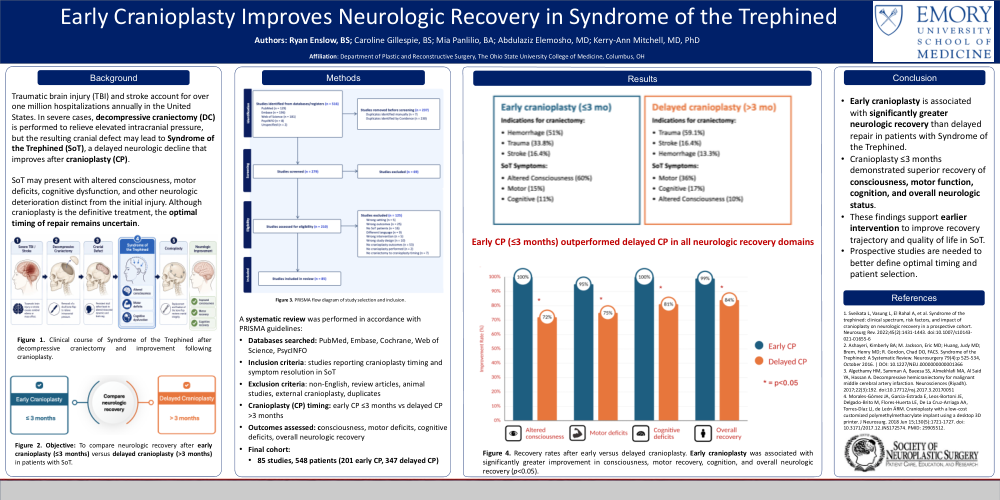
To compare neurologic recovery after early cranioplasty (≤3 months) versus delayed cranioplasty (>3 months) in patients with SoT.
Methods:
A systematic review was performed in accordance with PRISMA guidelines. Databases searched included PubMed, Embase, Cochrane, Web of Science, and PsycINFO. Inclusion criteria were studies reporting cranioplasty timing and symptom resolution in SoT. Exclusion criteria included non-English studies, review articles, animal studies, external cranioplasty, and duplicates. Cranioplasty timing was defined as early CP ≤3 months versus delayed CP >3 months. Outcomes assessed included consciousness, motor deficits, cognitive deficits, and overall neurologic recovery. The final cohort included 85 studies and 548 patients (201 early CP, 347 delayed CP).
Results:
Early cranioplasty was associated with significantly greater improvement in neurologic recovery than delayed repair. Recovery rates after early versus delayed cranioplasty were as follows: consciousness, 100% versus 72%; motor recovery, 95% versus 75%; cognition, 100% versus 81%; and overall neurologic recovery, 99% versus 82% (p<0.05).
Conclusion:
Early cranioplasty is associated with significantly greater neurologic recovery than delayed repair in patients with Syndrome of the Trephined. Cranioplasty ≤3 months demonstrated superior recovery of consciousness, motor function, cognition, and overall neurologic status. These findings support earlier intervention to improve recovery trajectory and quality of life in SoT. Prospective studies are needed to better define optimal timing and patient selection.
Figure Captions:
Figure 1. Clinical course of Syndrome of the Trephined after decompressive craniectomy and improvement following cranioplasty.
Figure 2. Objective: To compare neurologic recovery after early cranioplasty (≤3 months) versus delayed cranioplasty (>3 months) in patients with SoT.
Figure 3. PRISMA flow diagram of study selection and inclusion.
Figure 4. Recovery rates after early versus delayed cranioplasty. Early cranioplasty was associated with significantly greater improvement in consciousness, motor recovery, cognition, and overall neurologic recovery (p<0.05).
Keywords:
Syndrome of the Trephined; cranioplasty; decompressive craniectomy; neurologic recovery; traumatic brain injury; stroke; timing; systematic review; PRISMA